Burning Hot Events is a free, independent publication fueled by passion for music and art. We rely on ads to help us bring you great content, so if you enjoy our site, we'd love your support!
Please consider disabling any ad blockers to support us – we don’t force it!Dismiss
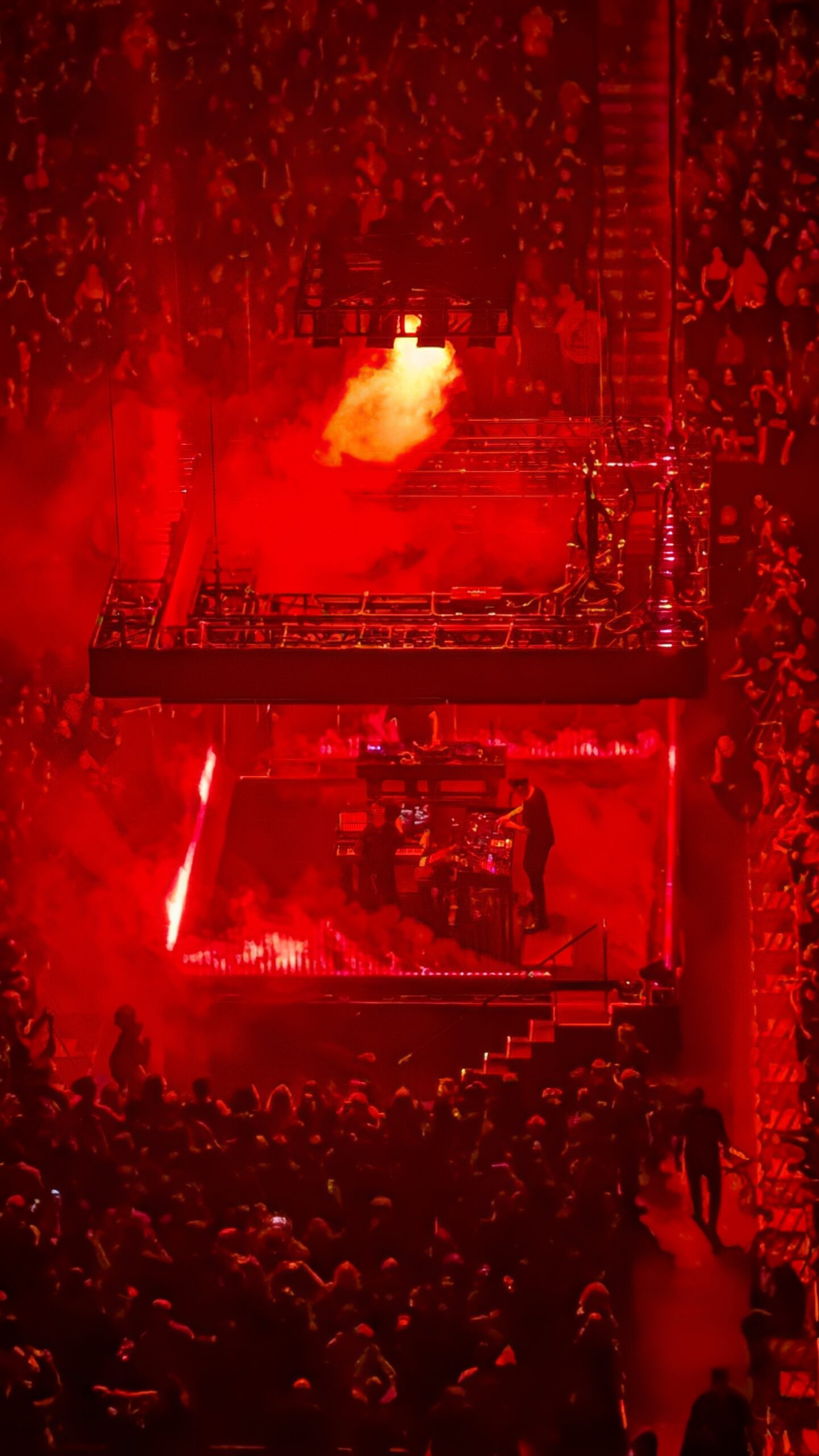
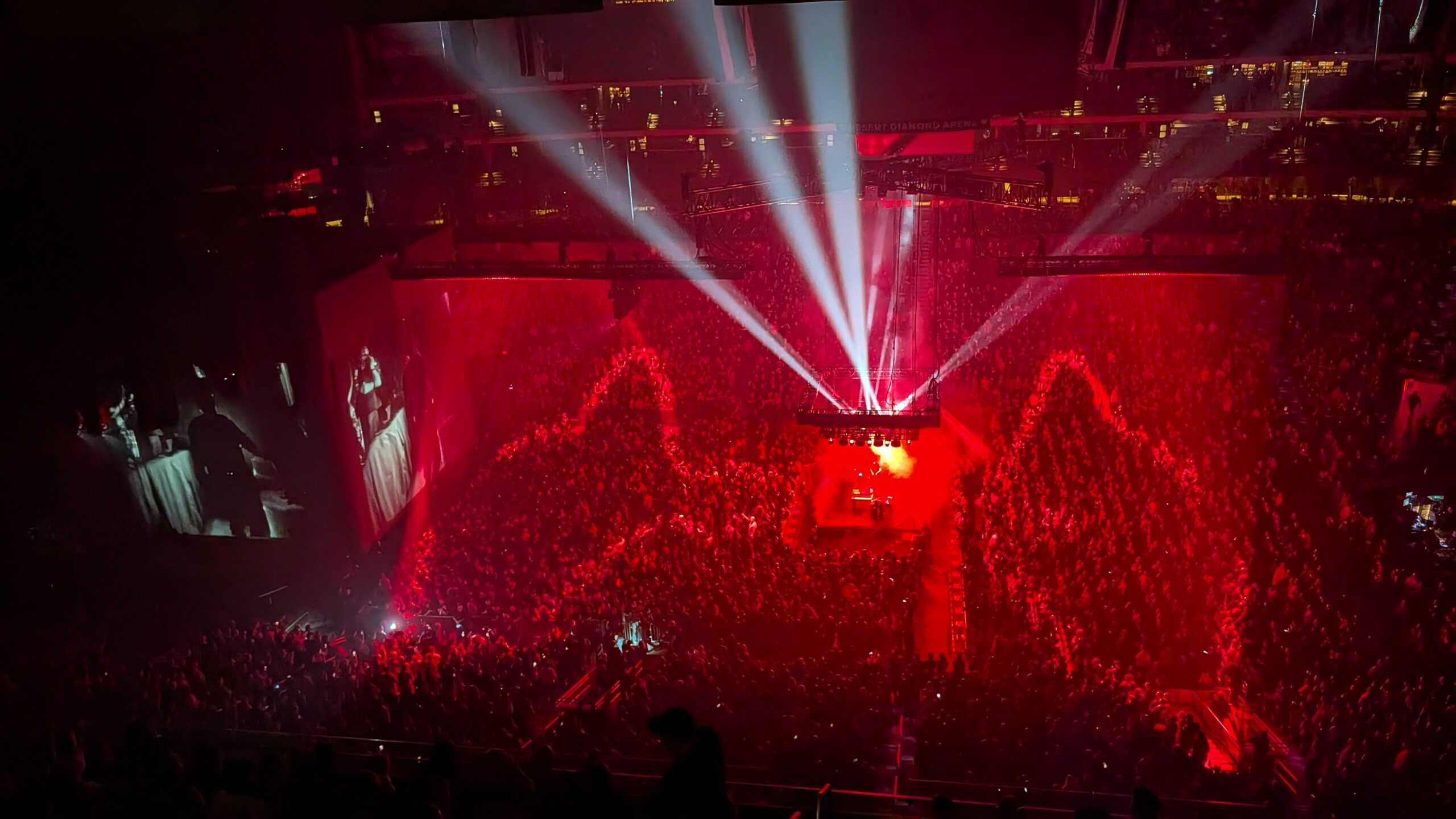
Nine Inch Nails turn the center-stage platform into a red-lit storm of fog and light. Audience photo by: Katherine Amy Vega
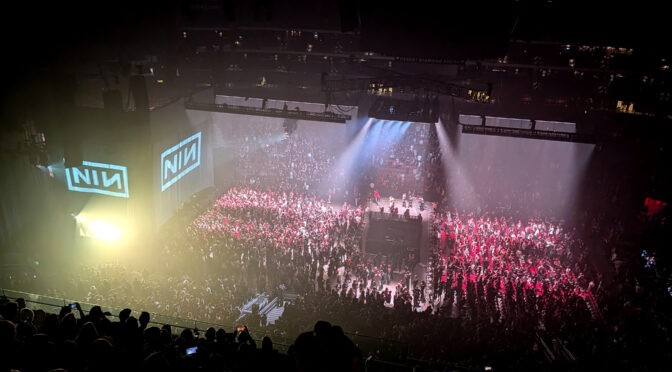
PHOENIX — An impressive crowd gathered at the Desert Diamond Arena for opener Boyz Noize and the legendary Nine Inch Nails. Bass pounded through the speakers as the opening set welcomed attendees to a darkened room, with occasional red lighting shifting between the center of the room, a shrouded, large box-shaped object sitting in the growing sea of fans.
Nine Inch Nails turn the center-stage platform into a red-lit storm of fog and light. Audience photo by: Katherine Amy Vega
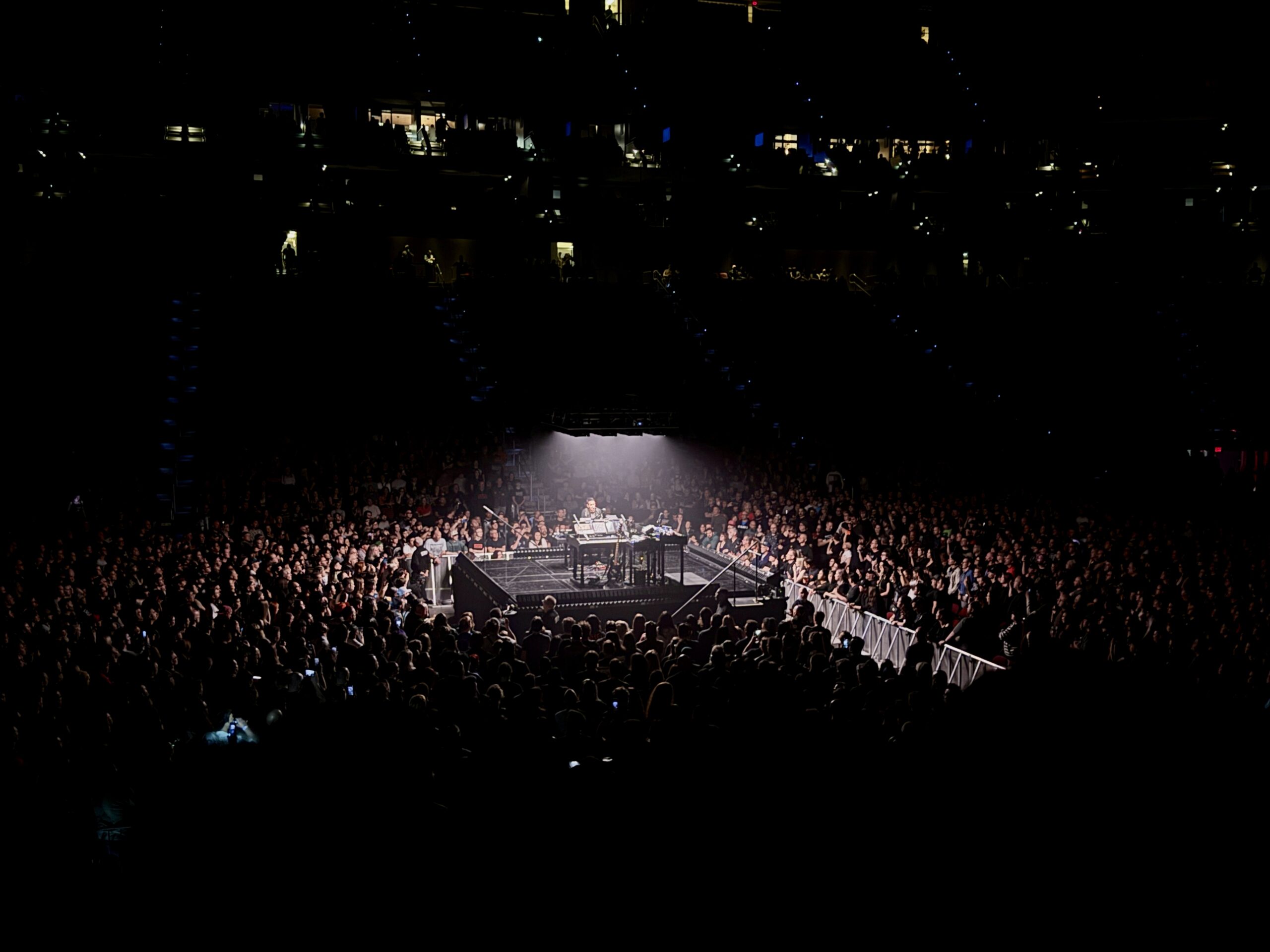
The room transformed as the walls were shed to reveal Trent Reznor playing the gentle notes to “(You Made It Feel Like) Home” (2022). His warm voice invites us into a feeling of intimacy while being surrounded by other fans in the shadows, gazing into the gold light holding him. The experience felt like I was the only one in the room, though when I looked, the arena had little room to spare.
Nine Inch Nails open the night with Trent Reznor alone at the center-stage rig as the crowd closes in around him. Audience photo by: Ali Crimson
The band assembles and Josh Freese returns
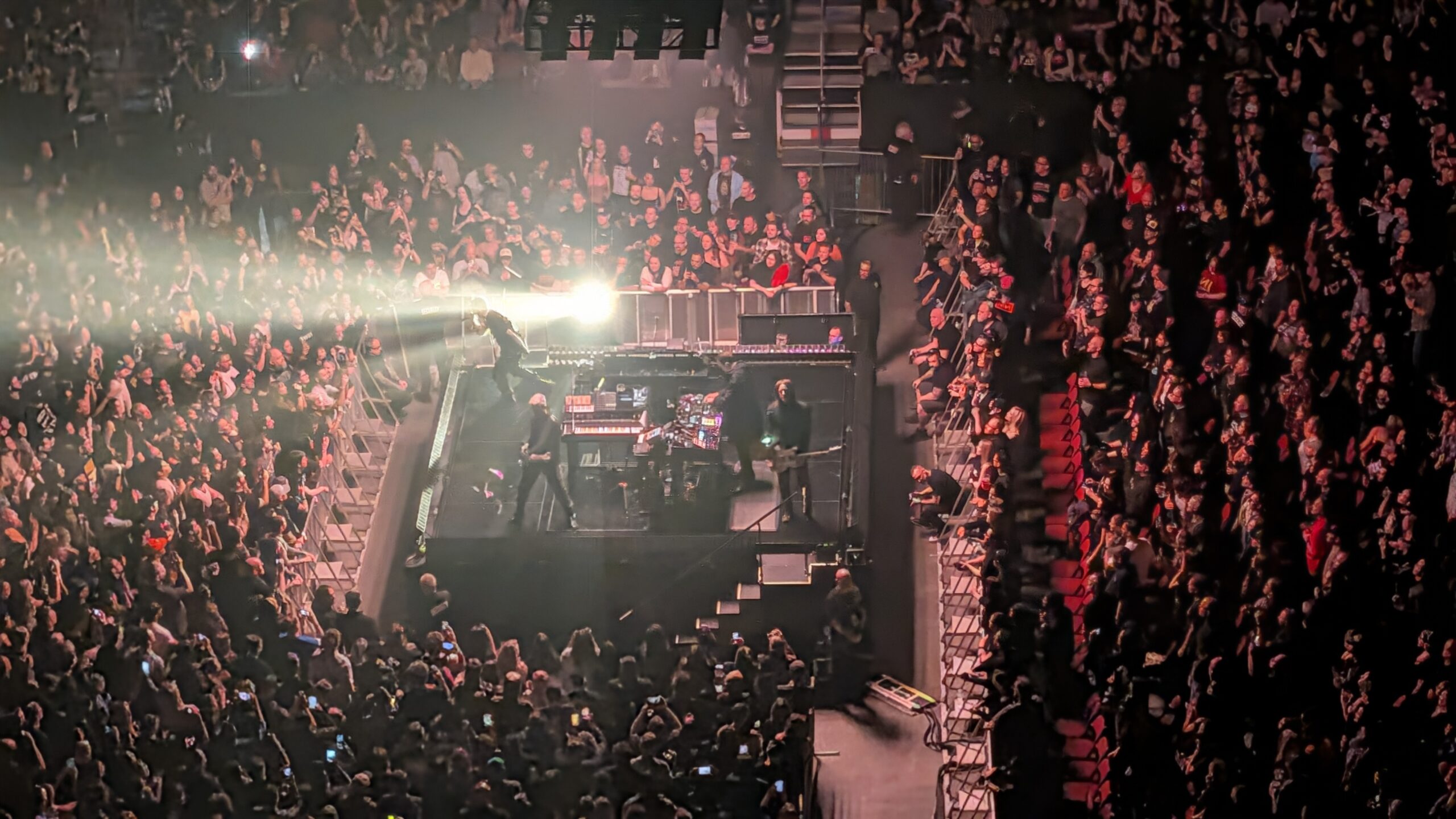
The warm light became cold, brighter, and sterile as the music transitioned to “Non-Entity” (2007). Guitarist/keyboardist Robin Finck and bassist Stu Brooks appeared, coordinated in all black with Reznor, to loud cheers.
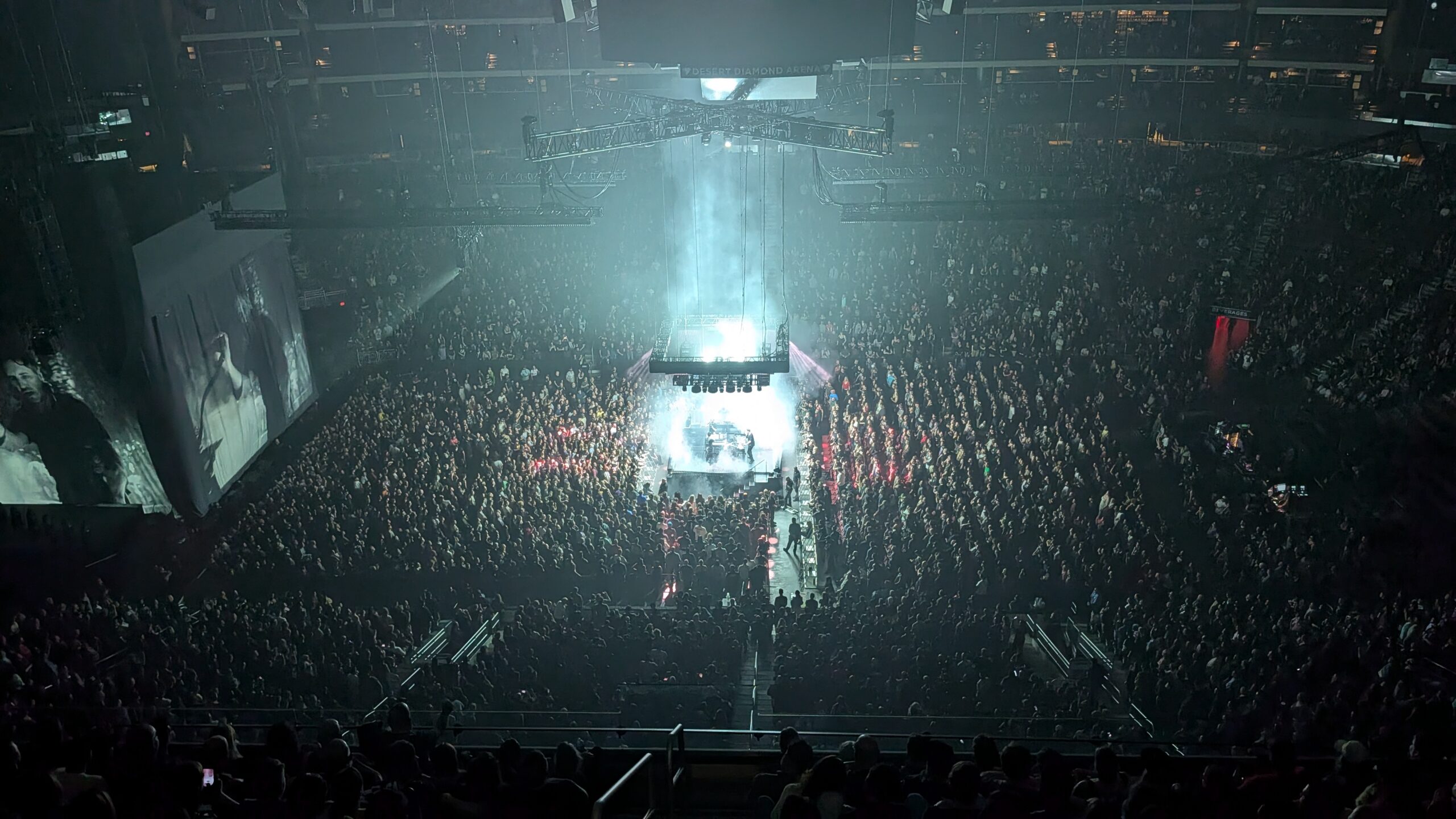
Nine Inch Nails perform on the center stage as the crowd packs Desert Diamond Arena in Glendale, Arizona (March 6, 2026). Audience photo by: Katherine Amy Vega
“Piggy” from the 1994 The Downward Spiralalbum followed, the lights shift back to gold, now a low glow this time with Reznor on his feet, bouncing with his finger to the ceiling signaling the room to bounce with him to the beat.
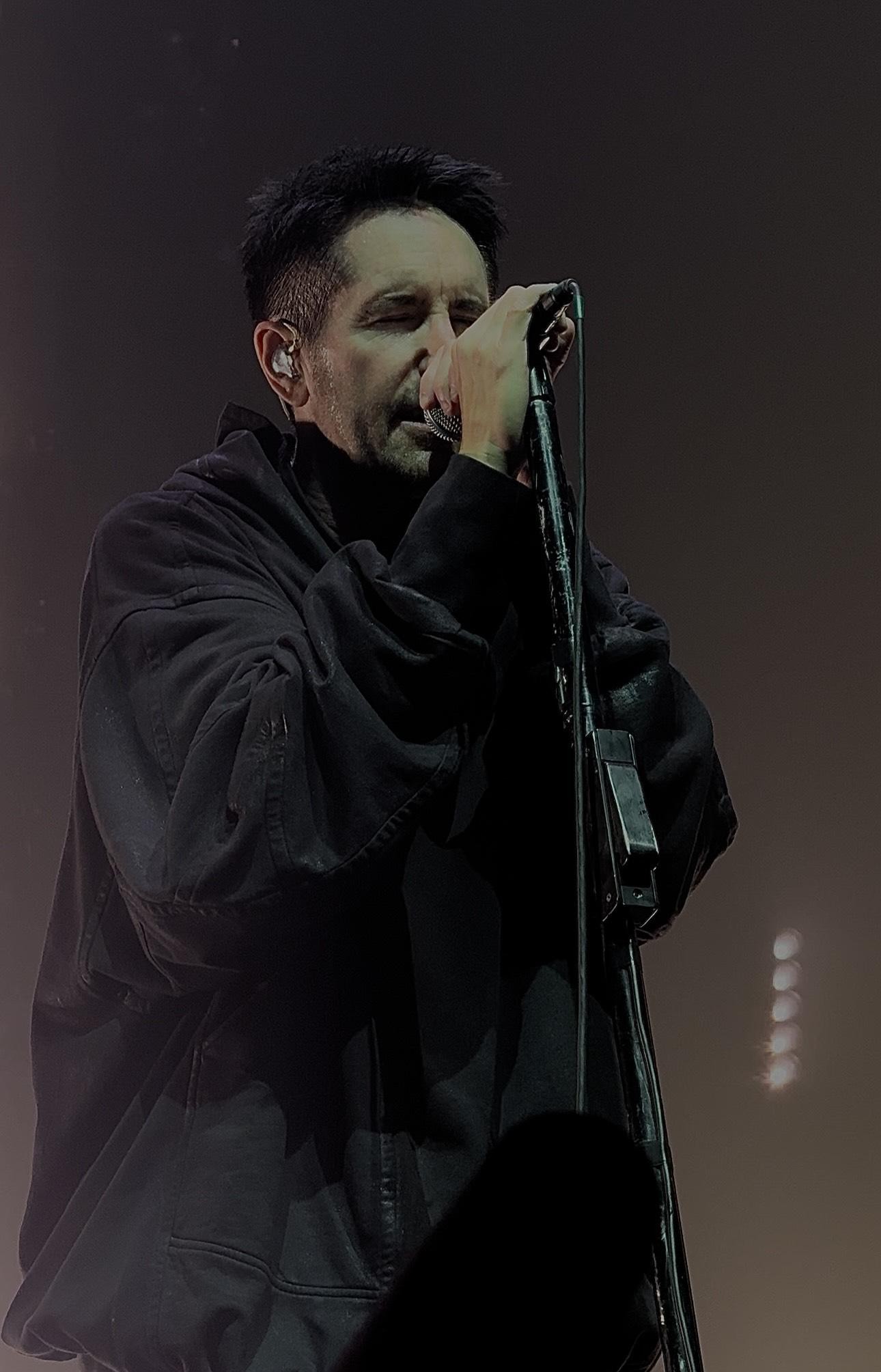
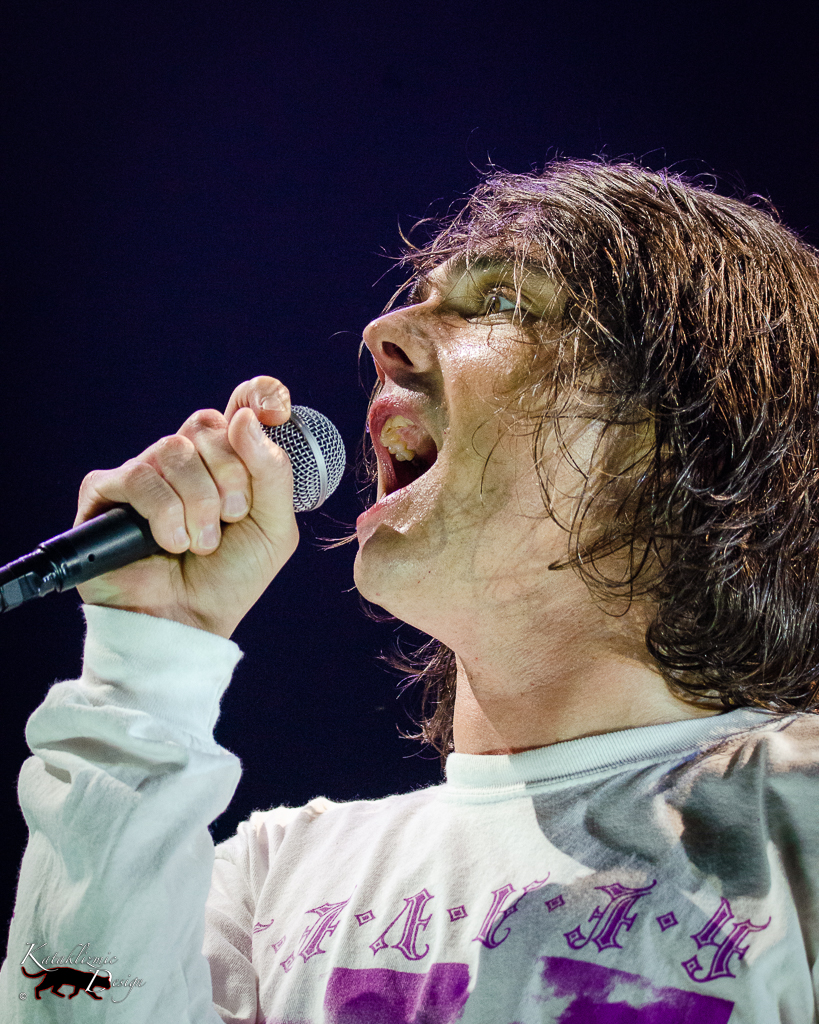
Nine Inch Nails frontman Trent Reznor grips the mic in a tight, moody close-up within the stage haze surrounding him. Photo by: Sara Perez
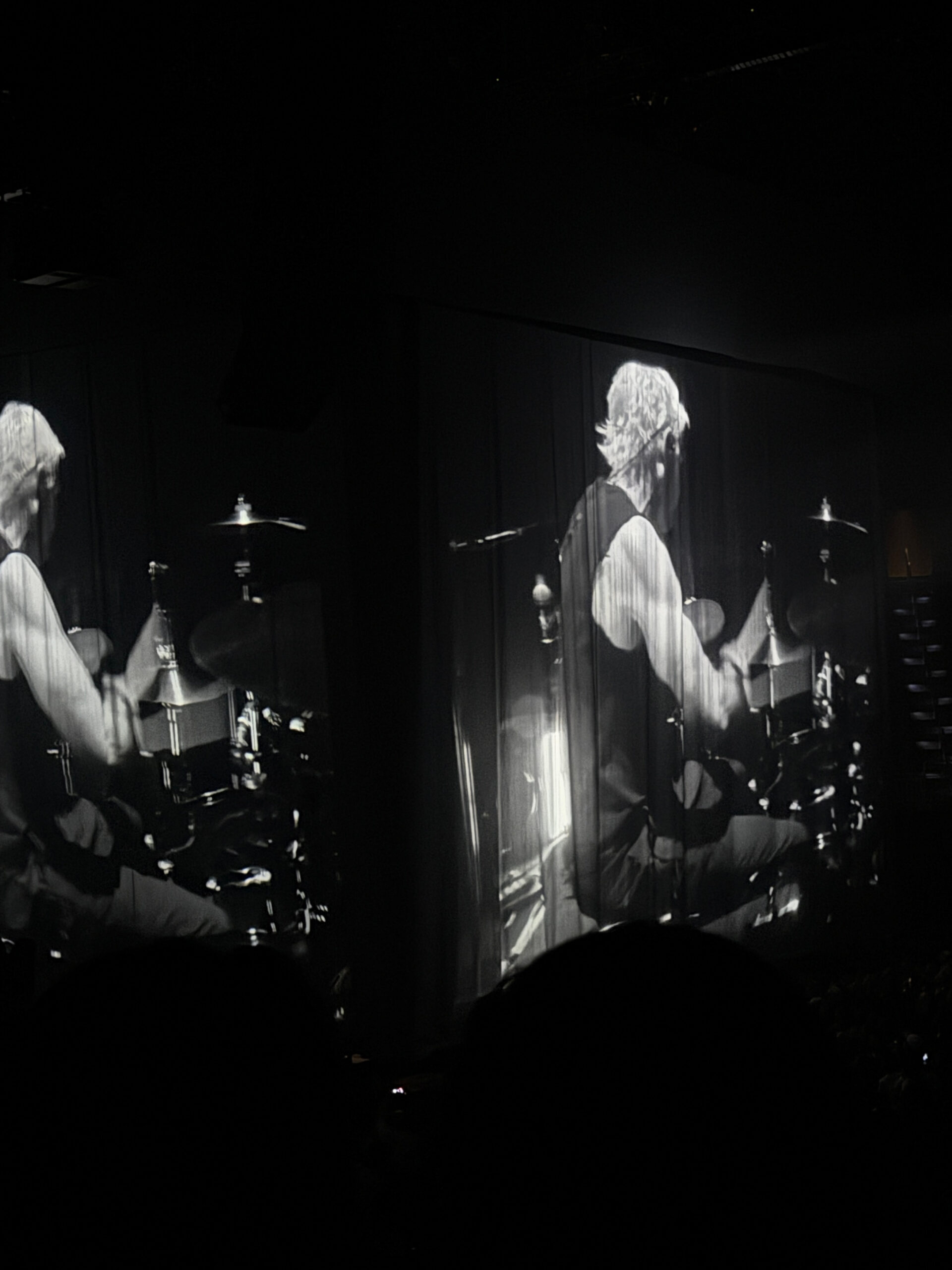
The glow allowed the room to slip into darkness, leaving only a screen at the front of the room showing a drum solo that marked the entrance of newly returned drummer Josh Freese, starting only on the North American leg of the tour. The curtain that once showed Freese lifts, showing the entire band surrounded by sheer veils.
Nine Inch Nails project a stark black-and-white close-up of the drummer Josh Freese across the sheer curtains during the early set. Audience photo by: Ali Crimson
Visuals as an instrument
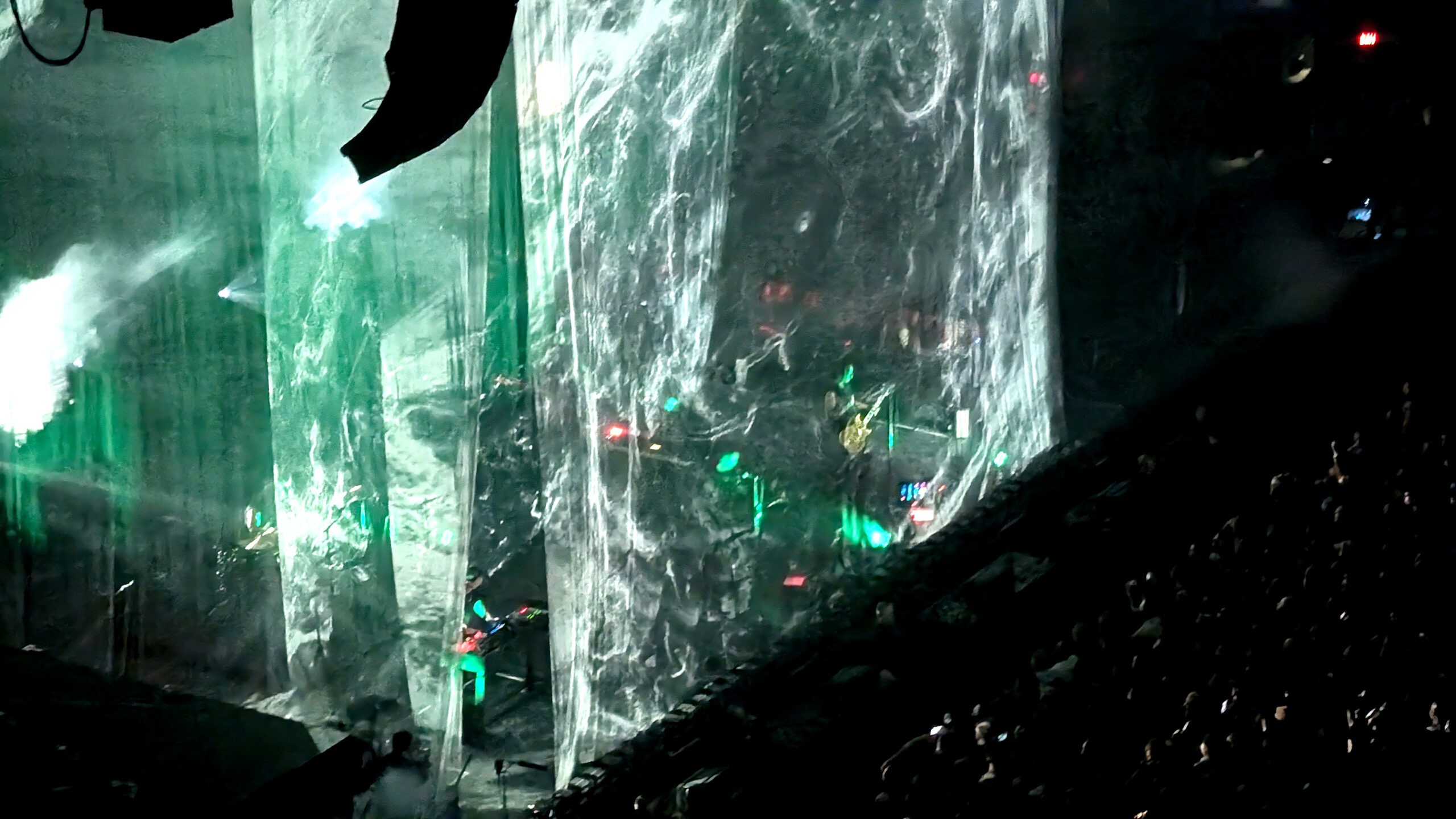
Live projections of each band member are shown on the sheer curtains as the band blasts into “Wish” (1992). New visuals come with each song; “March of Pigs” (1994) is the first time soundwaves are projected. A dramatic piano piece guides the performance into “Reptile” (1994) a standout at the sixth song in their set, the introduction contrasting heavily, grinding with aggressively flashing green lights as white whips across the screens with the rise and falls of the music.
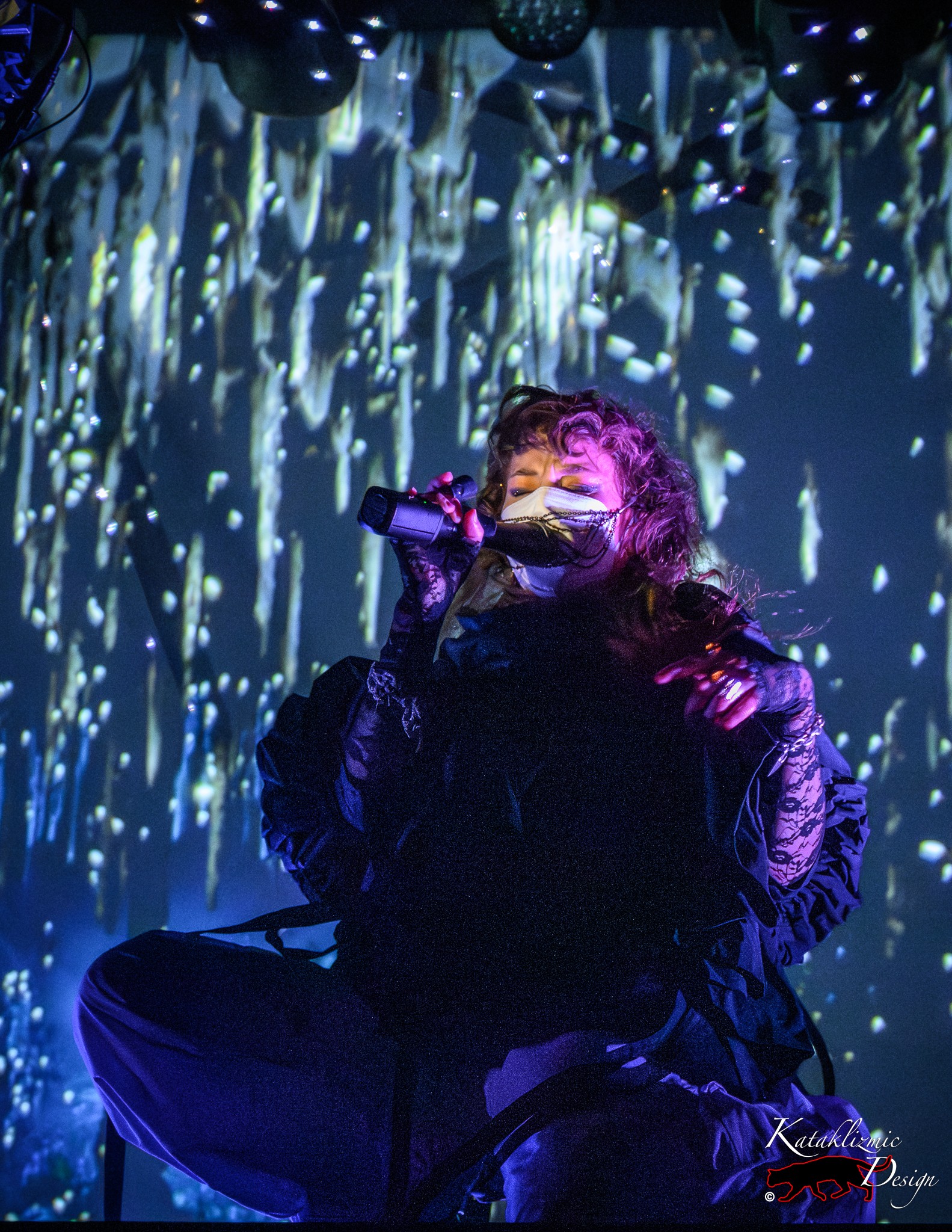
Nine Inch Nails perform behind shimmering sheer curtains as green light and abstract projections wash over the stage. Audience photo by: Katherine Amy Vega
Peak intensity and set highlights
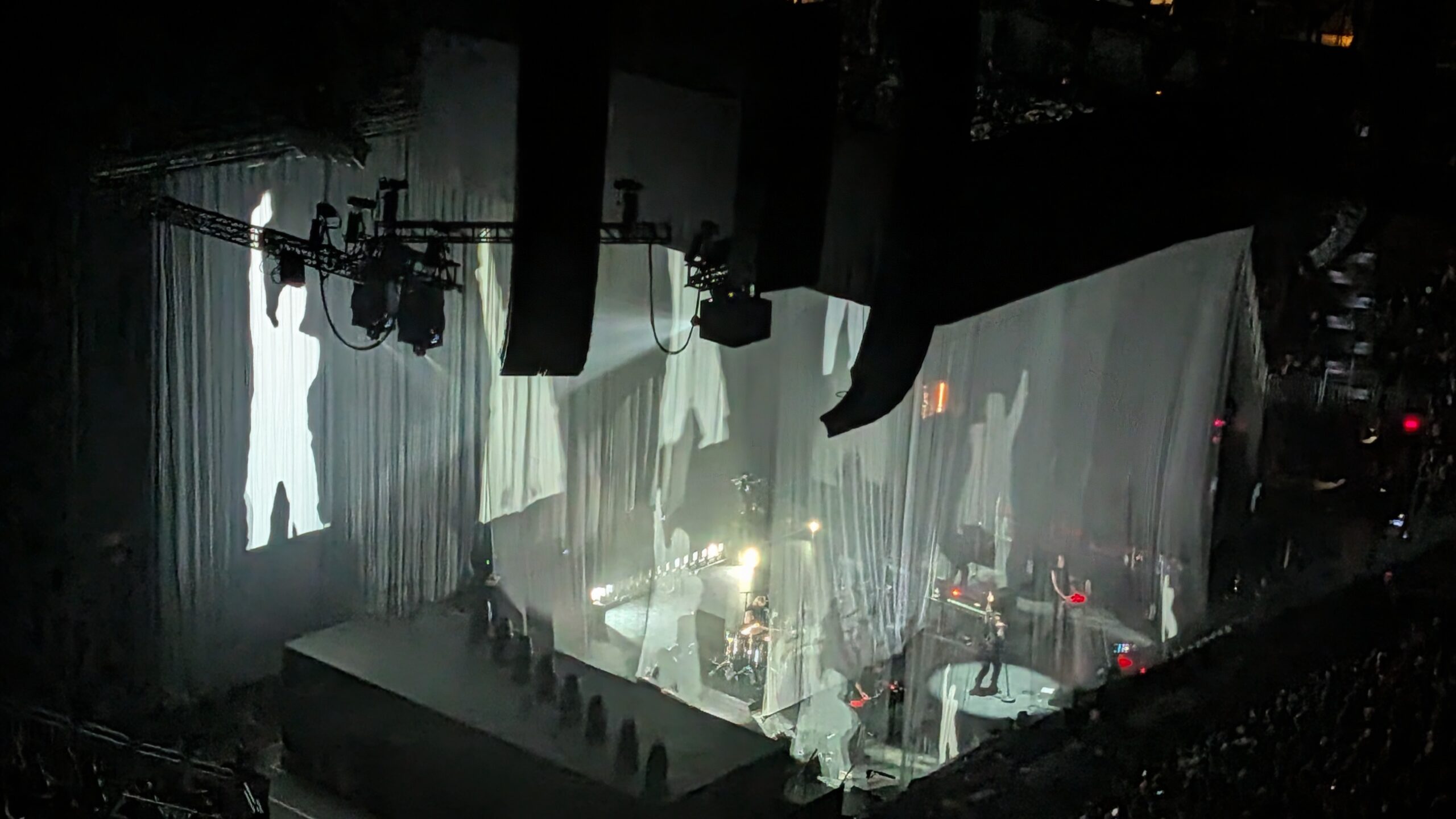
“If there is a hell, I’ll see you there,” Reznor sings to us in the foggy, red-lit arena, as the audience claps along with “Heresy” (1994). Lights flash chaotically as the lyrics “God is dead, and no one cares” echo into every inch of the space. Shifting away from the earlier chaotic lights, the room darkens to a single spotlight on Reznor, with smaller projections on the walls between the band members that look like a house of mirrors showcasing dancing white silhouettes of him performing “Copy of A” (2013) from Hesitation Marks.
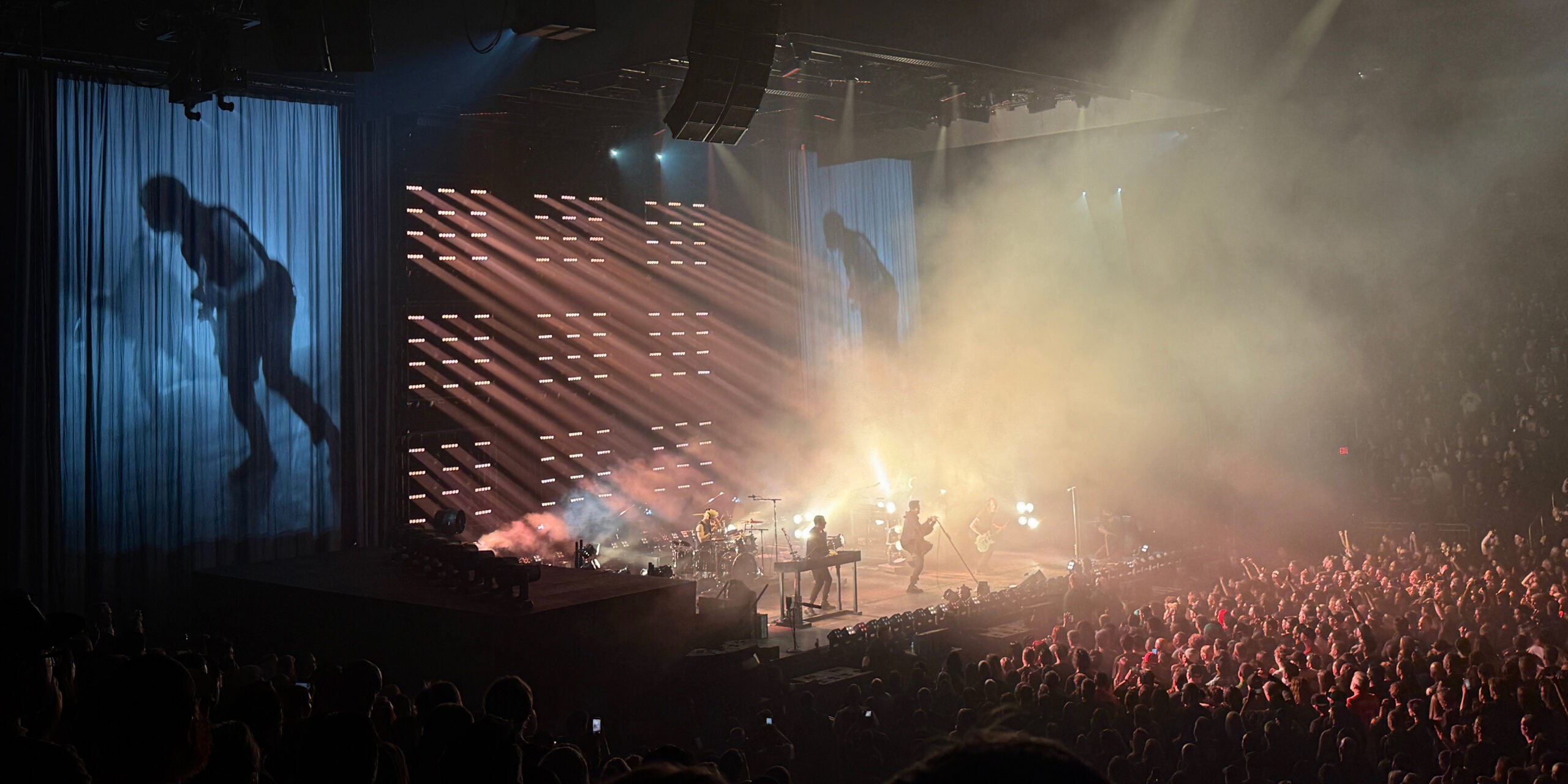
Nine Inch Nails perform behind sheer curtains as towering shadows and silhouettes ripple across the stage. Audience photo by: Katherine Amy Vega
The energy high, beneath the red and blue flashing lights during “Gave Up” (1992), a small, seemingly friendly mosh pit begins on the floor level. The room is one with Nine Inch Nails, every moment seeming perfectly executed to the plan of long-time industry professionals.
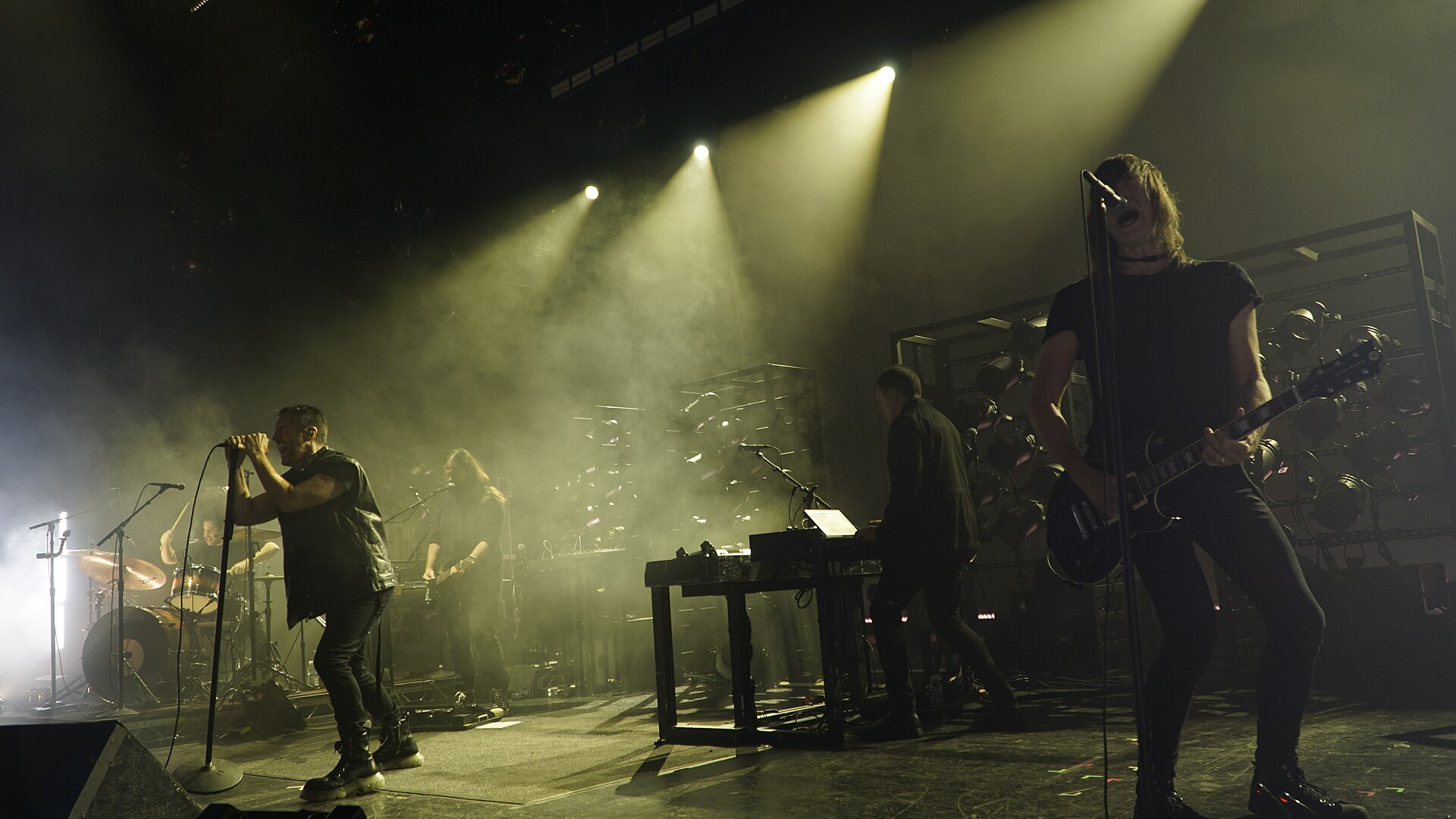
Nine Inch Nails performing at the O2 Apollo Manchester on June 20, 2022. Photography: aliina s. (CC BY 2.0), via Wikimedia Commons
Drowned in red and fog, almost by magic, Reznor has returned to the smaller center platform. Electric fuchsia zaps and flashes in the foggy clouds surrounding the stage as “Vessel” (2007), from Year Zero, pumps through the veins of every listener. The music surges beneath the skin.
Nine Inch Nails ignite the center stage in a burst of white light as the crowd surrounds them. Audience photo by: Katherine Amy Vega
The final stretch: “Closer” to the closing moments
Entering the final songs of the set list, the most popular song of Nine Inch Nails’ nearly 40-year career, “Closer” (1994) starts and engulfs the room in purple, fuchsia, and white, flickering to the heat of the music. The feeling this song gives is undeniable; the words are on the lips of everyone there.
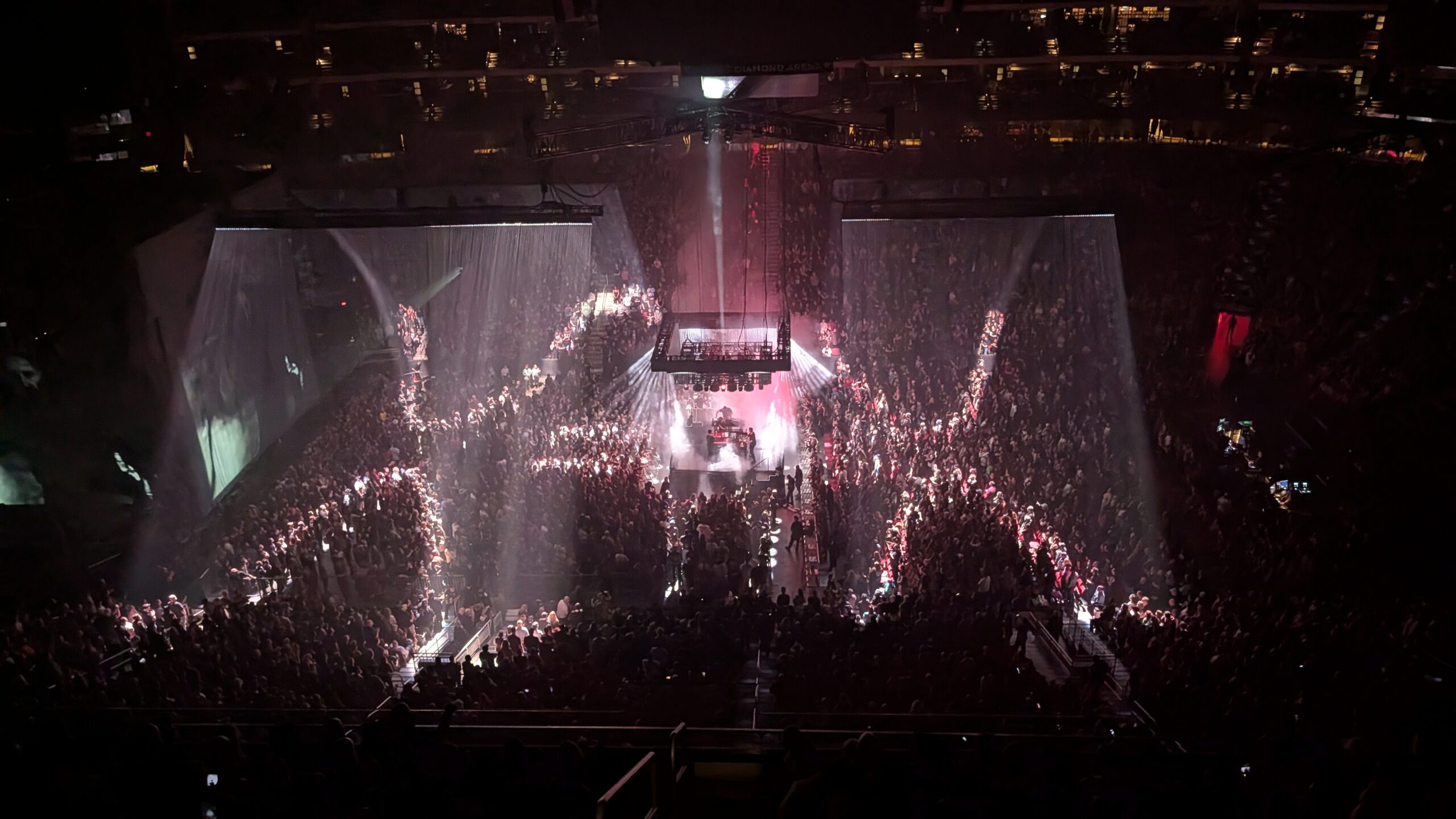
Nine Inch Nails light up the center stage as rippling, curtain-like beams pattern the crowd. Audience photo by: Katherine Amy Vega
“Parasite” (2010), originally by How To Destroy Angels (a band featuring Reznor and his wife Mariqueen Maandig Reznor) poured fresh green lights and fog down the room. The projections return with close-ups of Reznor, where I note a link chain around his neck I hadn’t noticed before. In this song, Trent Reznor’s vocals have a more digitized effect than in previous songs in the set.
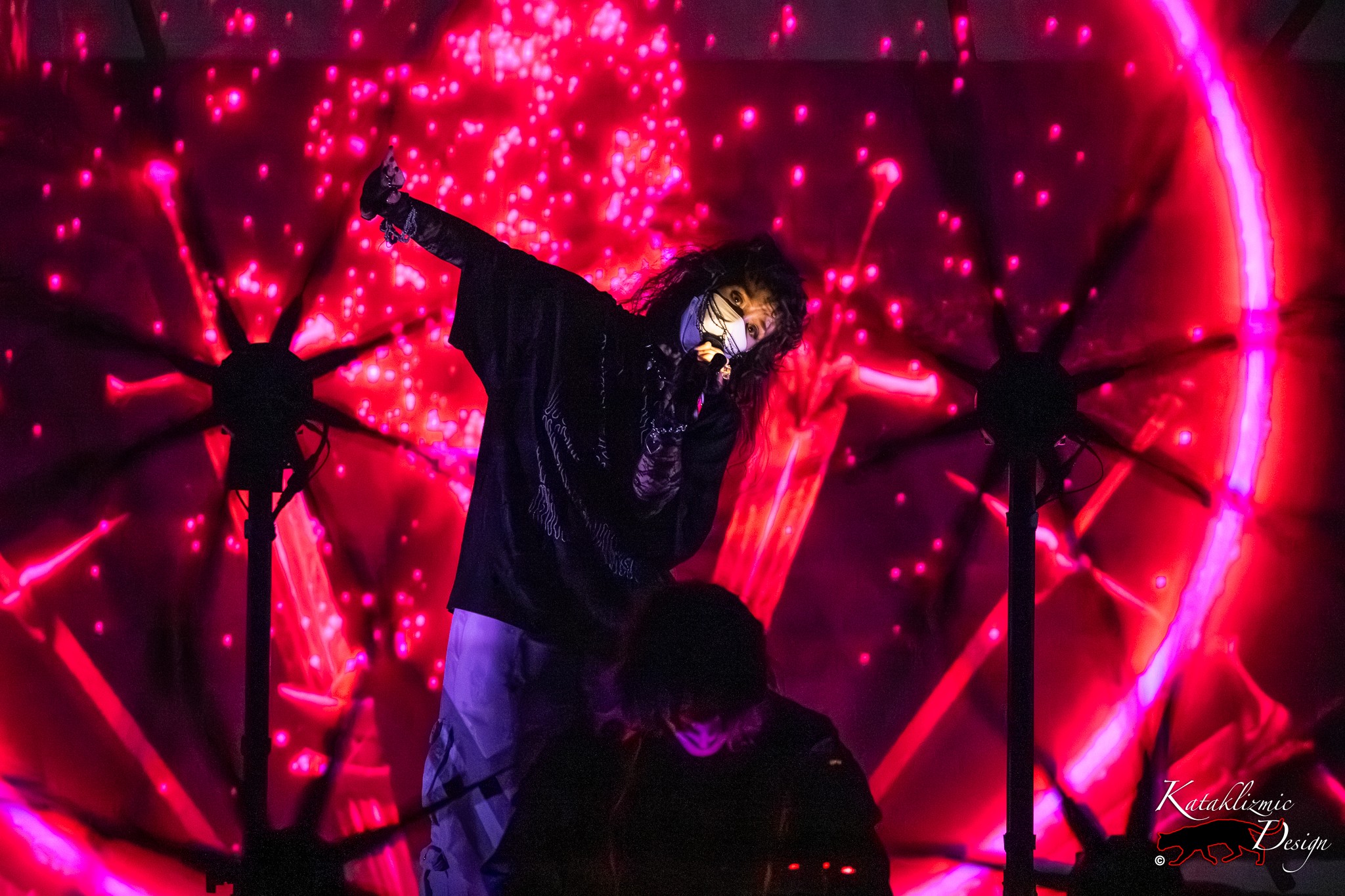
Nine Inch Nails bathe the arena in red as sharp white beams cut through the haze over the center stage. Audience photo by: Katherine Amy Vega
“As Alive As You Need Me To Be” (2025), off the newest album TRON Ares: Divergence(a 24-track soundtrack for a movie of the same name) plays with coordinating white and red flashing lighting. The full band returns to play “Mr. Self Destruct” (1994) with the entire stage flashing, energy peaking — a song they had played so many times before, and it shows only with the smoothness of their performance. It is practiced to perfection.
Nine Inch Nails surge into the open stage as the curtains lift, flooding the room with light, haze, and towering silhouettes. Audience photo by: Ali Crimson
“Less Than” (2017) raises the sheer curtains that provided the veiled cover for the entire show, signaling that it is one of the final three songs of the evening. This is the one and only time I believe Reznor plays a tambourine the entire show, which I did not expect.
“Head Like a Hole,” “Hurt,” and an unexpected interruption
The closing songs for the evening are fan favorites “Head Like A Hole” (1989), off Pretty Hate Machine, and “Hurt” (1994) from The Downward Spiral. “Head Like A Hole” is one of the most recognizable songs of the band’s extensive catalog, inspiring dozens of covers over the decades.
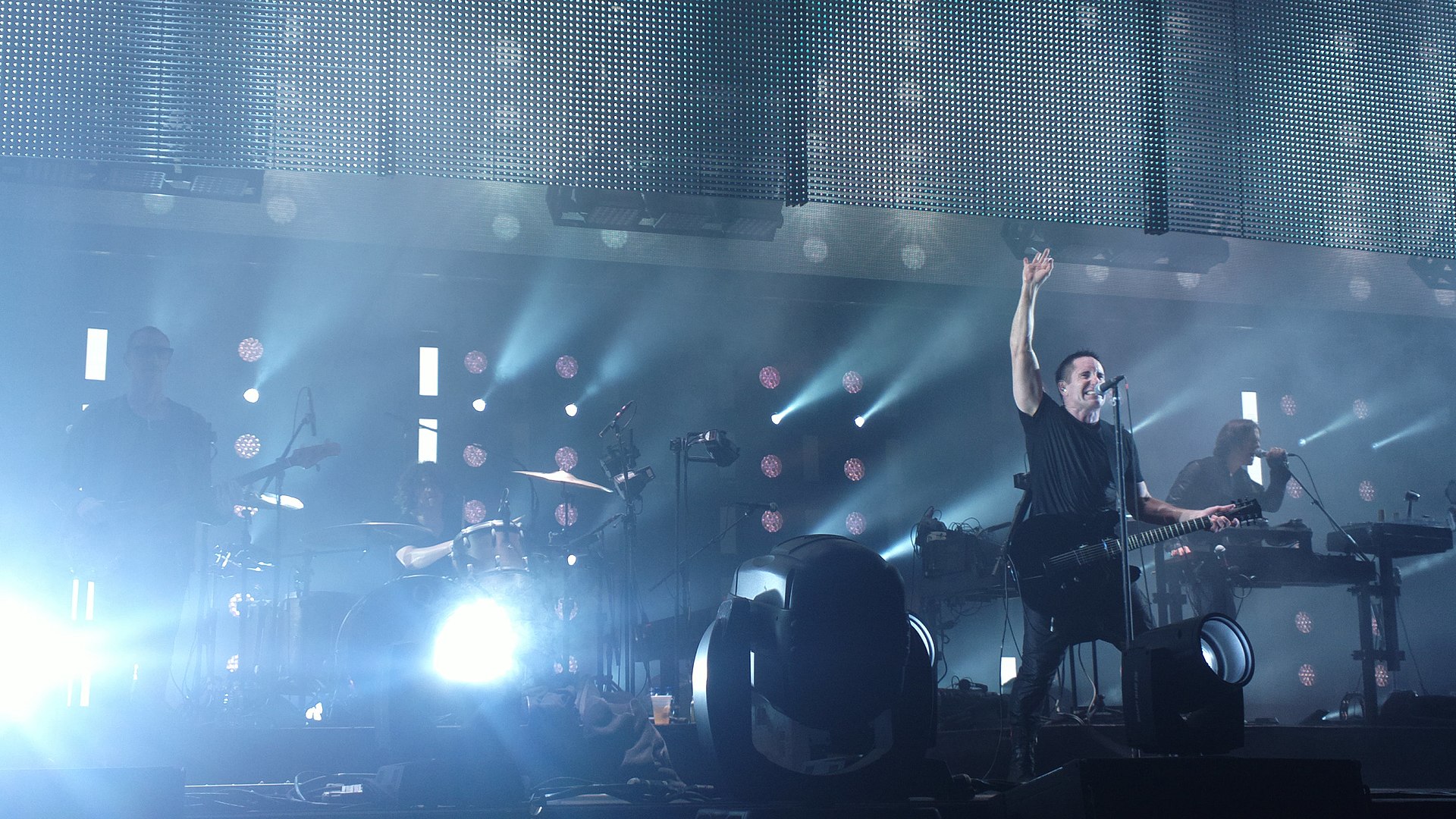
Nine Inch Nails blast through a bright, blue-lit moment as Trent Reznor raises a hand to the crowd at Staples Center in 2013. Photography: Al Pavangkanan (CC BY 2.0), via Wikimedia Commons
At the beginning of “Hurt”, a fight broke out in front of the stage. As it was yet to be broken up, Reznor stopped the song and spoke directly to the people saying, “Hey we’re not here for this shit man, hey HEY!! There’s enough bullshit happening out there, we don’t need it happening in the fuck here.” He turned, awaiting the resolution of the problem before continuing the performance after his very Dad-like scolding.
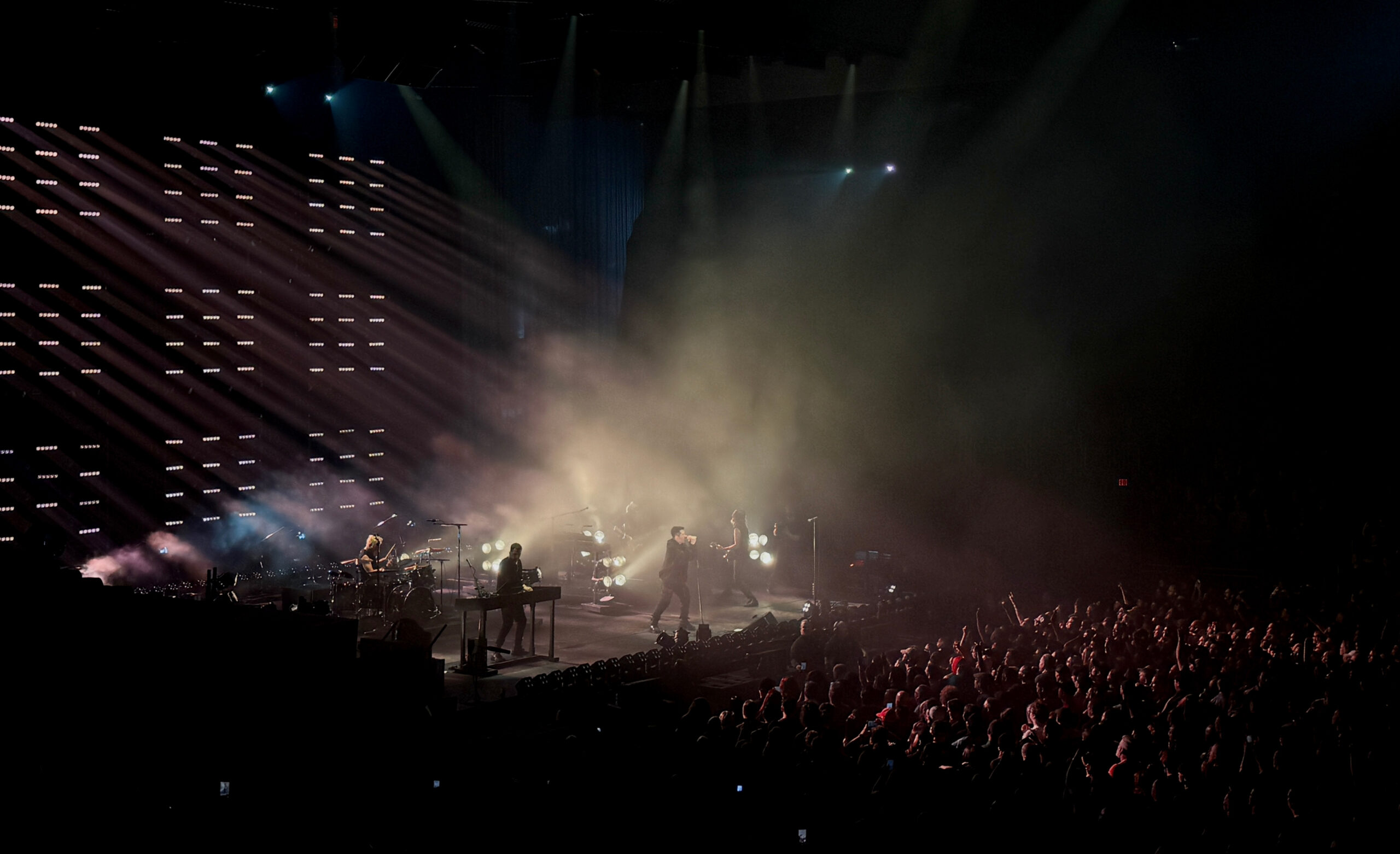
Nine Inch Nails push the full-band set into a haze of diagonal beams and drifting smoke as the crowd surges at the front. Audience photo by: Ali Crimson
“Hurt” closed the show, giving us a finale of Reznor’s emotive lyrics and vocals to send us off into the night. There was no encore, and one wasn’t needed.
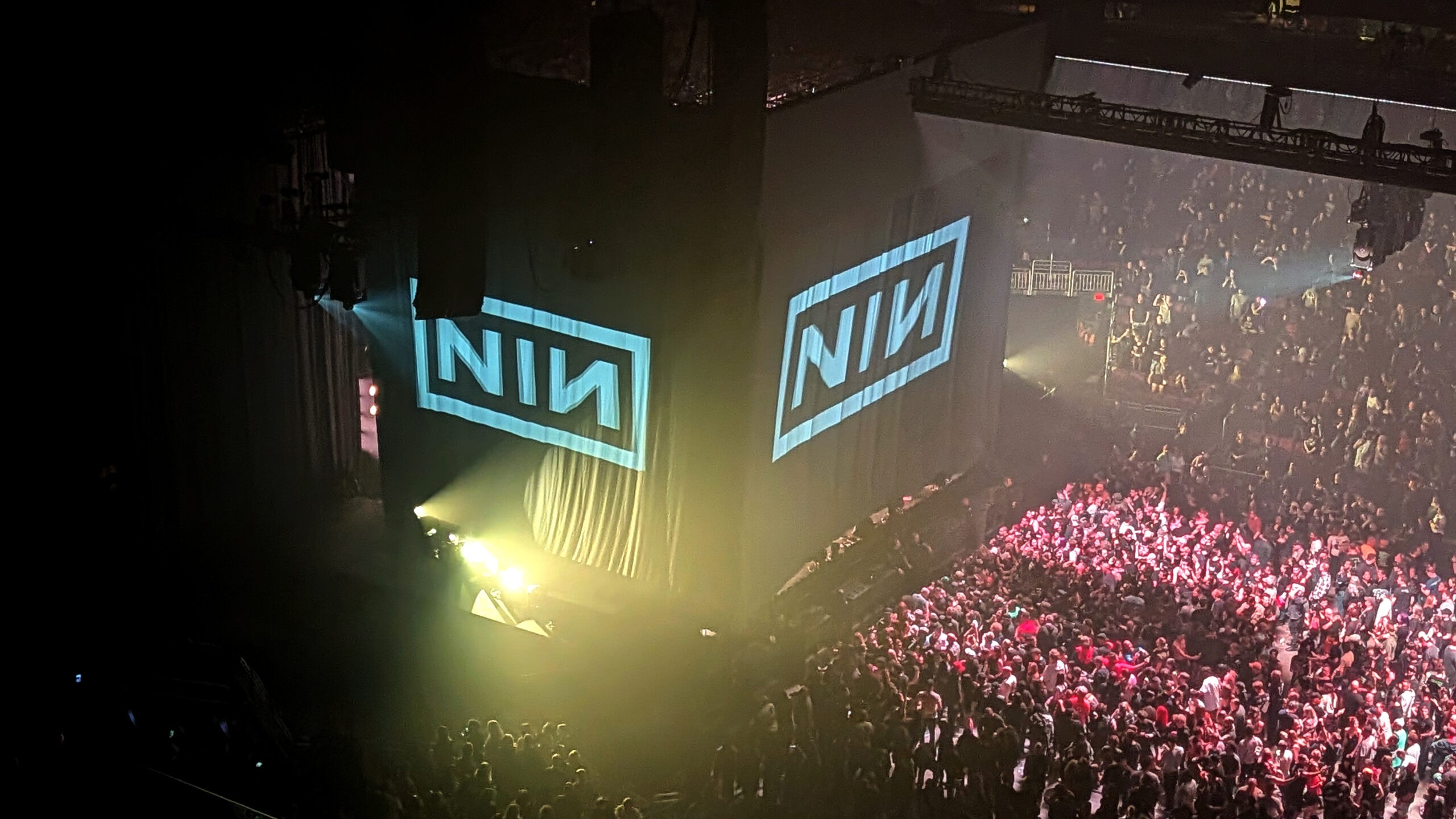
Nine Inch Nails leave the arena glowing as the NIN logo lingers on the curtains after the show. Audience photo by: Katherine Amy Vega
Peeling back the decades
You would think this performance would be one of simple nostalgia, but the music felt as fresh as when I listened to each release by NIN throughout the decades. The professionalism of this show was unmatched, smoothly transitioning between stages like the members had teleportation powers. The industrial music coursed through my veins with a unique awakening, the memorized words flowing from my tongue. The Peel It Back tour is an apt title, as this set list peels back the layers of years, and it is new again.
PHOENIX — Celebrating a decade as a group, TWICE brought their “THIS IS FOR” World Tour to Mortgage Matchup Center, transforming their long-awaited Arizona debut into a night rooted in belonging, empowerment, and shared emotional release.
TEN: THE STORY GOES ON (Cast Version), the 5th Korean studio album (11th overall) by TWICE. Released on October 10, 2025 to commemorate the group’s 10th anniversary. Available in Cast, Episode, & Party Lovely Versions
Marking the group’s 10-year anniversary, the performance felt less like a routine tour stop and more like a dedication to ONCE, a fandom built on mutual support, emotional connection, and collective growth. From large-scale production moments to deeply personal solo stages, TWICE delivered a show that honored its history while fully embracing Phoenix as part of the group’s journey.
This was TWICE’s first concert in Arizona, and that milestone shaped the tone of the entire evening — one defined by gratitude, intention, and a clear effort to make Phoenix feel seen, welcomed, and woven into the group’s story.
Community Before the Lights Went Down
Long before TWICE took the stage, a sense of community had already taken hold. Outside the venue, fans exchanged handmade bracelets, offered trinkets, volunteered to take photos for strangers, and struck up conversations with ease. When asked why they gave so freely without expecting anything in return, fans cited joy, connection and anticipation, offering something to look forward to after long days at work, school, hospitals or hours spent driving in from out of town.
That communal energy extended beyond giveaways. Informal dance battles broke out as short song clips played, drawing spontaneous participation. Others filmed TikToks together, interviewed one another and laughed while waiting in line. The experience felt participatory before the concert had even begun.
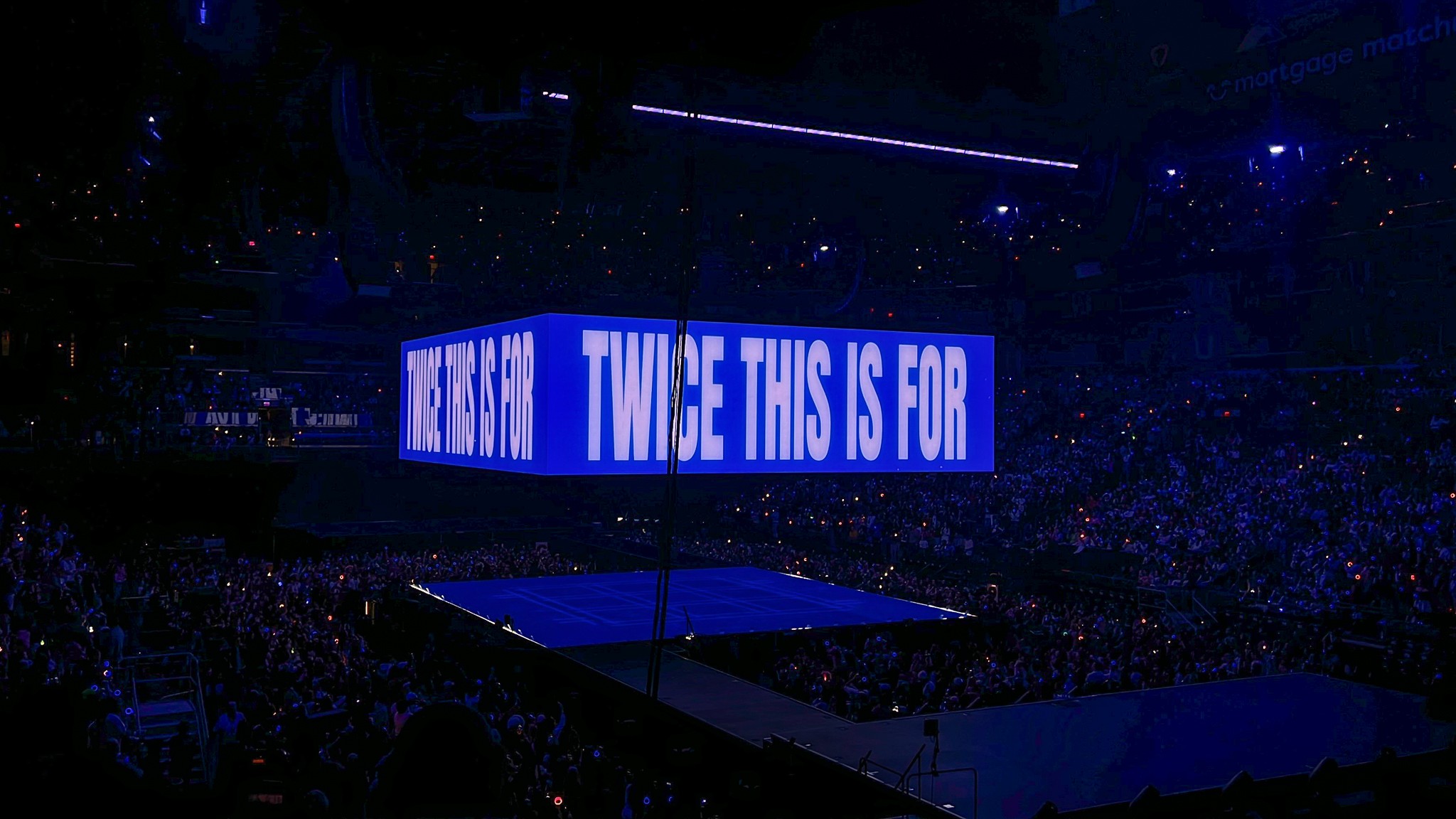
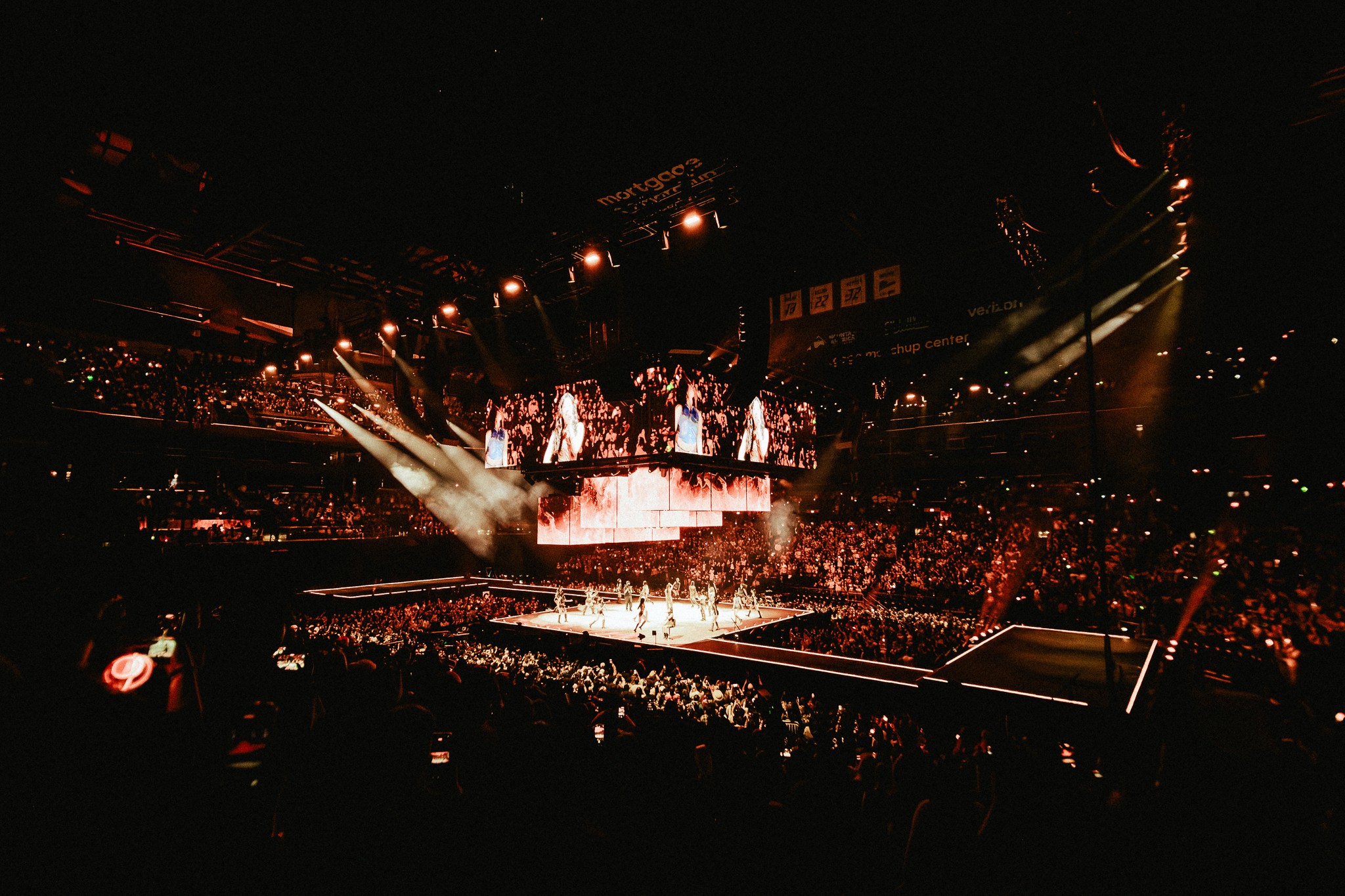
The arena glows as TWICE’s “THIS IS FOR” World Tour branding fills the screen, setting the tone for a night centered on connection between the group and ONCE in Phoenix. (Photo by Jasmyne Haskie, taken from the audience)
Inside the arena, fan fashion reflected TWICE’s longevity and cultural reach. Attendees recreated looks from different eras of the group, referencing past music videos and performances. Red hoods nodding to earlier releases appeared throughout the crowd alongside pink jumpsuits, coordinated red outfits, skirts paired with work ties and custom Candy Bong light sticks. Many were personalized with charms, teddy bear ears, wrist straps, or bedazzled designs, while some fans wore illuminated kitten ears.
Act 1: A Confident Opening Statement
As the lights rose for Act 1, it was immediately noticeable that only eight members stood on stage. Jeongyeon’s absence was apparent before a single note was sung, subtly altering TWICE’s familiar formation and signaling that the night would carry resilience and adaptation alongside celebration.
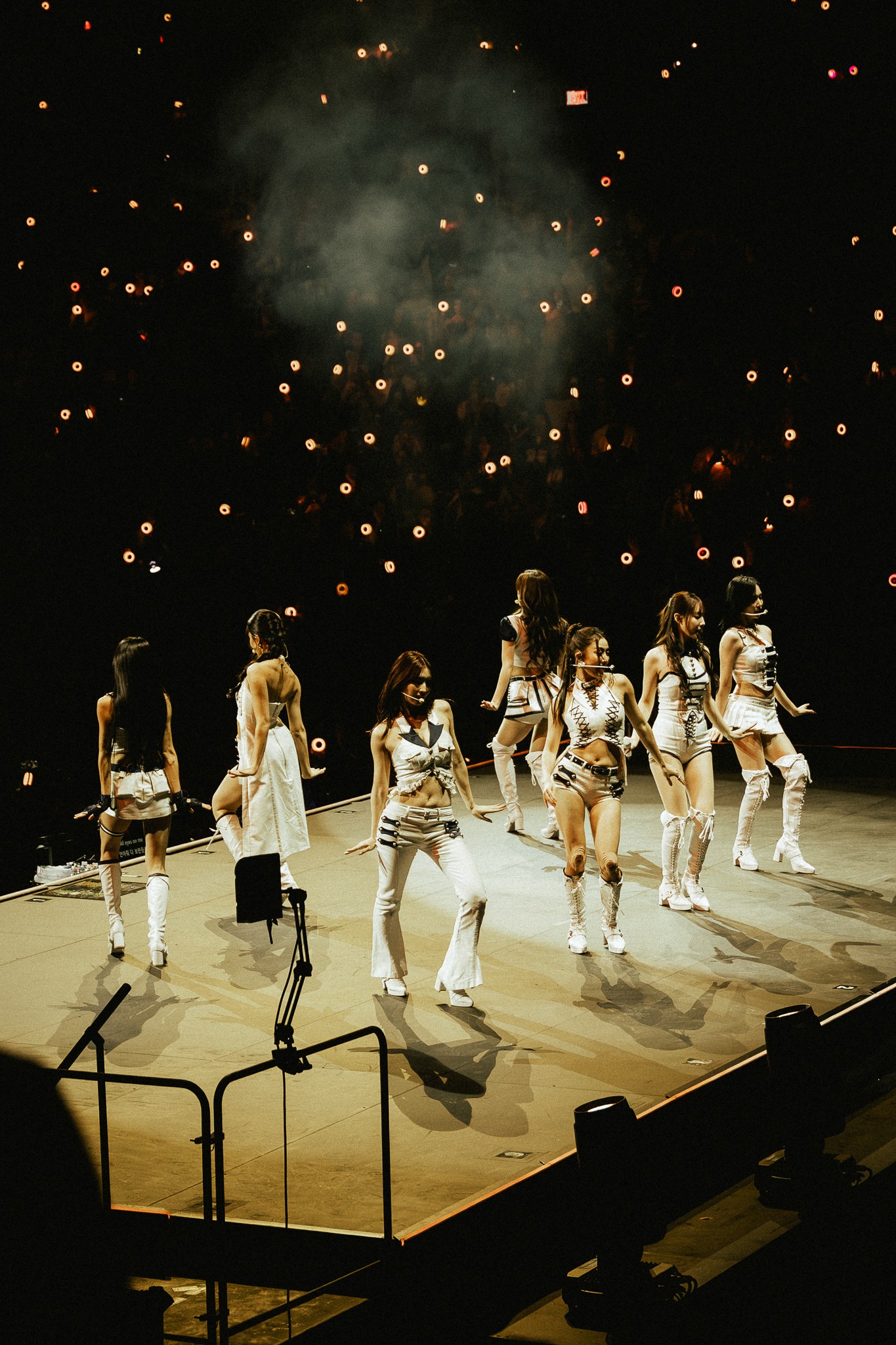
TWICE onstage with eight members present, their altered formation subtly emphasizing both the group’s adaptability and the emotional weight of the night. Photo credit: JYP ENTERTAINMENT, KYLIE BRENNAN
TWICE opened with “THIS IS FOR,” igniting the crowd under blue and yellow lighting. Fans sang and danced from the first moments, establishing a reciprocal exchange of energy that filled the arena. “STRATEGY” followed, quickly becoming a call-and-response moment as the repeated “go” prompted the audience to respond in unison. “MAKE ME GO” and “SET ME FREE” sustained the momentum, keeping the opening run tightly paced and high-energy.
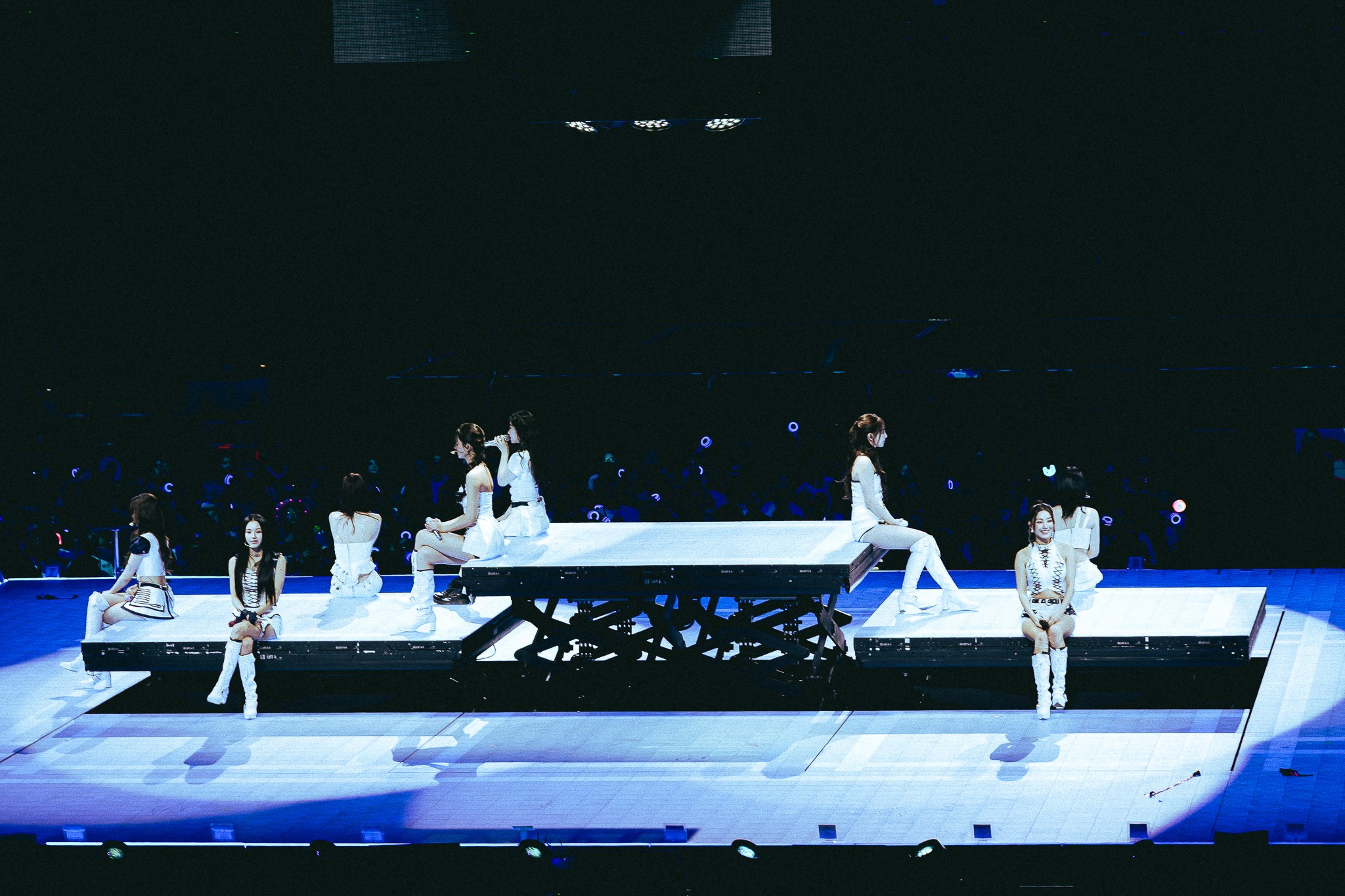
TWICE is seated across the main platform in coordinated white outfits as the opening act unfolds, bathed in cool blue lighting. Photo credit: JYP ENTERTAINMENT, KYLIE BRENNAN
A major visual shift arrived during “I CAN’T STOP ME.” Red lighting washed over the stage as dancers filled the space and a central platform rose, marking the first large-scale production moment of the night. The staging amplified the song’s central tension of desire versus restraint, heightening the urgency that defines the track.
TWICE fills the arena from a central stage as towering video screens and warm amber lighting surround the crowd, emphasizing the scale and immersion of the production. Photo credit: JYP ENTERTAINMENT, KYLIE BRENNAN
After the opening run, the group paused to formally greet Phoenix. When the camera landed on Jihyo, the arena erupted with cheers and chants of her name. Smiling, she teased the crowd by asking, “Who am I?” before laughing and greeting the audience, effortlessly establishing command of both the stage and the room.
Introductions continued across the group, as TWICE welcomed Phoenix fans into its first Arizona show. Each member received waves of cheers, reinforcing the affection and anticipation that filled the venue.
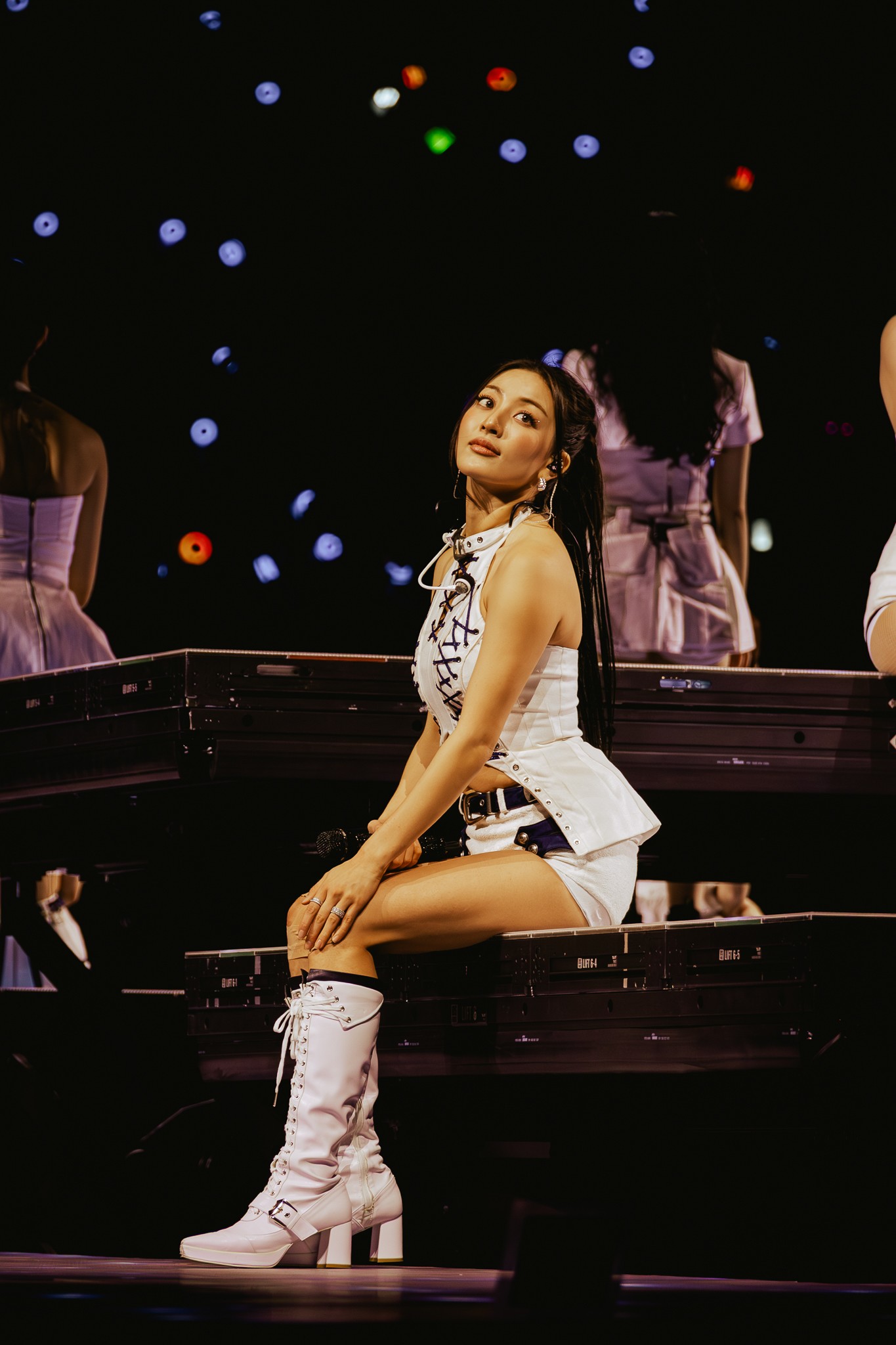
Jihyo of TWICE holds the stage in a poised seated moment, her focus locked on the crowd as the arena responds in full voice. Photo credit: JYP ENTERTAINMENT, KYLIE BRENNAN
When Dahyun appeared on screen, the crowd erupted into loud chants of “Dubu, Dubu.” Laughing, she responded, “Wow, the Phoenix energy is so high,” before addressing the audience more seriously. She explained that due to an ankle injury, she would be performing seated, reassuring fans that she was otherwise healthy.
Sana followed with warmth and honesty, acknowledging both the crowd’s anticipation and the group’s circumstances. Mina offered a brief greeting, keeping the introductions moving before the tone shifted.
Jihyo then addressed the audience with transparency, explaining that Jeongyeon had been receiving treatment backstage earlier in the day and was ultimately unable to perform. She asked the crowd to enjoy the show to the fullest in Jeongyeon’s place, which was met with resounding cheers.
Act 1 concluded with “OPTIONS” and “MOONLIGHT SUNRISE.” The latter softened the atmosphere as cosmic visuals of galaxies and stars filled the screen, allowing the audience to collectively pause before transitioning into the next act.
Act 2: From Cosmic Reset to Commanding Power
Between Acts 1 and 2, background dancers took over under strobe lighting, building tension through synchronized movement before the energy surged again.
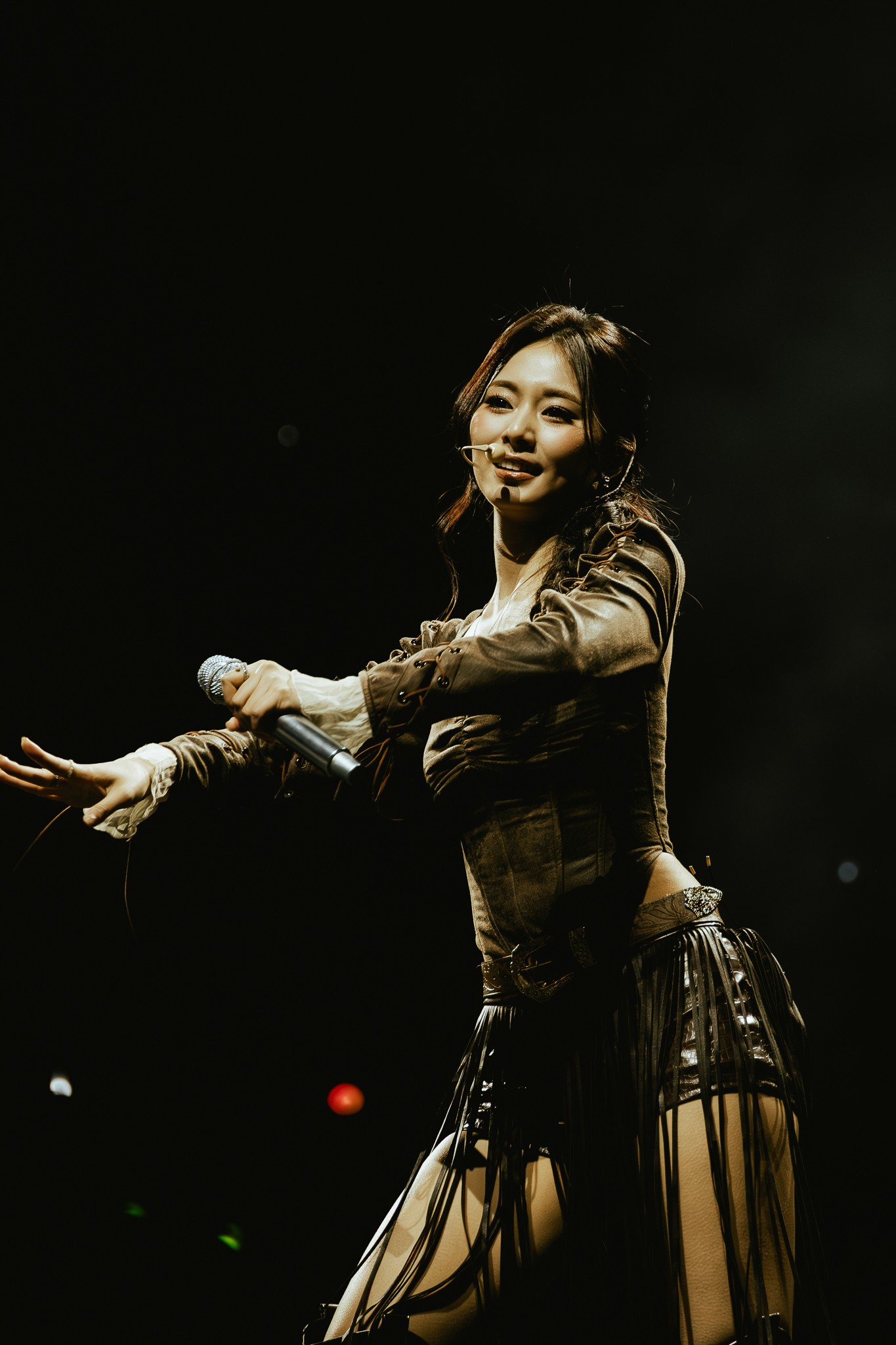
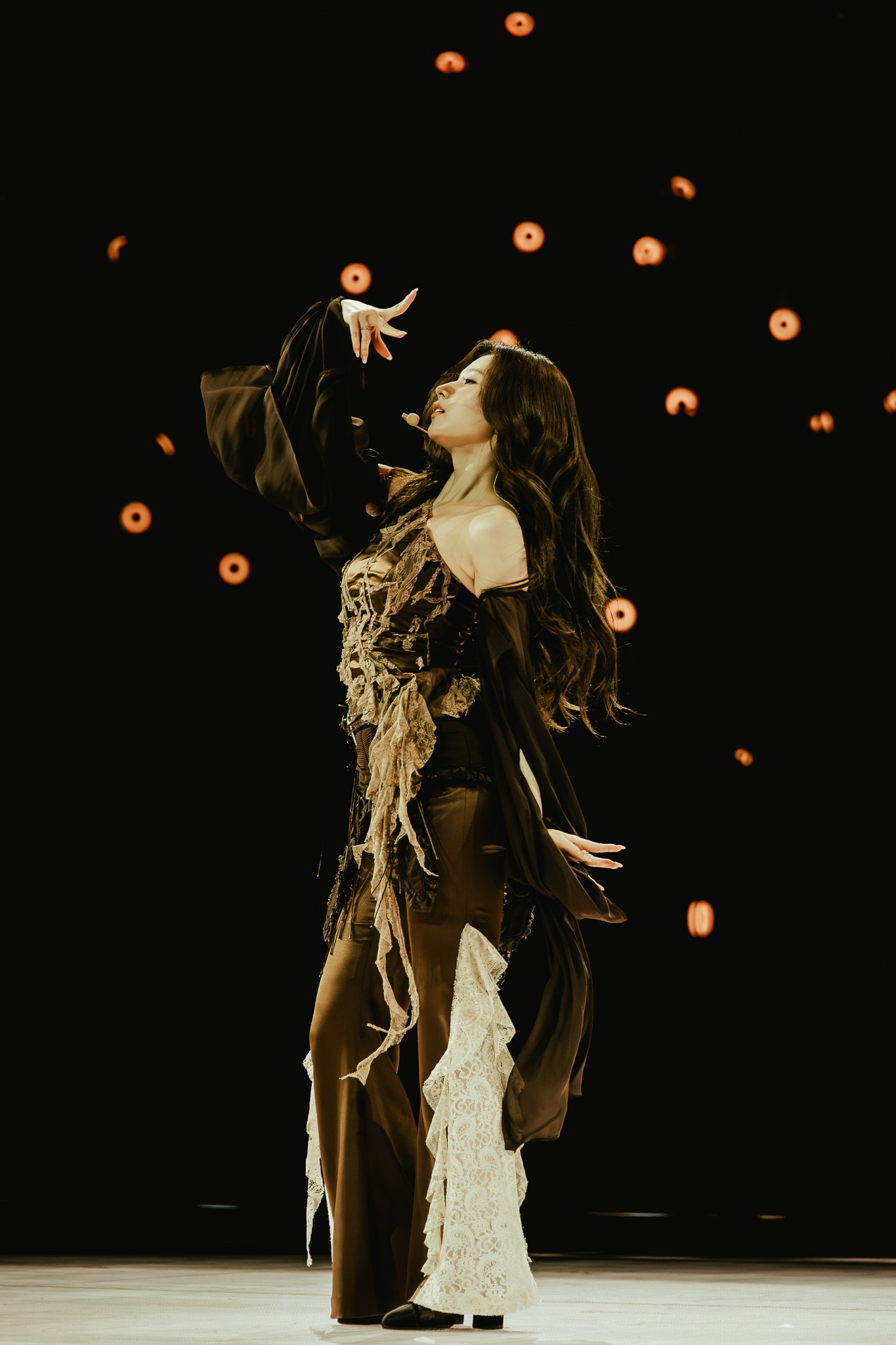
Tzuyu of TWICE reaches toward the crowd mid-performance, her movement calm and assured as she commands the stage. Photo credit: JYP ENTERTAINMENT, KYLIE BRENNAN
Act 2 opened with “MARS,” launching with a high-impact introduction as TWICE appeared elevated on a platform in darker, earth-toned outfits under purple lighting. Despite performing seated, Dahyun remained fully engaged, matching choreography through upper-body movement and interacting with fans even when facing away from the group.
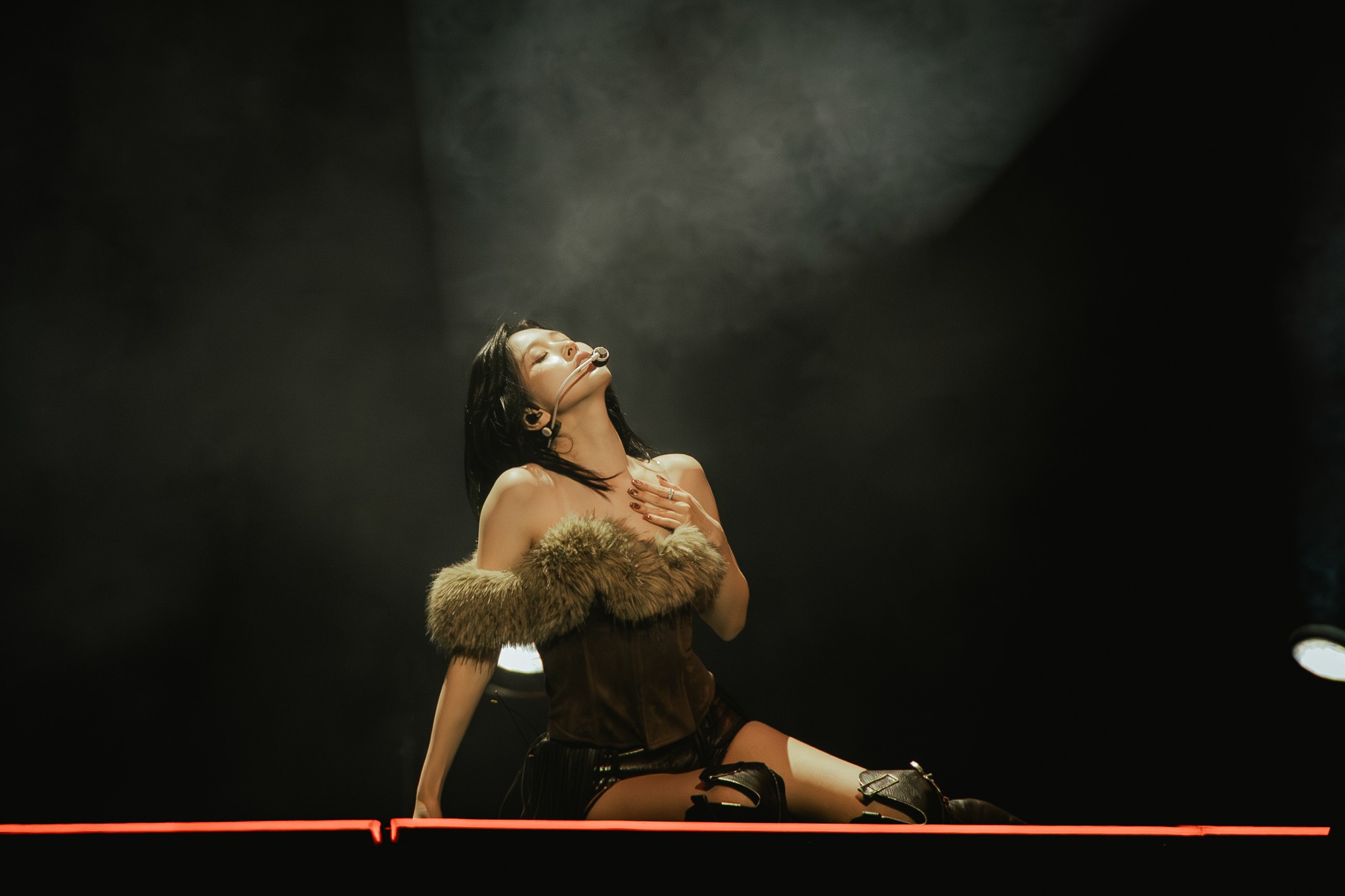
Mina of TWICE pauses in a sculptural pose following a wardrobe change, spotlighted as haze and low lighting heighten the intimacy of the moment. Photo credit: JYP ENTERTAINMENT, KYLIE BRENNAN
The set continued with “THE FEELS,” “GONE,” “CRY FOR ME,” “HELL IN HEAVEN,” and “RIGHT HAND GIRL.” “CRY FOR ME” stood out visually and emotionally, drenched in red lighting and carrying a message of resilience and empowerment. During “RIGHT HAND GIRL,” fan interaction increased again, reinforcing the reciprocal energy between TWICE and ONCE.
Throughout the night, one phrase echoed repeatedly: “This is for ONCE. This is for TWICE.”
Act 3: Individuality at the Core
The transition into Act 3 began with a live band moment positioned opposite the main stage. A guitar solo under red lighting and flame effects played out as the screen lowered in sections, creating a conversational exchange between performers and crowd.
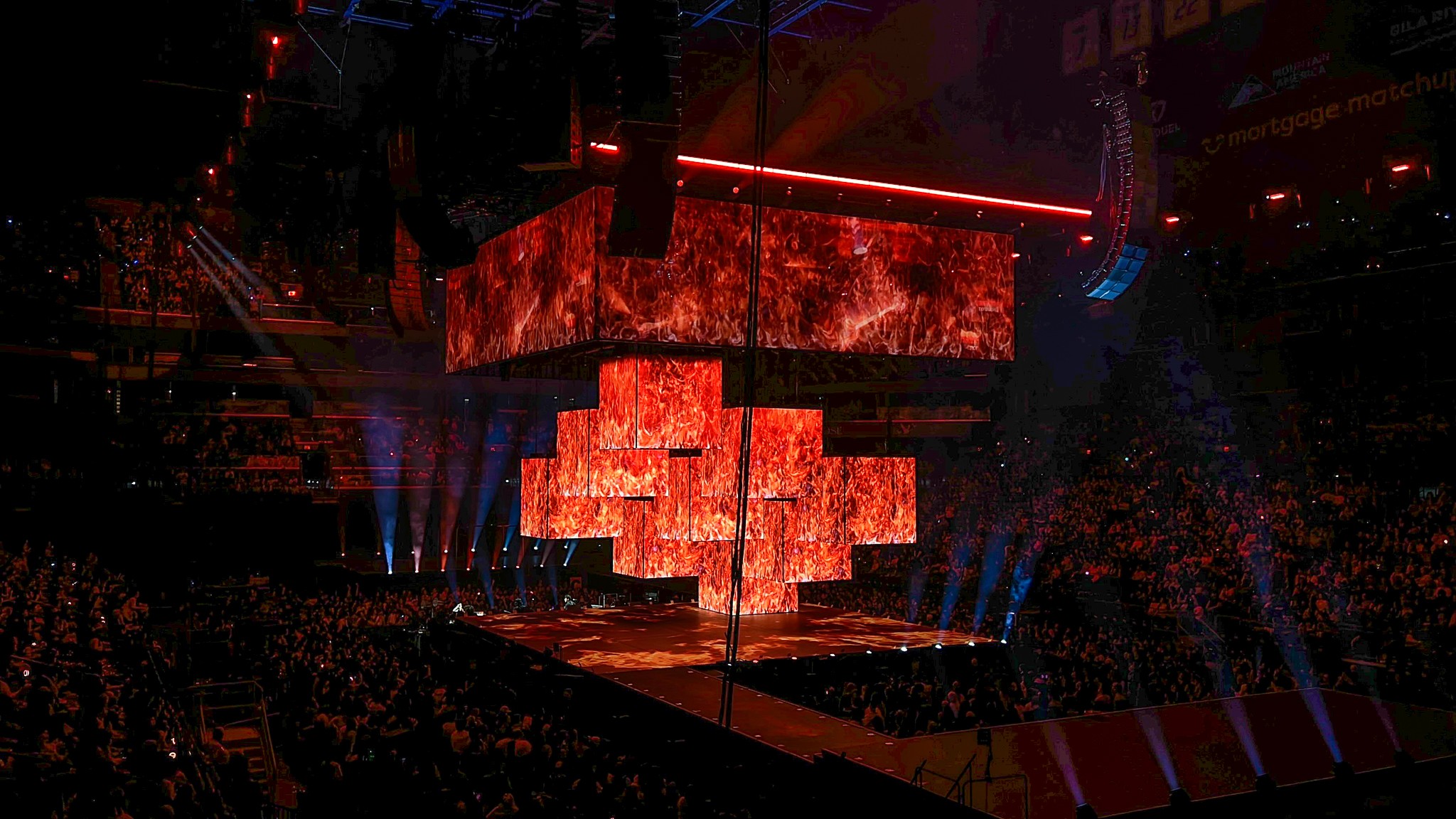
The stage transforms under red lighting as the screen lowers in layered sections, signaling the shift from ensemble spectacle into the solo-focused structure of Act 3 (Photo by Jasmyne Haskie, taken from the audience)
Act 3 centered on solo stages, allowing each member’s individuality to come fully into focus. Transitions were seamless, maintaining momentum throughout the section.
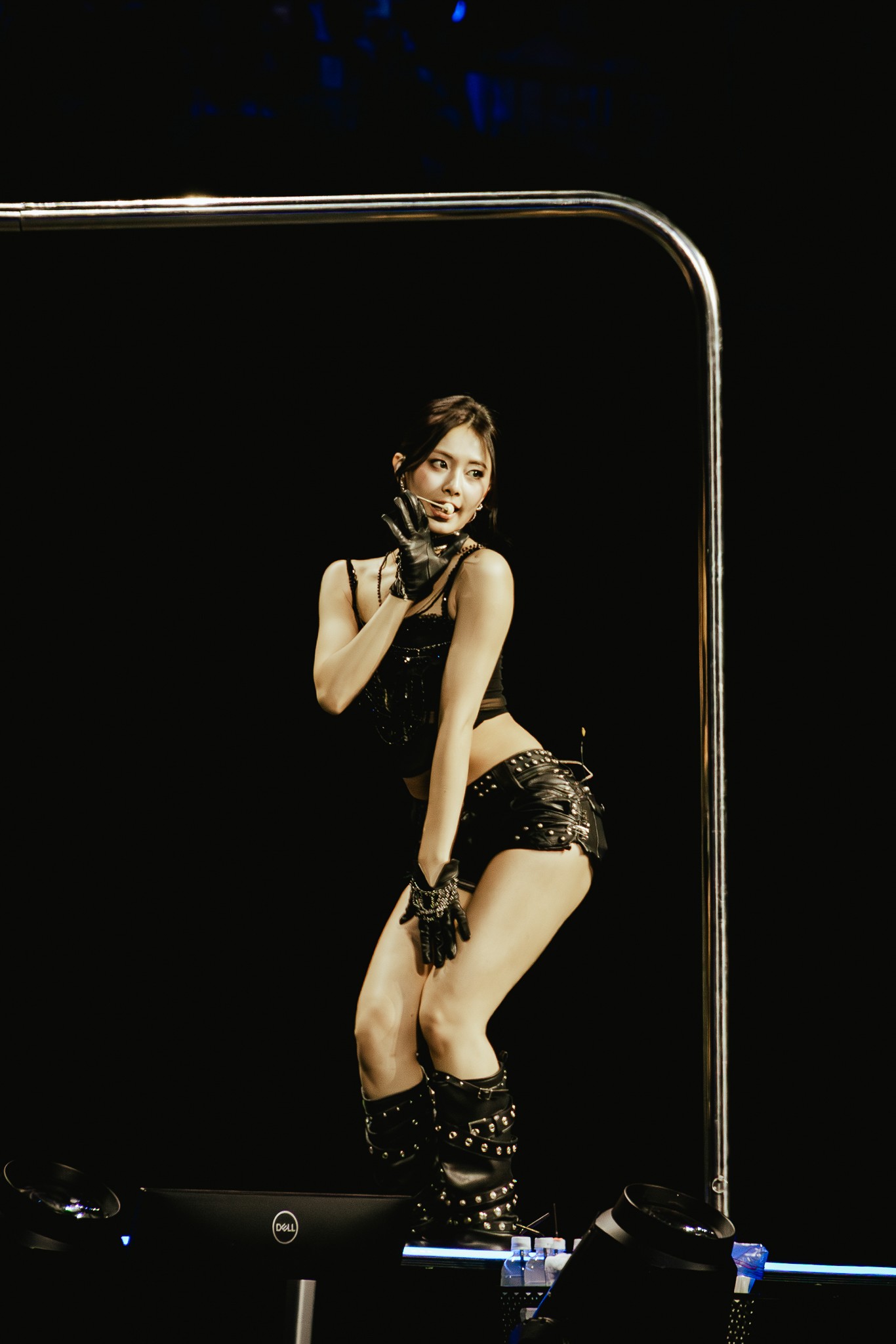
Tzuyu of TWICE performs her solo framed by a metal structure, her movements restrained and deliberate against the darkened stage. Photo credit: JYP ENTERTAINMENT, KYLIE BRENNAN
Tzuyu opened with “DIVE IN,” staged in blue lighting and structured around a metal prop that confined both Tzuyu and her dancers, reinforcing the song’s emphasis on control and intentional intimacy. Mina followed with “STONE COLD,” a slow, emotionally weighted performance under warm orange lighting. Dressed in white and surrounded by black-clad dancers, the visual contrast evoked a striking Black Swan–White Swan dynamic that visibly moved audience members.
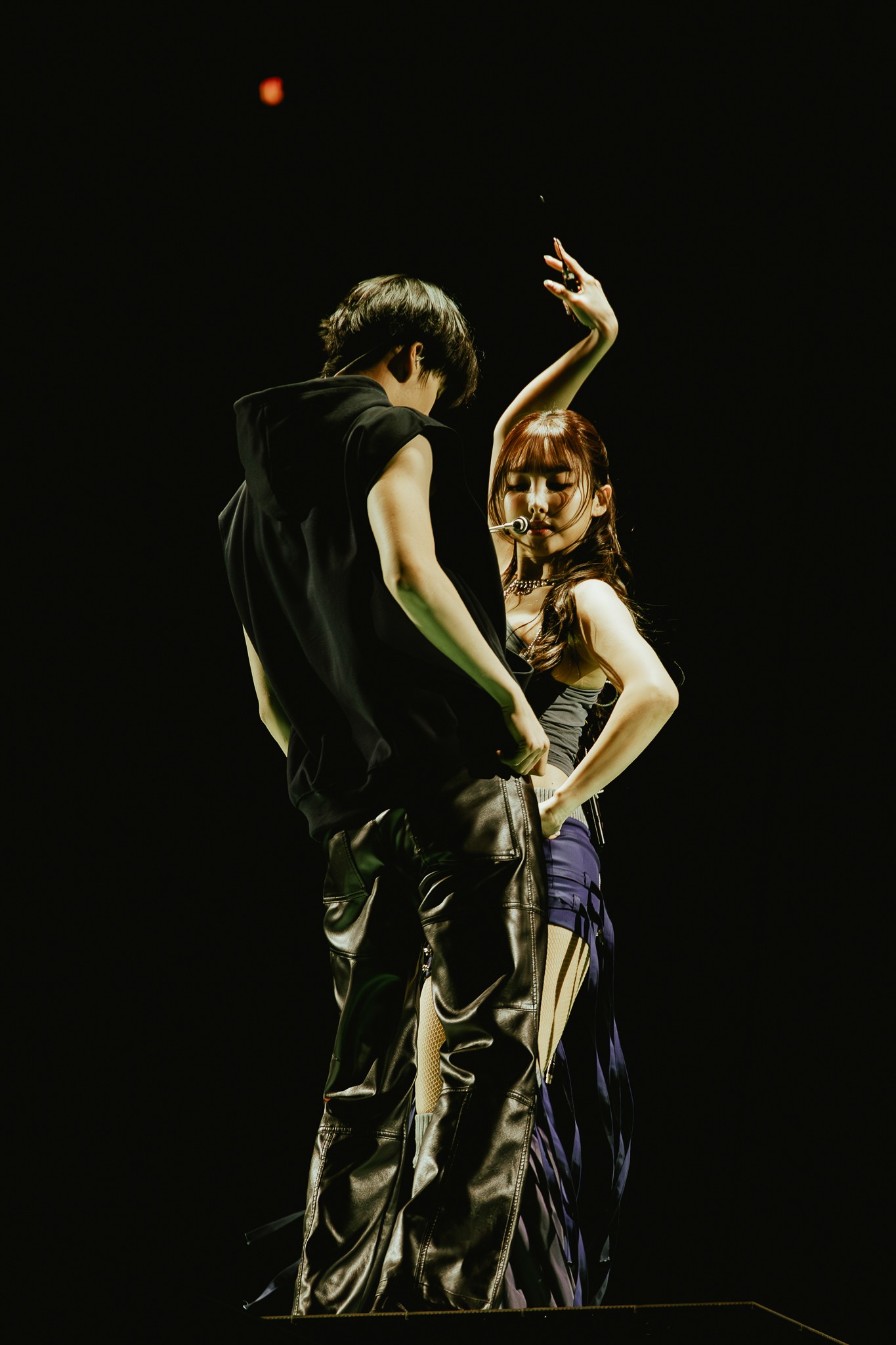
Nayeon of TWICE commands the stage during her solo, framed by a close, stylized interaction with a dancer that emphasizes control, precision, and confidence.Photo credit: JYP ENTERTAINMENT, KYLIE BRENNAN
Nayeon shifted the energy with “MEEEEEE,” performing high above the crowd on a raised platform alongside multiple dancers. A duet moment highlighted her confidence and command. Jeongyeon’s “FIX A DRINK” was not performed due to illness, making Dahyun’s “CHESS” one of the most memorable moments of the night. Dahyun opened the song seated at the piano and proceeded to deliver an intimate performance defined by restraint and poise.
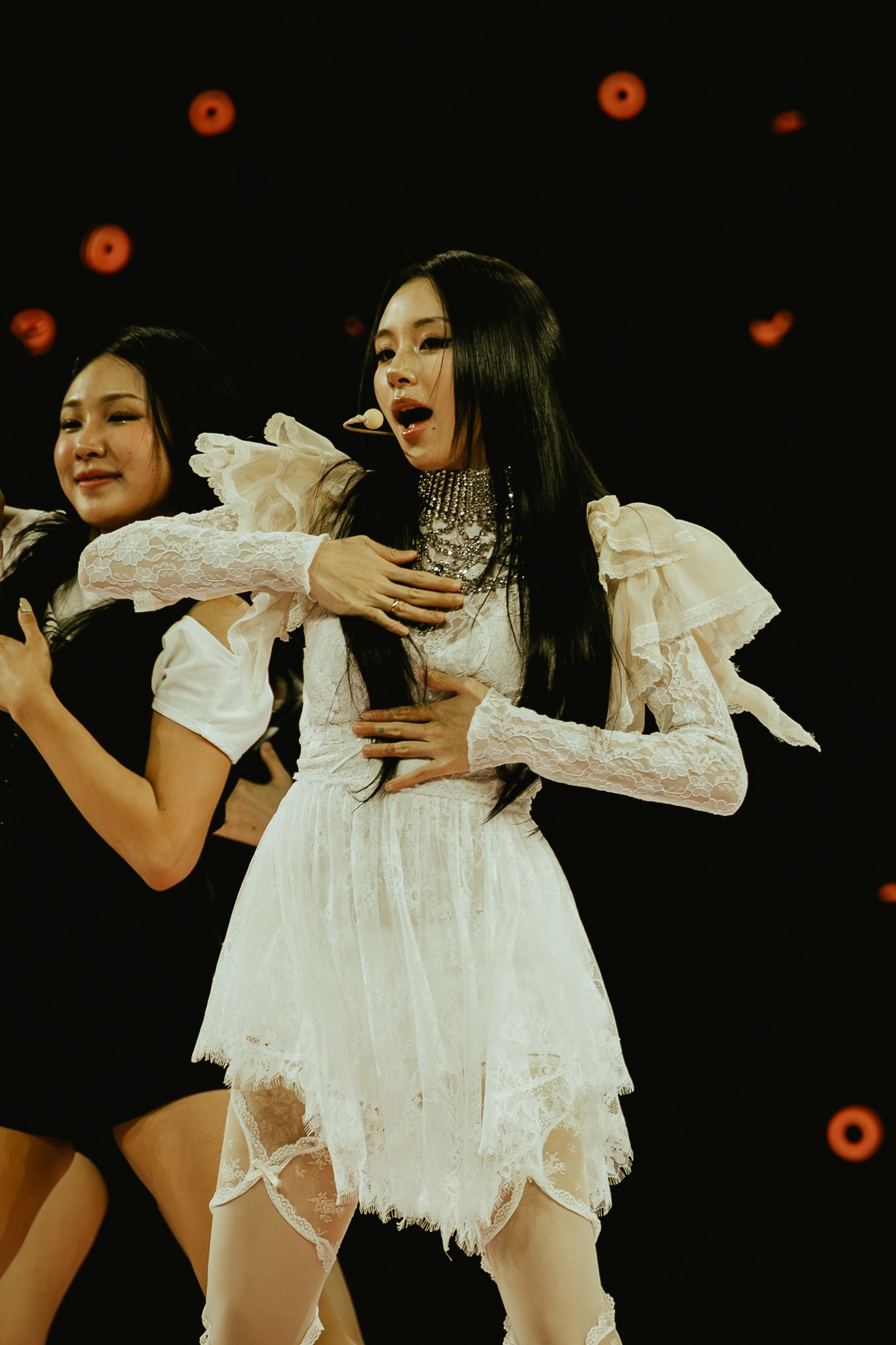
Chaeyoung of TWICE performs in a white lace dress, contrasted against black-clad dancers during a tightly choreographed solo moment. Photo credit: JYP ENTERTAINMENT, KYLIE BRENNAN
Chaeyoung followed with “SHOOT (Firecracker),” performing in a white dress against black-clad dancers as playful doodle-style visuals appeared above her. Jihyo drew one of the loudest crowd responses of the night with “ATM,” her hip-hop-influenced choreography commanding the arena. Sana’s “DECAFFEINATED” became a shared moment as the audience sang along to the repeated refrain.
Sana of TWICE performs her solo under warm amber lighting, her movement and expression drawing focus against a darkened arena backdrop Photo credit: JYP ENTERTAINMENT, KYLIE BRENNAN
Momo closed the solo section with “MOVE LIKE THAT,” delivering a dance-driven performance punctuated by a final lift that saw her raised into the air by two dancers. The section concluded with “TAKEDOWN,” a track from KPop Demon Hunters, featuring Chaeyoung and Jihyo. Originally intended as a trio, Jeongyeon’s absence was felt but did not diminish the moment’s intensity.
Act 4 and Encore: Where TWICE and ONCE Became One
Before Act 4, a high-fashion VCR played across the lowered screen, featuring editorial-style visuals of the members. Cheers peaked whenever Jeongyeon appeared, underscoring how strongly she was missed.
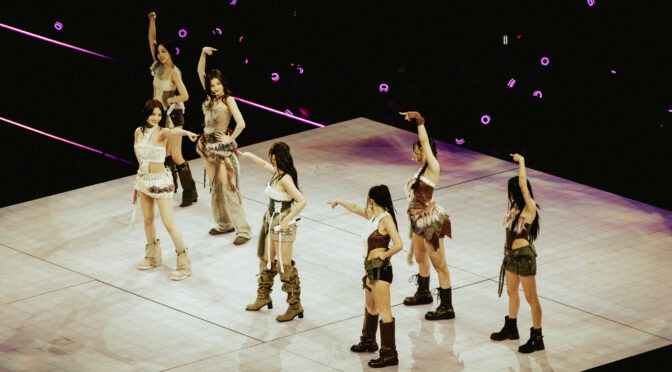
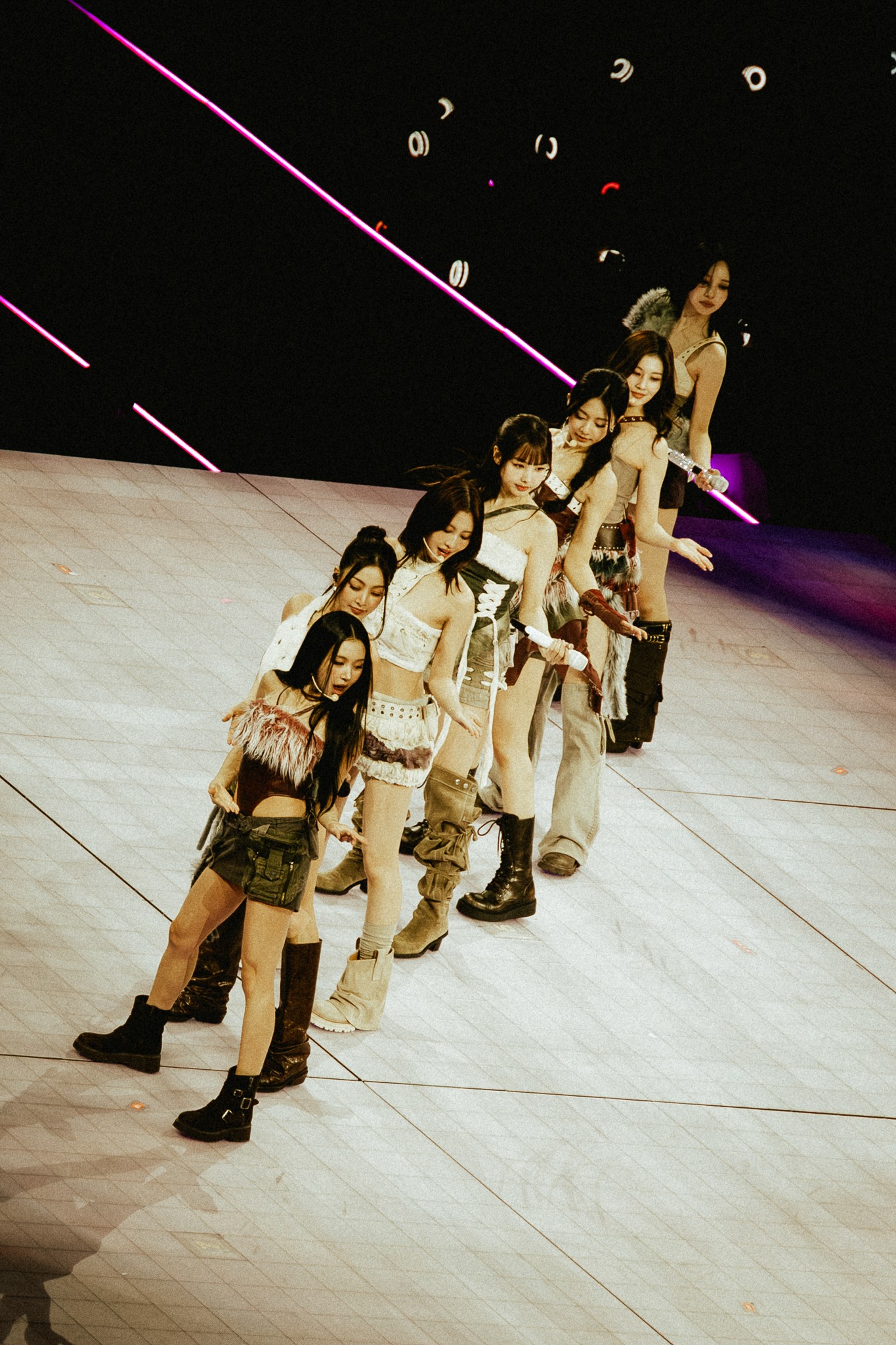
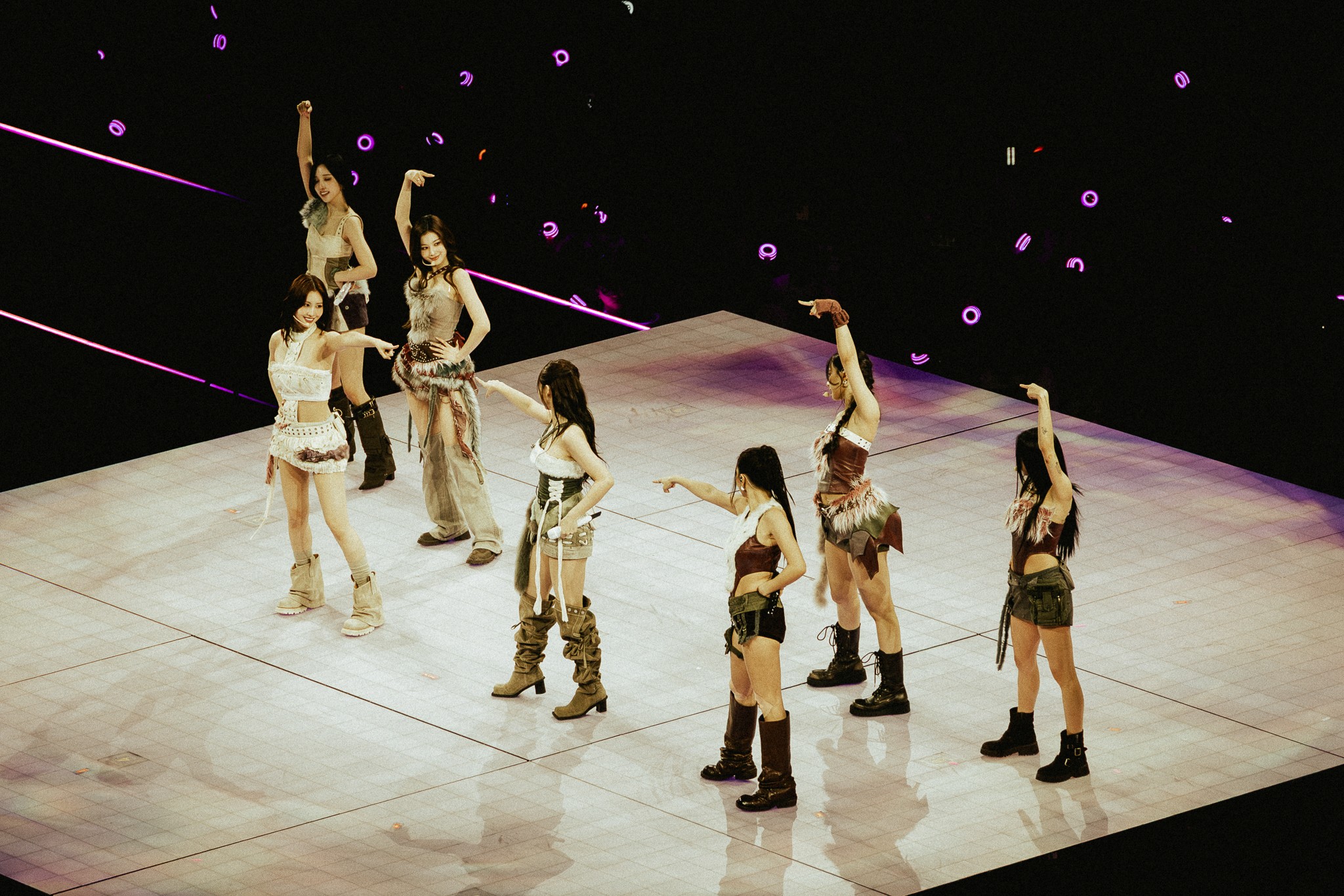
Act 4 opened with “FANCY,” reigniting the arena. TWICE appeared in coordinated yet individualized outfits in earthy tones of brown, sage and white, with no two looks identical, yet cohesive as a whole. The momentum continued into “WHAT IS LOVE?” and “YES OR YES,” sending the arena into full motion as nostalgia swept through the crowd.
TWICE moves through a diagonal formation as Act 4 begins, their individualized styling unified through texture, tone and synchronized movement. Photo credit: JYP ENTERTAINMENT, KYLIE BRENNAN
During “YES OR YES,” Jihyo stepped fully into her role as leader, directing the audience with ease as fans followed her movements instantly. “DANCE THE NIGHT AWAY” followed, transforming the venue into a sea of synchronized light sticks that visually reinforced the collective energy building throughout the night.
TWICE lingered on stage, engaging directly with the audience. Jihyo mused that Phoenix may have surpassed Los Angeles in cheering, drawing explosive reactions. Nayeon acknowledged that the crowd was already standing before asking them to do so, then asked, “Phoenix, you have waited a long time for us. Are you ready to burn it all up?”
As the audience completed lyrics in unison, the moment seamlessly transitioned into “FEEL SPECIAL.” When TWICE declared, “This is for ONCE,” the crowd answered, “This is for TWICE.” The exchange felt ceremonial and earned.
The encore carried that energy forward. “FEEL SPECIAL” opened the final stretch as fireworks filled the screen and fans sang along, hugging, crying, raising lightsticks, and recording the moment. A dance cam highlighted fans throughout the arena, reinforcing ONCE’s role as active participants rather than spectators.
Before closing the night, TWICE promised to return to Arizona with Jeongyeon on stage. This statement was met with emotional applause. The fan-chosen closer, “ALCOHOL-FREE,” ended the night on a celebratory note. Rarely performed on tour, its inclusion felt like an intentional, final gift to Phoenix.
TWICE stands together on the main stage as fan lightsticks glow throughout the arena, reflecting the collective energy shared between the group and their audience. Photo credit: JYP ENTERTAINMENT, KYLIE BRENNAN
TWICE’s first Arizona performance was more than a concert. Throughout the night, the group deliberately bridged the distance between artist and audience, transforming a packed arena into a space where fans felt seen and emotionally present.
In Phoenix, TWICE and ONCE didn’t simply meet.
They became one.
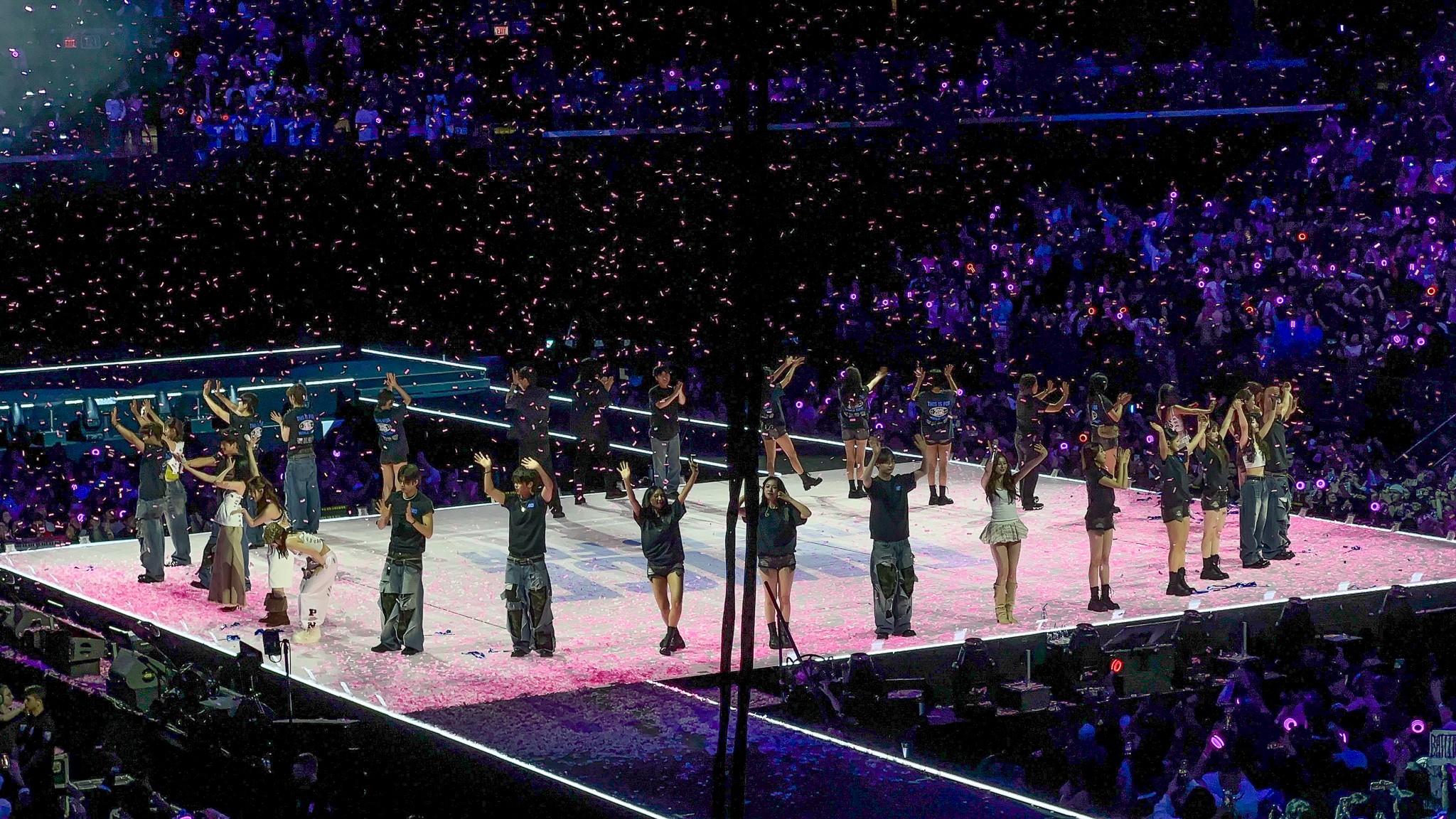
TWICE and their dancers take a final bow as confetti fills the arena, closing out the group’s first performance in Arizona. (Photo by Jasmyne Haskie, taken from the audience)
Featured (top) photo credit: JYP ENTERTAINMENT, KYLIE BRENNAN
PHOENIX — For a band whose early work has become synonymous with mid‑2000s indie‑pop nostalgia, The Format proved they’re as essential as ever during a heartfelt mid‑day performance at Crescent Ballroom.
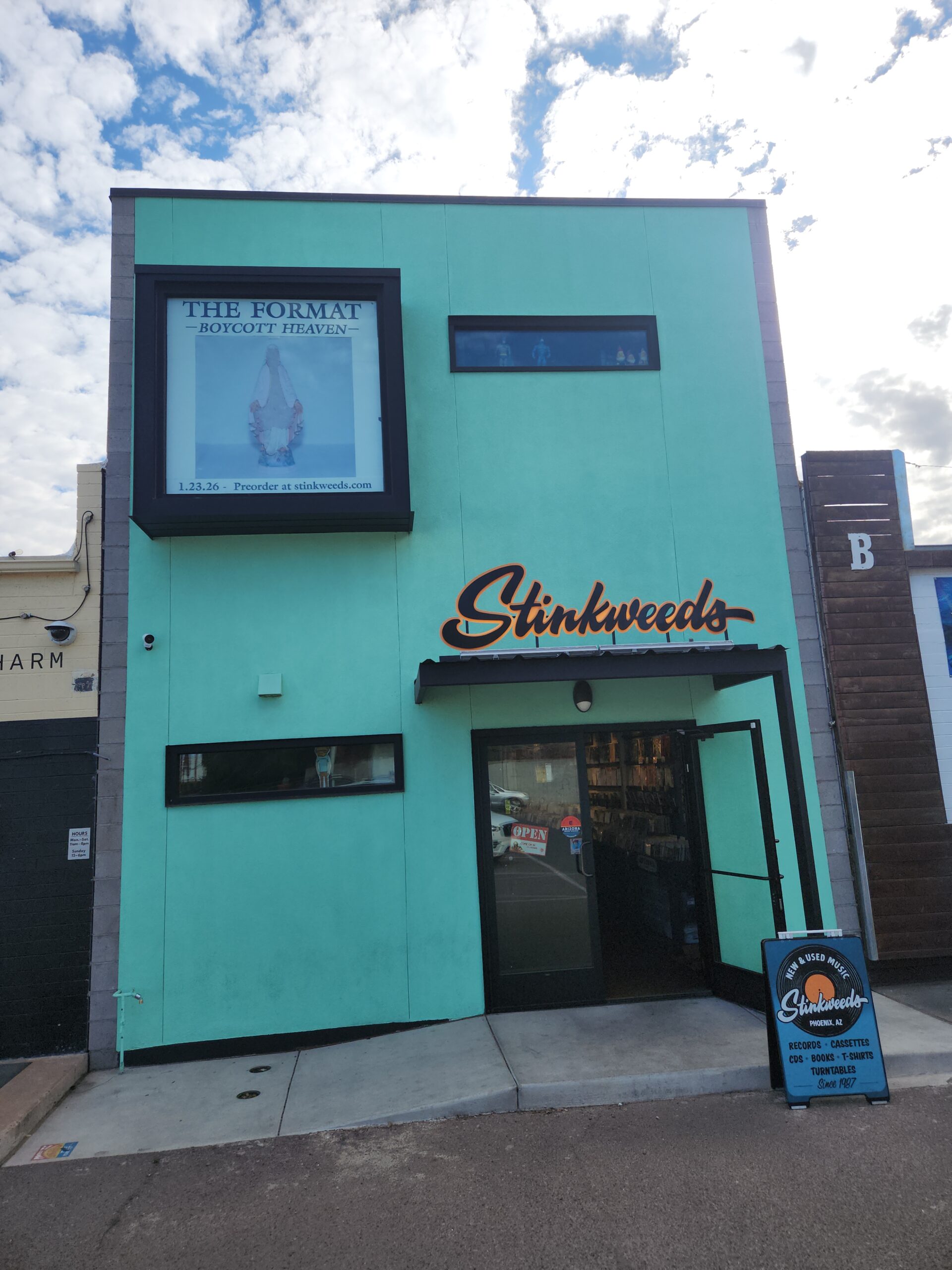
Limited to fans who pre-ordered the new album Boycott Heaven, and originally planned as an intimate “in‑store” in the parking lot of Stinkweeds Records, the show was relocated due to weather concerns. The move indoors may have averted rain that never came – but it also meant missing out on a planned surprise rooftop performance, a Beatles‑style moment that would have overlooked the Stinkweeds lot and lived in Phoenix music lore.
Stinkweeds Records, where fans who pre-ordered Boycott Heaven by The Format were originally set to see an exclusive parking lot performance.
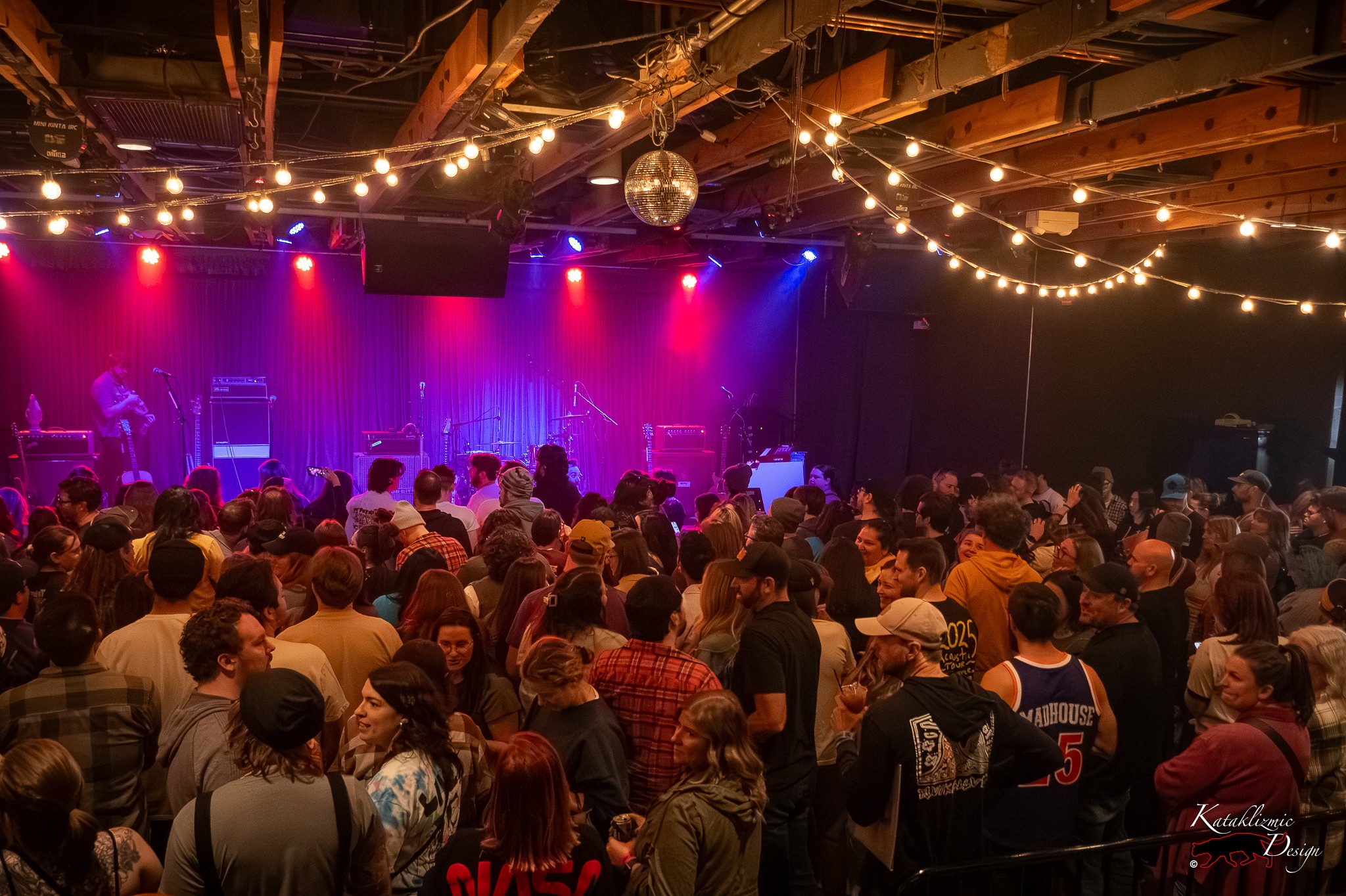
There was an unmistakable buzz in the room. With 500 fans packed into the sold‑out Crescent, the afternoon felt like a reunion of friends and kindred spirits. It marked the second of two Phoenix appearances, following an in‑store at Zia Records the day before. These homecoming events bookended the start of a limited run of shows, with additional stops planned in Long Beach, Seattle, and New York City.
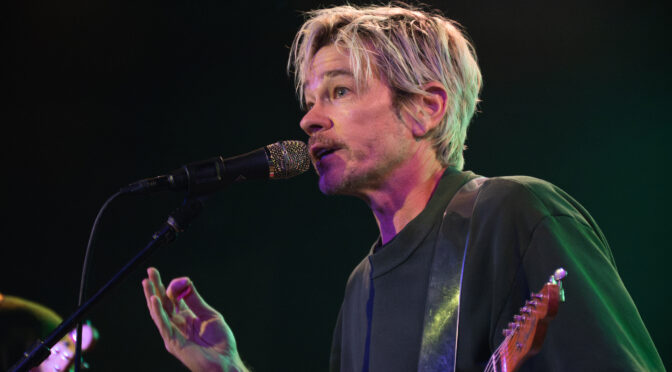
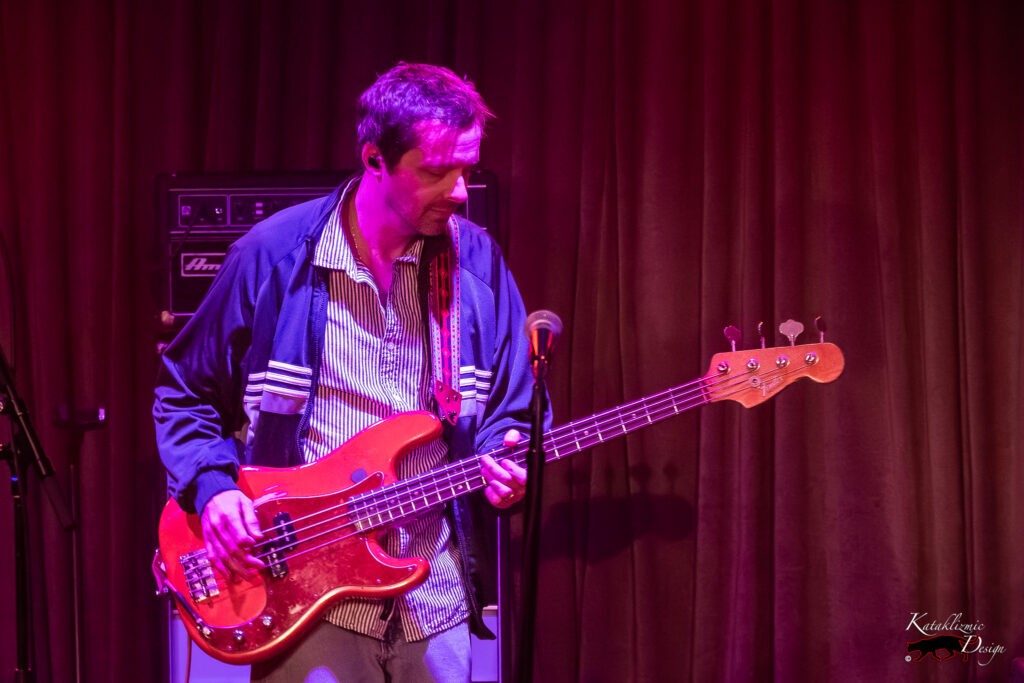
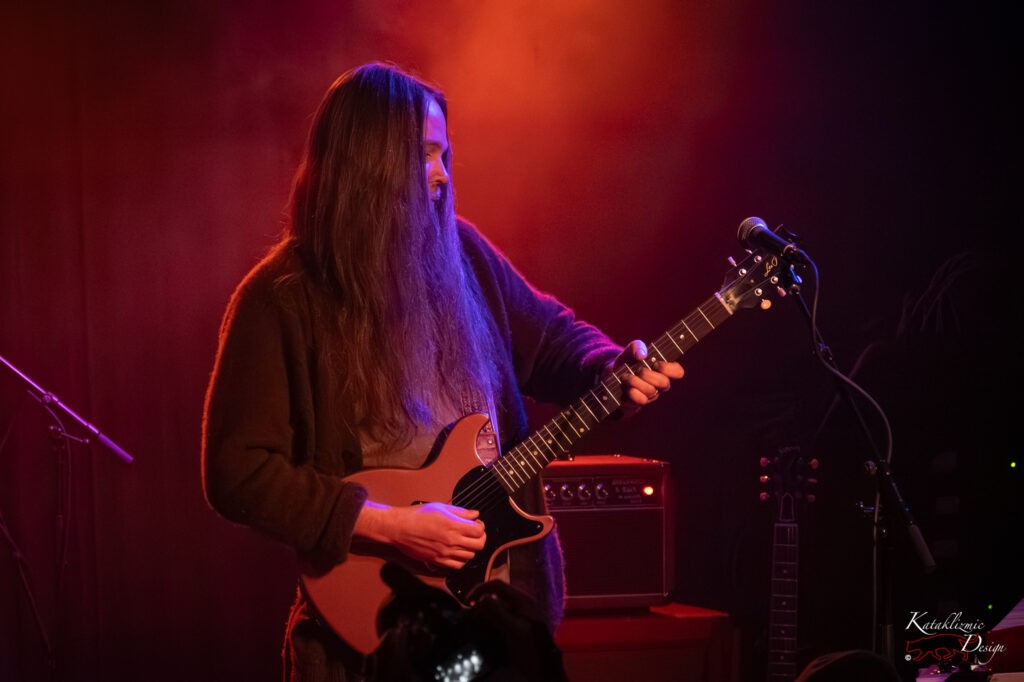
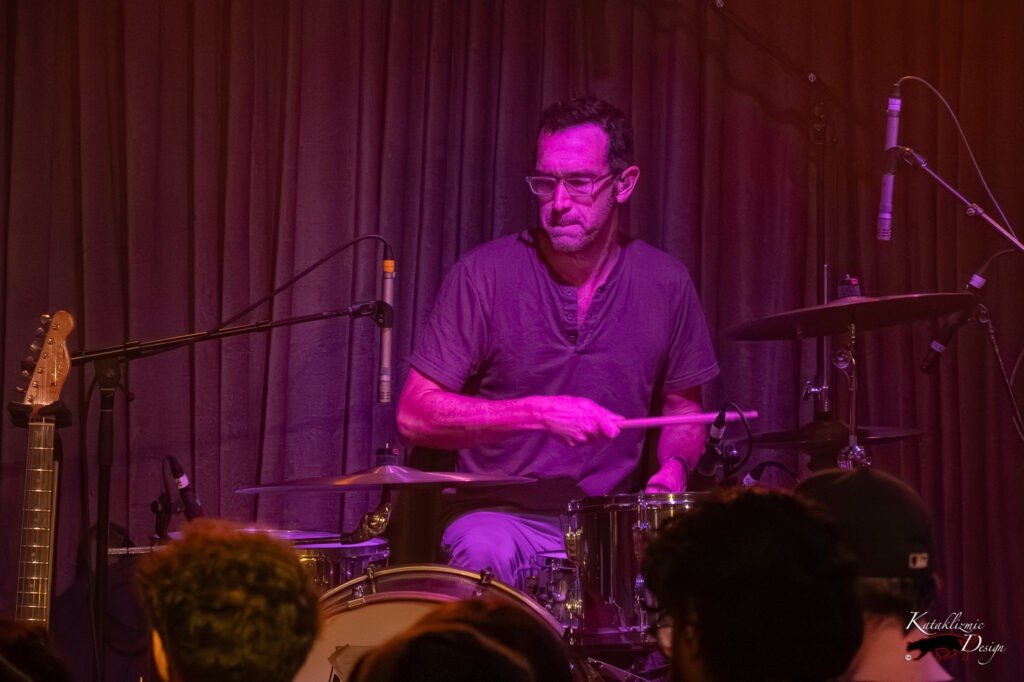
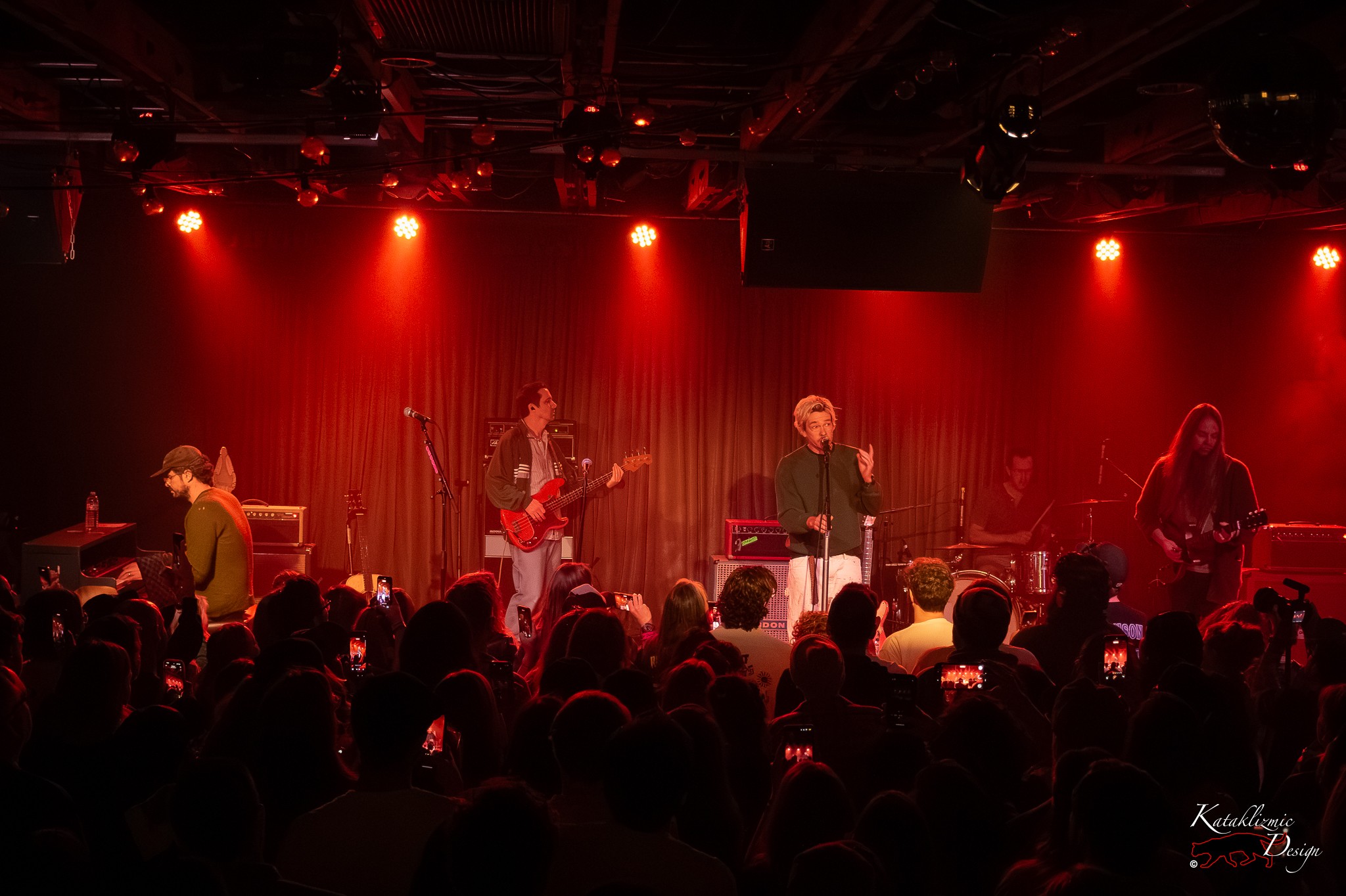
Backed by original live members Don Raymond, Jr. on bass and Marko Buzard on guitar, along with Will Noon (of Ruess’ other band, fun.) on drums, Nate Ruess and Sam Means offered a performance that was honest, uplifting, and deeply connective.
Don Raymond, Jr. (bassist)
Marko Buzard (guitarist)
Will Noon (drummer)
Their bond with the crowd ran deep, bolstered by the band’s willingness to speak directly about the times. The Format make no secret of their views – and based on the crowd’s reaction, most were right there with them.
From the moment they launched into the soaring “Back To Life,” the band leaned into tracks from their long‑awaited new album, released just the day before on January 23. The setlist flowed naturally from the upbeat “Shot In The Dark” to the candid “Depressed” and “Right Where I Belong.”
Sam Means began the first verses of the title track “Boycott Heaven,” a special moment highlighting his occasional solo vocals, before Ruess belted, “It’s a long line / And it bleeds into the pavement / Sixty-something words to save them / From this recent misery,” stirring goosebumps throughout the room.
During “Holy Roller,” the crowd softly sang along with a familiarity that seemed to call forth something rare and profound: a shared sense of energy and connection not felt in years. Since the song’s October 6, 2025 release (following its live debut at their first reunion show on September 27 at Arizona Veterans Memorial Coliseum), it has become something of an anthem – not just a song people recognize, but one people also feel deeply. The song’s message, a critique of passive faith that urges immediate action, felt all the more resonant given the times.
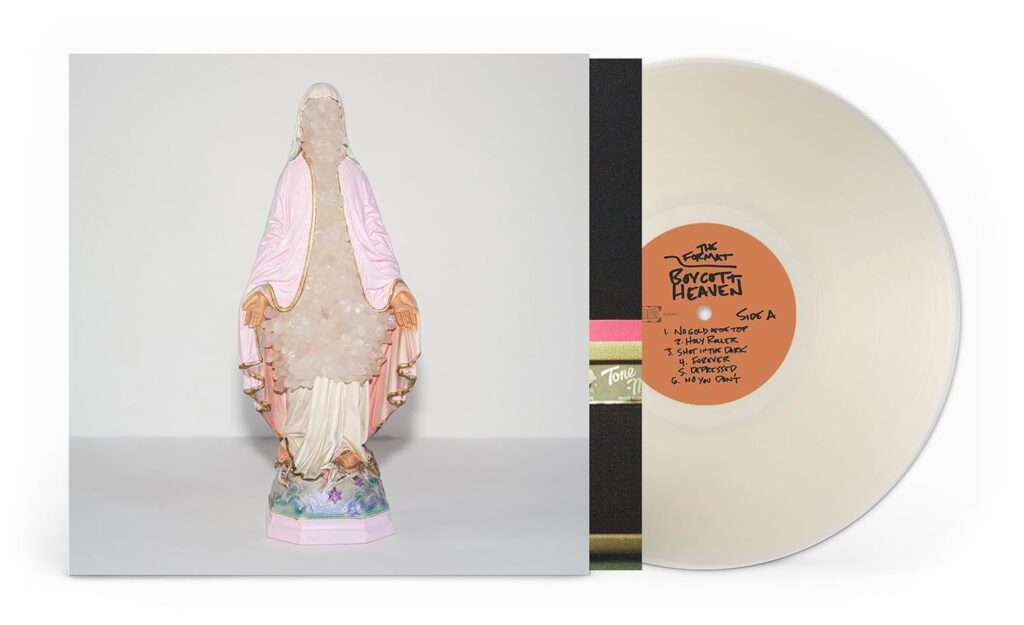
Boycott Heaven’s announcement, cover art (featuring a crystallized Virgin Mary sculpture by Australian artist Kyle Montgomery), and title stirred some controversy among religious fans. One commenter wrote, “Ugh I used to love your music. This picture of whom I’m assuming was Mary absolutely breaks my heart and infuriates me at the same time.” Another defended the band, saying, “Don’t always judge an album by its name or artwork… it could have a deeper meaning than any of you holy molys think.”
The Format have long served as a beacon for fans navigating dark times. In an era dominated by hyper‑independence and the disconnection caused by social media, their music offers something increasingly rare: community. Arizona’s local scene has been deeply impacted by the loss of figures like Stefan Pruett (Peachcake) in 2020 and Jonah Foree — known for his work in Ikonoklast, Goth Brooks, and HARDWIRE — in 2022. These were artists who brought two very different music communities together, and their absence is still felt. The return of The Format helps begin to fill that gap by re‑establishing the connective tissue that once held disparate music communities and cultures together.
Their new track “Shot In The Dark” seems to reference kintsugi – the Japanese art of repairing broken pottery with gold – with the lyric:
“Me and my friends, we used to fall apart / And piece ourselves back together like a work of art.“
Ruess addressed the pain of the current moment in a powerful monologue before the encore, referencing a police shooting that had occurred earlier this day – the fatal shooting of 37‑year‑old Minneapolis ICU nurse Alex Pretti by federal officers. Visibly emotional, he told the crowd:
“It’s amazing just being here in Arizona for the release of this album… It’s great to play shows, and you make music, and… um… usually it’s like a good time, then sometimes you realize… just, awful fucking shit is happening, everywhere.” (Ruess makes a lengthy pause.)
“But uh… they fucking shot somebody again today. And…”
“Anyways… they fucking shot somebody again and I can’t fucking take this shit anymore. I can’t take everything that’s going on in the fucking world. Nine fucking times. It’s hard to… it’s hard… it’s HARD to get up here and just have a straight face. Uh, you know… but at the same time, that’s what music is for. Sometimes it’s there to take us away from the fucking awful shit that’s fucking happening all around us.”
“We work hard, all of us, all of you work hard… you come to see a concert. Sometimes you come to get taken away from shit.”
That emotional release came in the form of the final song of the set – an unreleased track called “The Bar is Set So Low,” written a year ago but excluded from the album. The song’s somber lyrics cut deep:
“Get away, get away, get away cause the fear has gotten whole, and I’m struggling. / It’s a shame, it’s a shame, it’s a shame that the bar is set so low. / I’m caught under it.”
Despite its heaviness, the performance was filled with solidarity, especially when the crowd locked into the line:
“There is one goal. For all of our brothers, we must lighten the load.“
That sentiment reflects something Ruess recently shared in an interview with Minnesota Public Radio’s station The Current: “Our goal as human beings is to lighten the load for our brother.”
The Format deliver both clarity and comfort, unafraid to speak hard truths while giving listeners something to hold onto.
In response to the new material, one Facebook group commenter summed it up simply:
Thankfully, unlike The Beatles, this was not their final live performance together – just the beginning of something new. The Format’s return both satisfies nostalgia and reminds us what’s been missing. At Crescent Ballroom, they reawakened a feeling of joy, of belonging, of catharsis that many in the room hadn’t felt in years. And for a few unforgettable hours, it felt like we were all being pieced back together again.
Mesa, AZ — The Ikeda Theater at the Mesa Arts Center showcases the highest level of elite performers and so attracts refined audiences who appreciate talent and bask in emotional experiences. On this Sunday evening, the house was again packed and everyone was dressed to the nines to see Matteo Bocelli, a young Italian who carries the surname of vocal royalty. He has been traveling the world to showcase his own signature sound and to earn the prestige associated with the name.
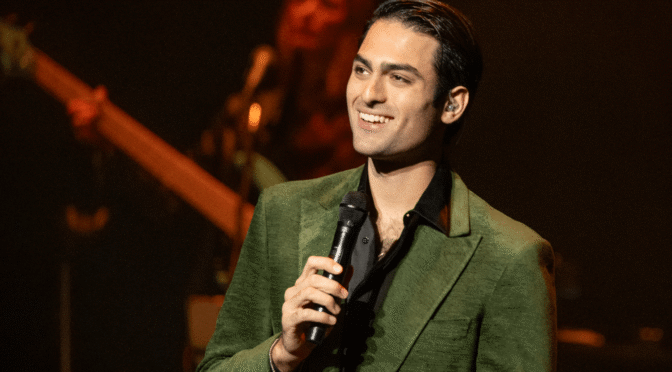
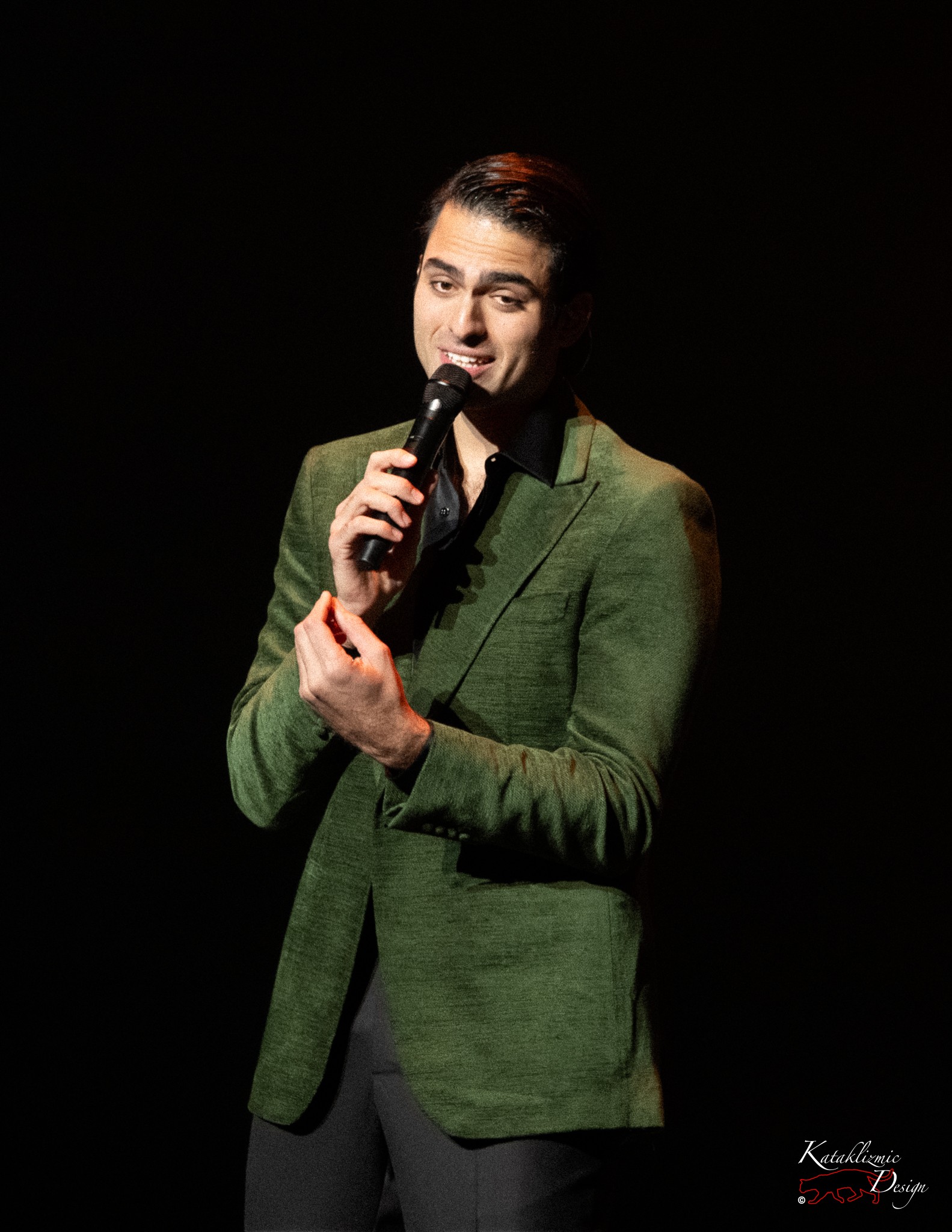
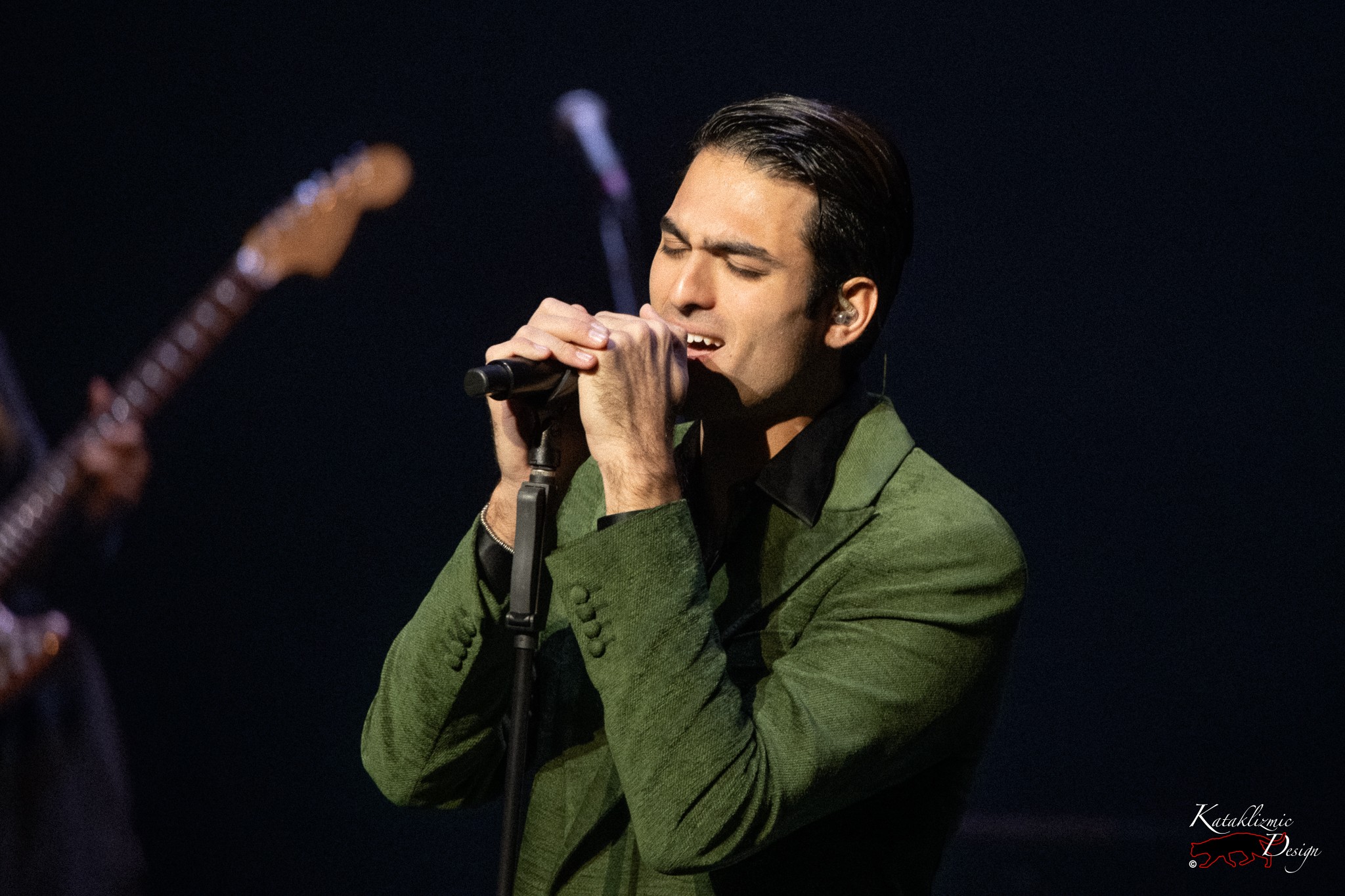
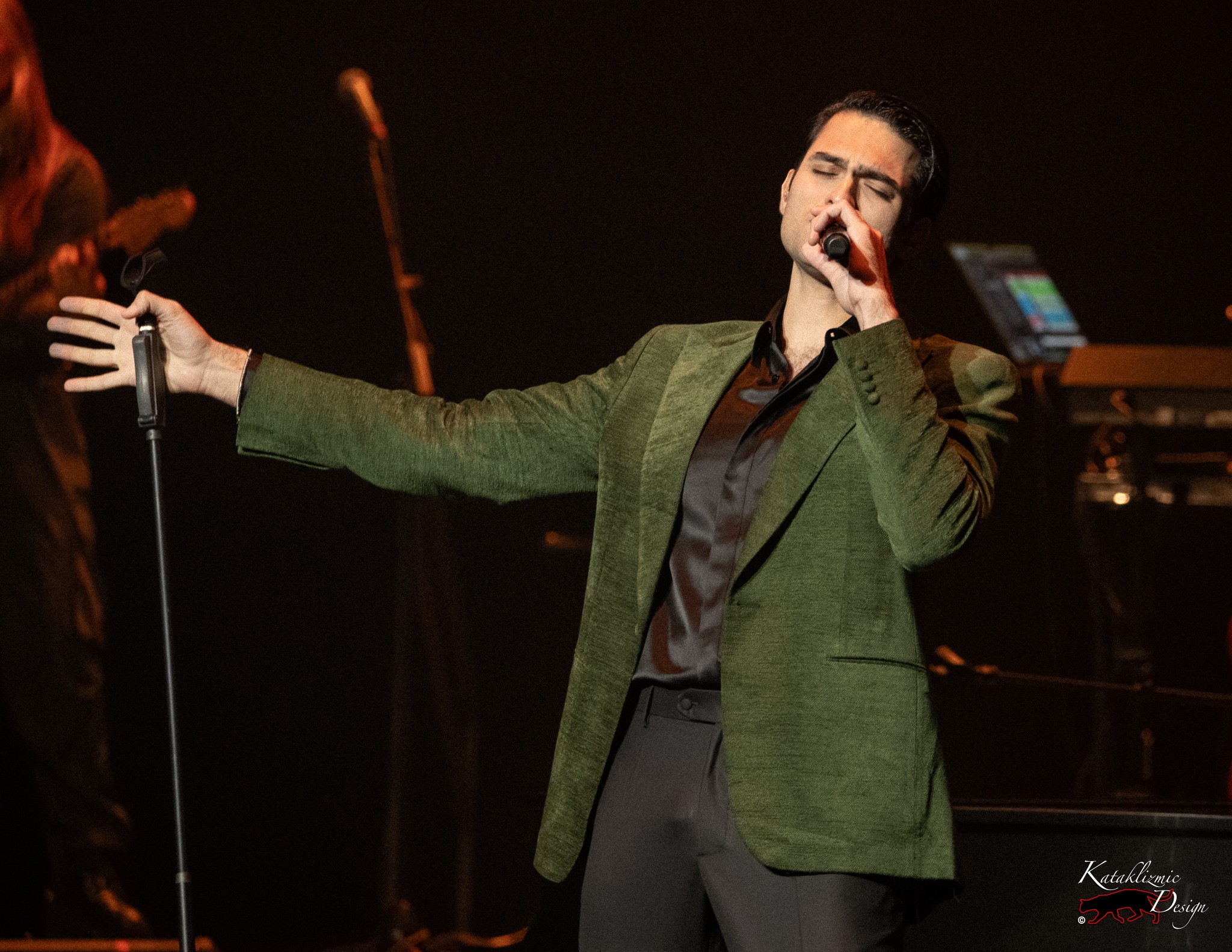
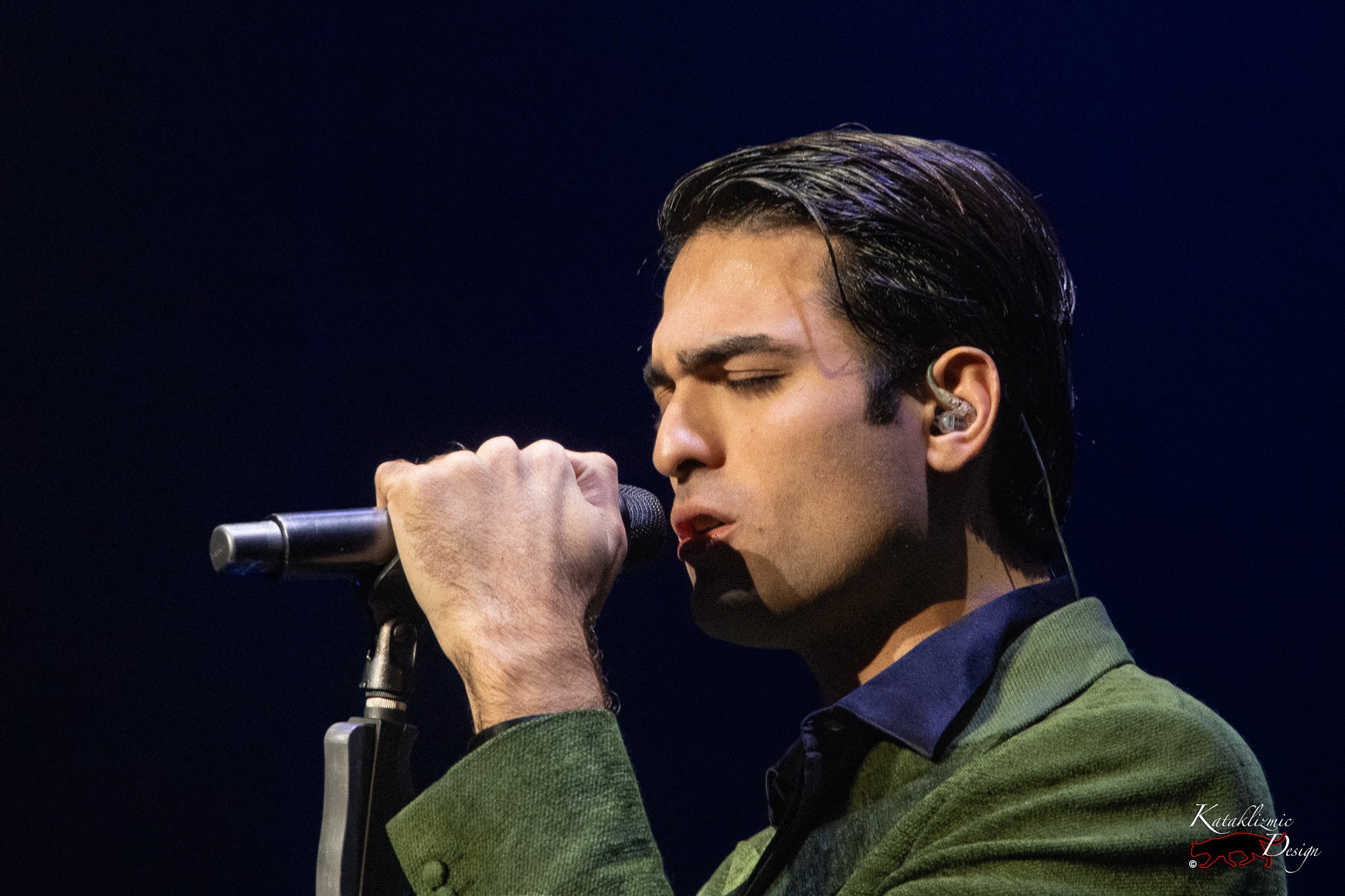
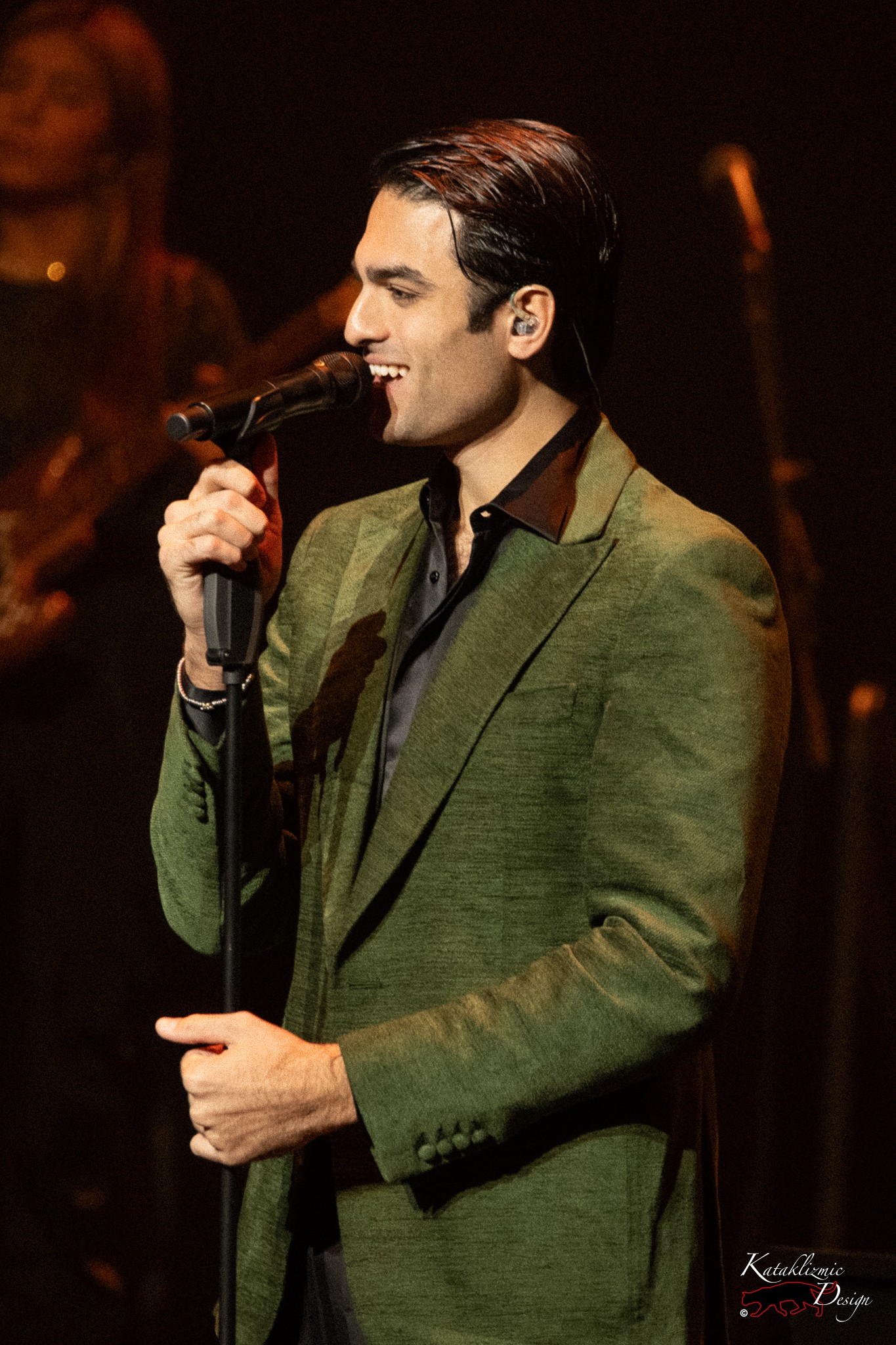
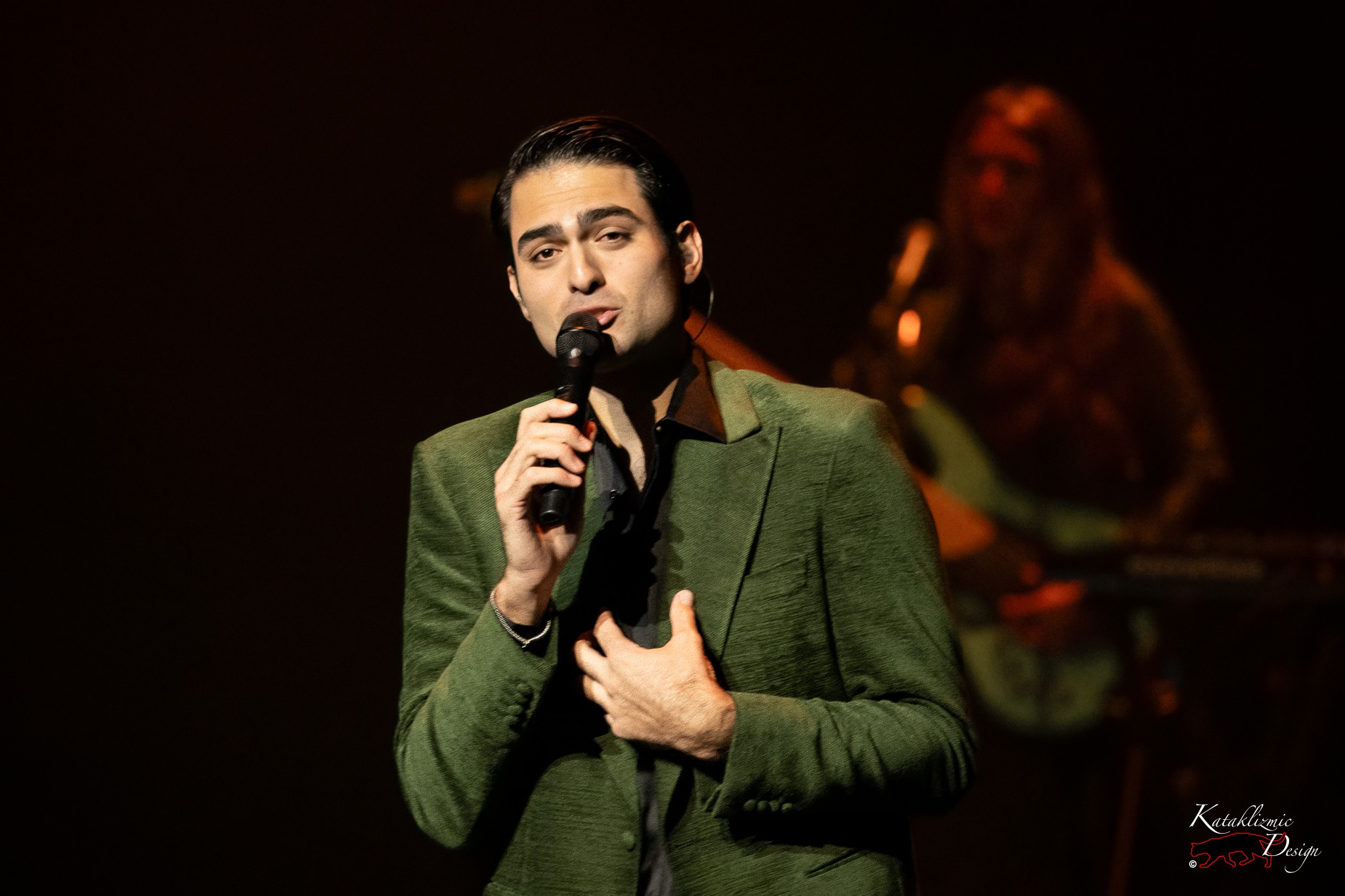
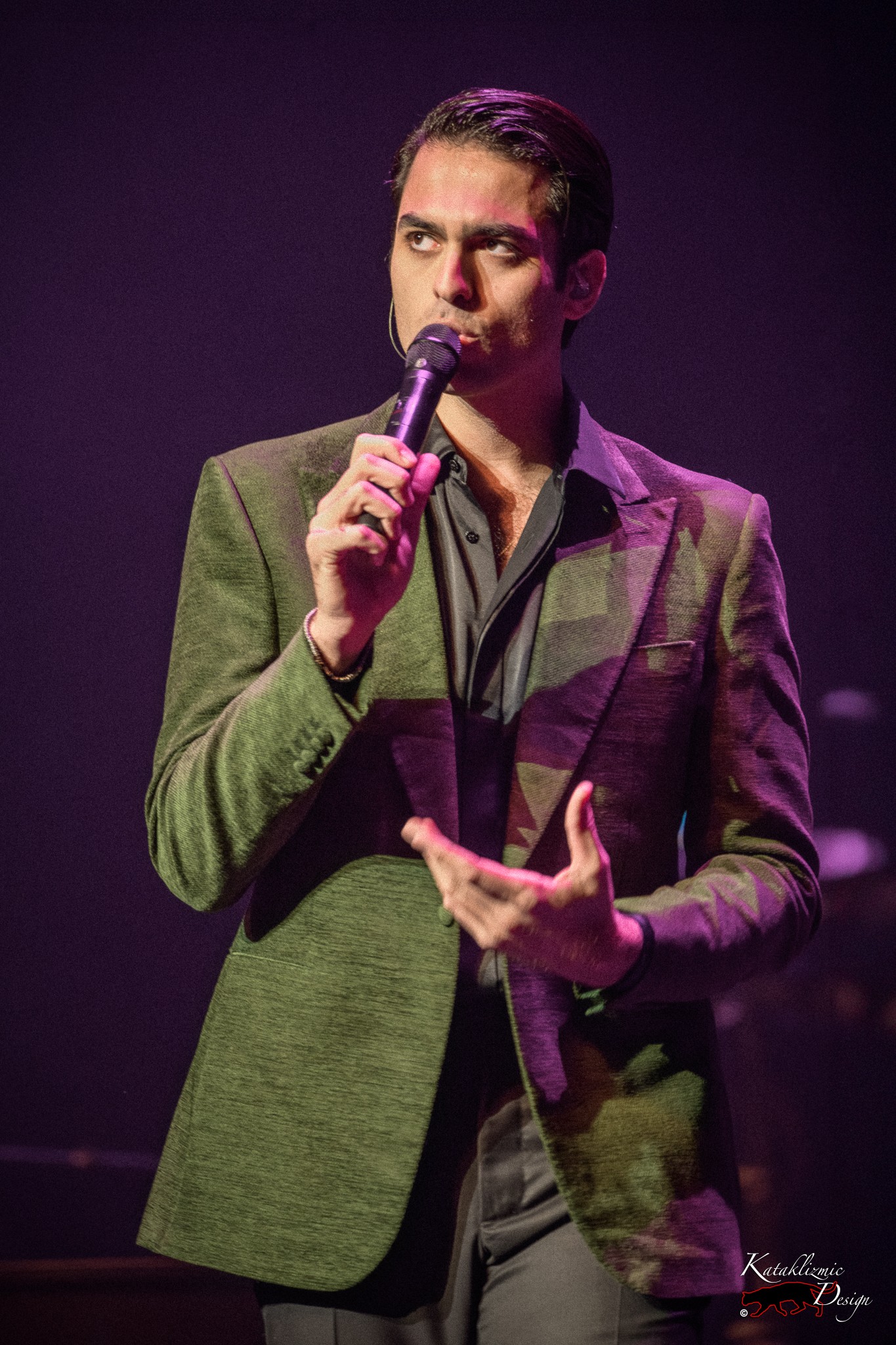
As the house lights went down, the stage lights began to twirl to a soundscape, heralding a message in multiple languages, perhaps foreshadowing the culturally diverse lyrics that would soon ensue. A spotlight landed on an unassuming man walking onto the stage with a boyish smile and a friendly wave. His ‘GQ’ hair and stylish olive green jacket gave him the appearance of the charismatic crooners of the timeless ages.
He had the demeanor of a close, personal friend who just wanted to humbly share his songs in hopes that somebody might like them. He kicked off the show with “Love Like This” and “Naïve” – two upbeat songs from his new album, Falling In Love. It’s safe to say that everybody liked them!
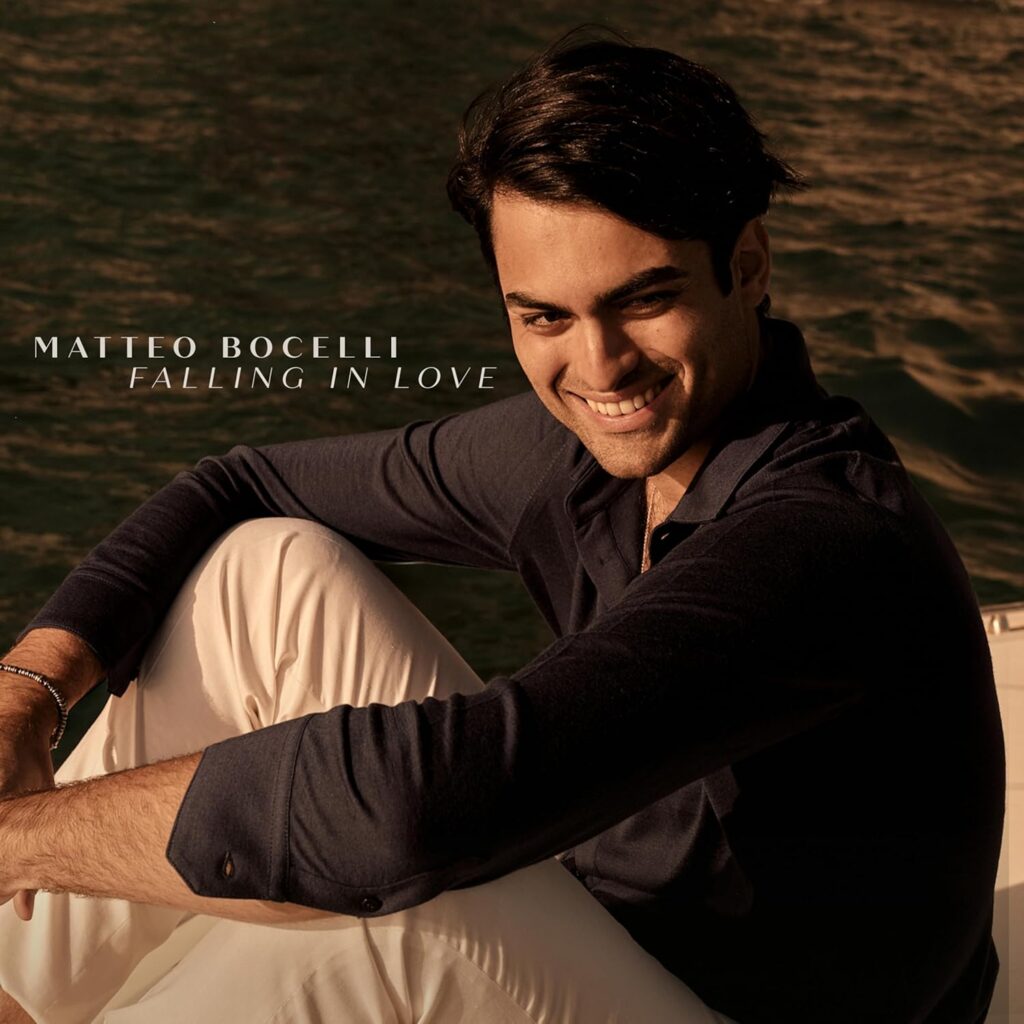
“Falling In Love” album cover
The new album was produced at Bocelli’s home in Tuscany, Italy, with producer Martin Terefe and was just released in September 2025. The album’s style is listed as “a blend of Italian heritage and modern pop,” and that does seem to sum up the song selections in his setlist, which included 10 of the 11 songs from this new album (none from his debut album, Matteo, released two years ago, although the song “Honesty” is often part of his setlist).
Most songs were in English, but several were in his native tongue of Italian. Luckily, music is the universal language that makes translation unnecessary. Every song was a story and the bilingual Bocelli would introduce each one with the back story in English for the American audience. His conversational delivery and, of course, his Italian accent commanded the attention of everyone in the audience.
“I’m so excited to be back in Arizona,” he said, “I love you guys. I love everything about this place… the weather, the temperature… coming from New York, it was pretty cold there.” This reference was to his Thanksgiving appearance three days prior at the Macy’s Thanksgiving Day Parade in New York City. There, Bocelli performed the Lucio Dalla cover of “Caruso,” which would eventually be the closing song of this show.
Some may have incorrectly assumed that he would fill the night with operatic overtures laced with vocal gymnastics at the upper reaches of human abilities. However, his superpower is not what you would expect from The Three Tenors, but instead the precision of tone, the emotional infused melodies, and the relatability of the upper echelon of the world’s pop solo artists. One could easily cite influences of Frank Sinatra, Julio Iglesias, and Elvis Presley from decades before he was even born, to the modern array of artists like Josh Groban, Michael Bublé, and Ed Sheeran.
In fact, Bocelli did a cover of Sheeran’s “Perfect Symphony” and Presley’s “I Can’t Help Falling In Love” during his set. All of this is not to say that he has limited range and power. There were moments when he channeled the vocal prowess of his tenor father and his upper range seemed to be where he found his most iconic sound. Later there were moments of soft falsetto on the other end of the spectrum. His singing evolved through each song to adapt to the array of styles, and though moments were reminiscent of his idols, he introduced his own unique blend.
The backing band was a foursome that were introduced by first name only as Andrea on guitar, Eduardo on drums, Patricia on bass, and Fabio on keyboards . For the majority of the set, Bocelli was the frontman with the band lined up on the risers behind him, but for the song “Glimpse of Happiness,” he sat down at the piano as the fifth musician. “I’ve been studying (piano) for many years, without any good results,” he joked, “But at least I enjoy it a lot.” He was humble, but very talented and delivered a beautiful song after telling the story of his collaboration on it with Jon Batiste. He would later share his guitar playing abilities too on the song “Angel In Disguise” as part of the three song encore.
The dynamics of the set ebbed and flowed with ballads and songs meant for dancing. Bocelli turned on the charm when he drifted into the audience to samba dance with adoring fans as he sang the classic Italian song “Quando, Quando, Quando.” The energy of the crowd flowed into the next song, “Tempo,” which was so fun to listen to and even more fun to watch as Bocelli tickled the ivories again and bassist Patricia and guitarist Andrea came out front to do solos. The show was devoid of unnecessary pyrotechnics and theatrical tricks of the trade, but chock full of musicianship, candidness, and connection.
The recurring theme of the evening was love. The tour was named “Falling In Love” world tour in support of the new record of the same name that included the song of the same name! A block of three of the new songs had “love” in the title… don’t let the language fool you with the first one, “Amnesia D’Amore,” a song originally written for his father, but after singing on the original demo tape, Matteo asked to keep the song for himself. This was followed by “Loving You” and then the title track, “Falling In Love.” He introduced this song:
“And now the song that gave the title to the album, and the album title is “Falling In Love.” And why this song? Because I thought that it was describing with its title… the whole meaning of the project. It’s about falling in love. I do believe that it’s important to be able to fall in love every day of your life. (pause) I’m a good boy, not in that sense (audience chuckles). But falling love for everything that surrounds us. You know you wake up in the morning and just admire the nature… and simply your love with it… and it makes you happy and it makes you feel fulfilled.”
The handful of cover songs that were mixed in seemed to perfectly complement the character of his originals and of course highlighted his versatility. He introduced “Mi Historia Entre Tus Dedos” as a duet that he recorded with Gianluca Grignani, who had huge success with it in 1994 in Italy (note that Bocelli would not be born until 1997) and then the whole Latin market. He said, “It probably didn’t reach the US, but there’s always a first time.” This one had the audience singing along. “Anime Imperfette” is another song that may not be on either of Bocelli’s albums, but it’s not really a cover. It is the Italian song that he sang for the Netflix series “From Scratch” that appears on the series soundtrack. This song was preceded by an epic synth solo by Fabio.
The Ed Sheeran cover of “Perfect Symphony” was definitely a highlight. Sheeran contacted Andrea Bocelli to do a duet of the song with him. Matteo recalled, “So one day Ed Sheeran called my father…I wish he had called me, but… (audience laughs)I had some good pasta with him still.” In the video, Sheeran sings the first half in English and Andrea belts out the response in Italian before they harmonize at the end. Matteo and his father have since sung the song together, but this time he was on his own and he brought the house down when he switched to Italian to sing his father’s part.
He performed “Fall On Me,” the duet he originally recorded with his father for Andrea’s 2018 album Si. Matteo shared the story of how this song was really how he got started. He had sung on the demo for this song and it was pitched to the team who was looking for original songs for Andrea’s upcoming album. “So I made the demo,” he said, “And the first two people to listen to it were the president of the label and the producer they were working with, Bob Ezrin. And he goes, ‘you know I love this song, I think it should be on the record, but I also love this guy, but it is not Andrea’ – it was me.” And it came to be their duet. This night it was his song and it brought a standing ovation.
The three-song encore consisted of two more songs from the new album: “Angel In Disguise” on which he played acoustic guitar, and “If I Can’t Have You,” that featured an astounding rock guitar solo by Andrea while Bocelli played piano.
Before the last song, Bocelli told the story of how David Foster discovered him and wanted to produce him, but his father wasn’t on board since he was too young and needed to stay in school. As time went by, Foster still found opportunities to put Bocelli on world stages such as his 75th birthday celebration at the Hollywood Bowl and the American ICON Awards where they chose to cover the Lucio Dalla song “Caruso.” It has become a personal favorite for Bocelli and he closes each show with this song. He finally recorded his own version of this song and it is appropriately the closing track on Falling In Love. As he held the last note of this passionate song the room erupted with applause that continued through the final bow. He left center stage with a huge smile on his face, giving a final wave and glance to everyone.
As much as it meant for this audience to receive the gift of his musical talents, it truly seemed that it meant even more to him to share them.
PHOENIX — Purity Ring’s fall 2025 “place of my own” tour came to The Van Buren, with yuniVERSE as the sole opener on her first tour. The beautifully historic, repurposed downtown venue set the stage for an evening the band had described in their July Substack tour announcement as “three-dimensional… expansive but intimate,” and the night delivered as promised.
yuniVERSE
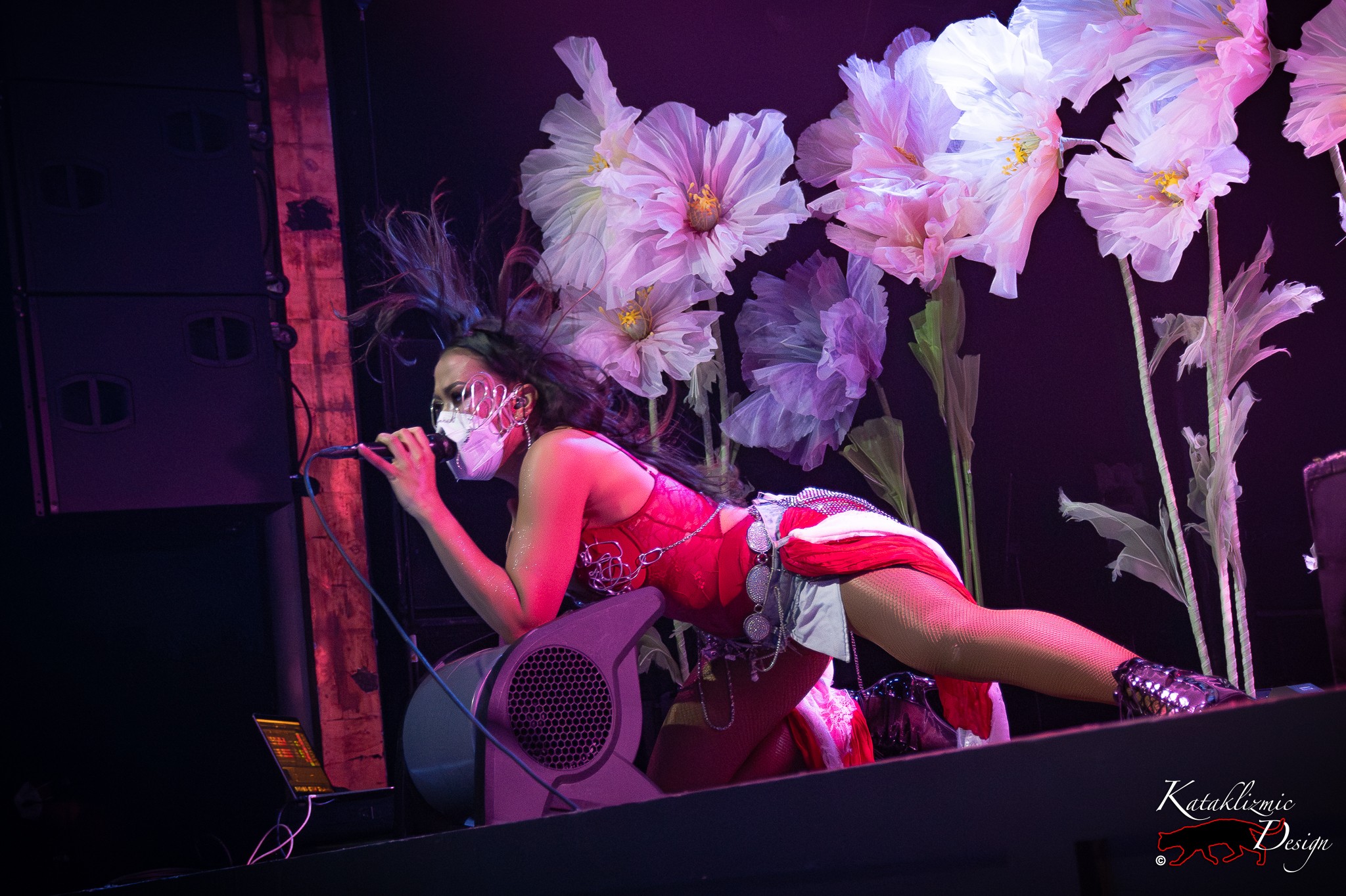
The venue’s stage at first was strange to look at, one half covered in human-sized flowers and the other looking like metal stars or fans. I waited in the rapidly filling room with no idea of what to expect. When the lights faded, people abandoned the bars and the winding merch line spilling into the main room as the attention turned to a new performer on her first tour, yuniVERSE.
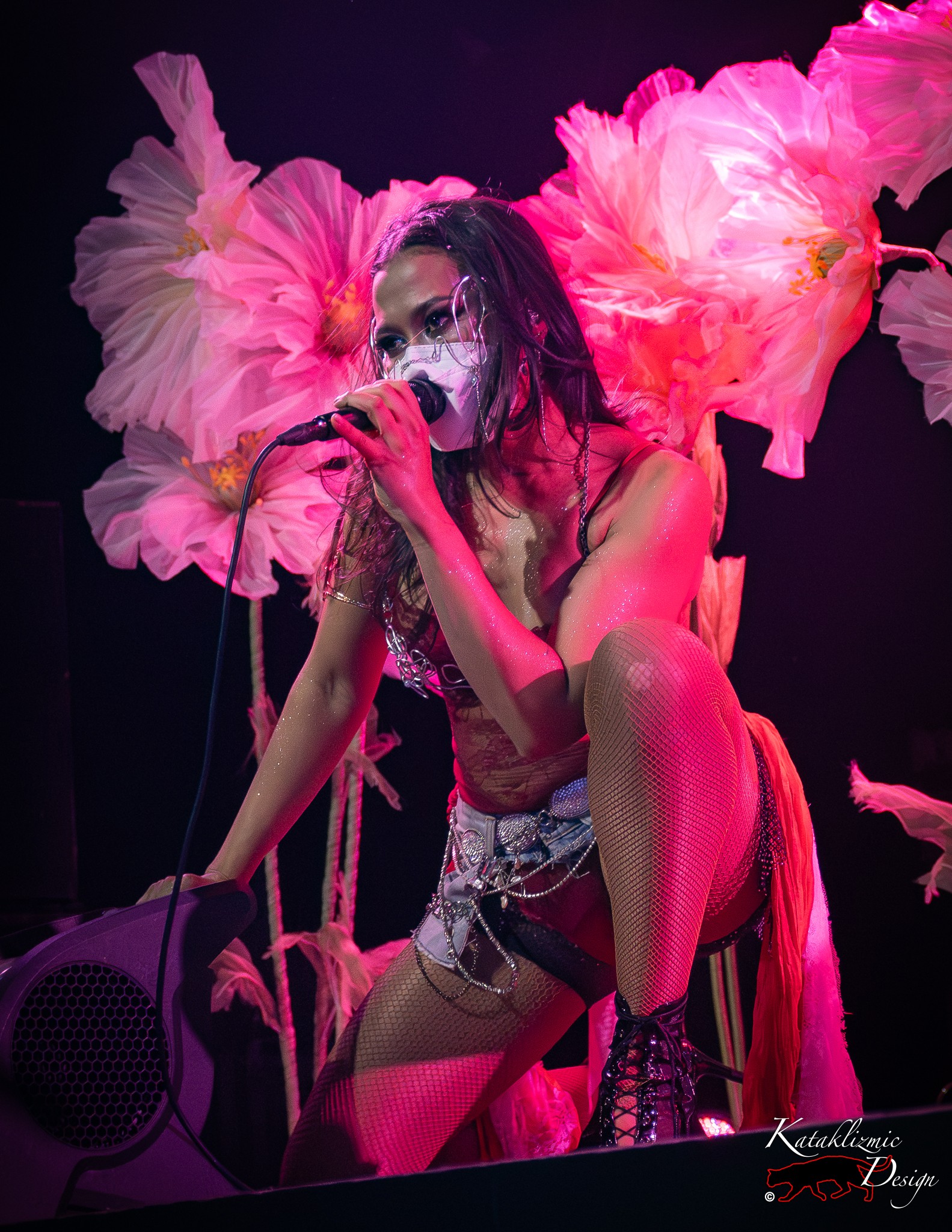
Even though she only used a portion of the stage, she invited us into the jewel-lit garden of her design, where she shared her intimate confessions through emotive electric pop. yuniVERSE weaves through each song like a layer within a dream, her hair gently blowing as she captivates the audience with her presence and movements. Her performance feels like a journey into her private world as she navigates through love and life. She continued to captivate the room completely, her sensual, charismatic movements paired with the softness of her vocals as she sang behind the mask she wore in unity with Purity Ring’s request for community care.
yuniVERSE said she wished this tour were longer because she wasn’t ready for it to end yet, and I can imagine I’m not the only one who felt the same. She playfully joked, “I know you’re here for Purity Ring, but together, we’ll keep it a secret that you’re actually here for me, okay?” giving a little laugh before closing out her set and leaving the stage for the headliner, Purity Ring.
Purity Ring
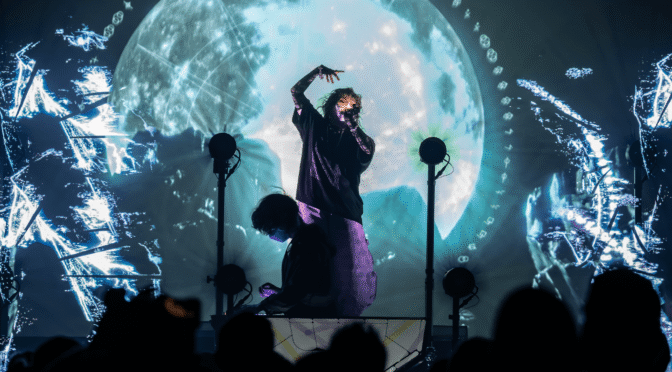
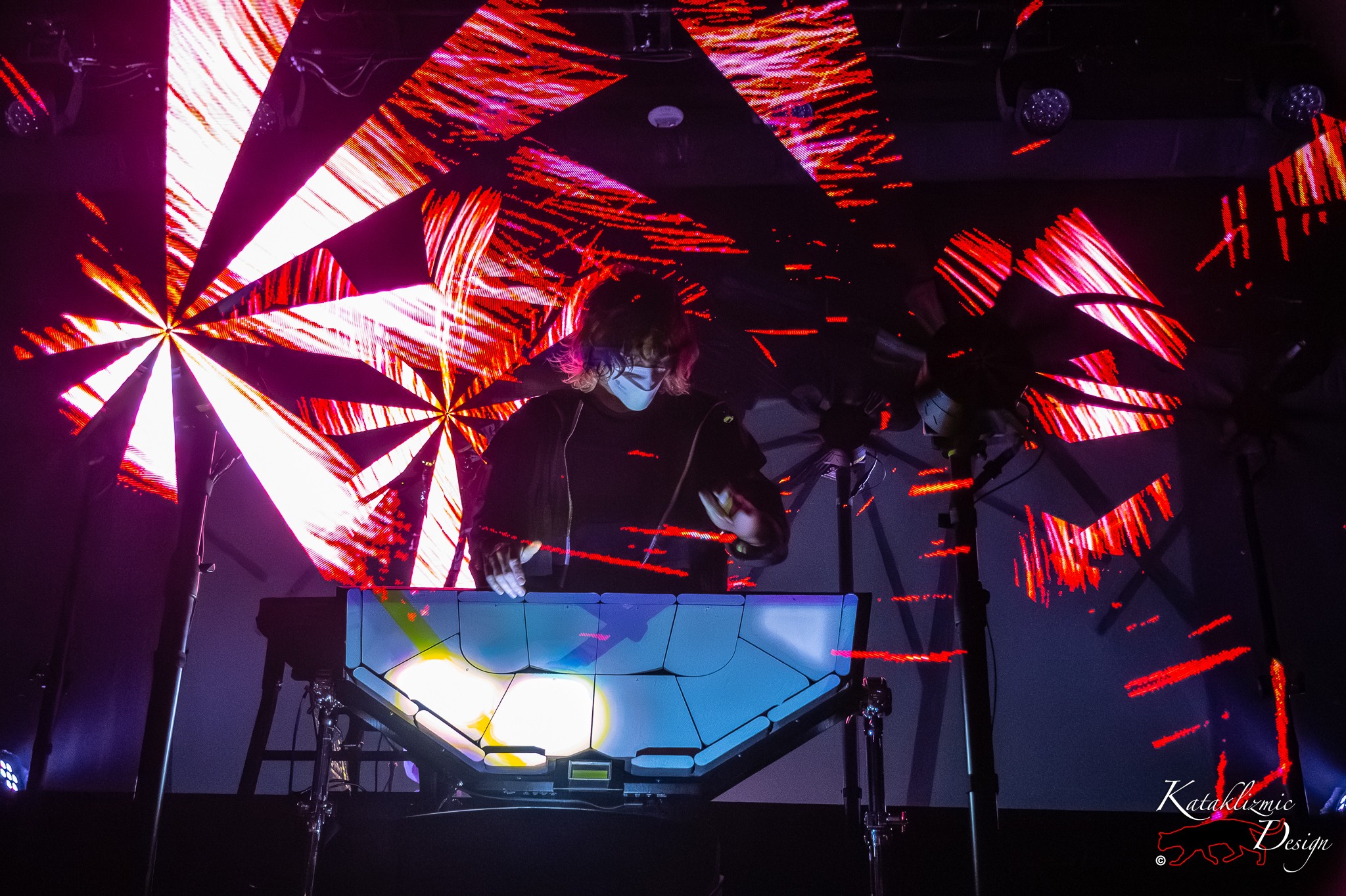
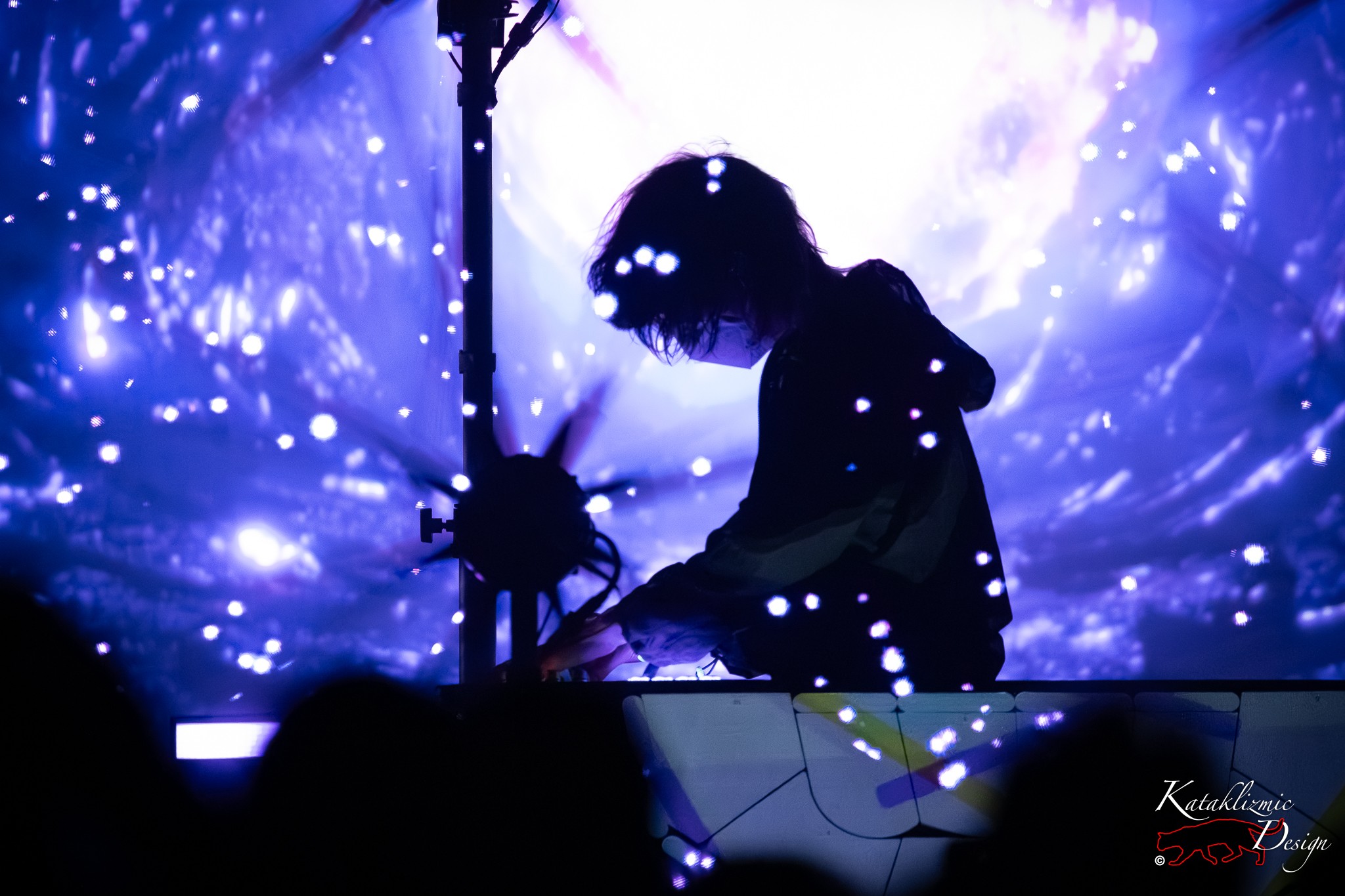
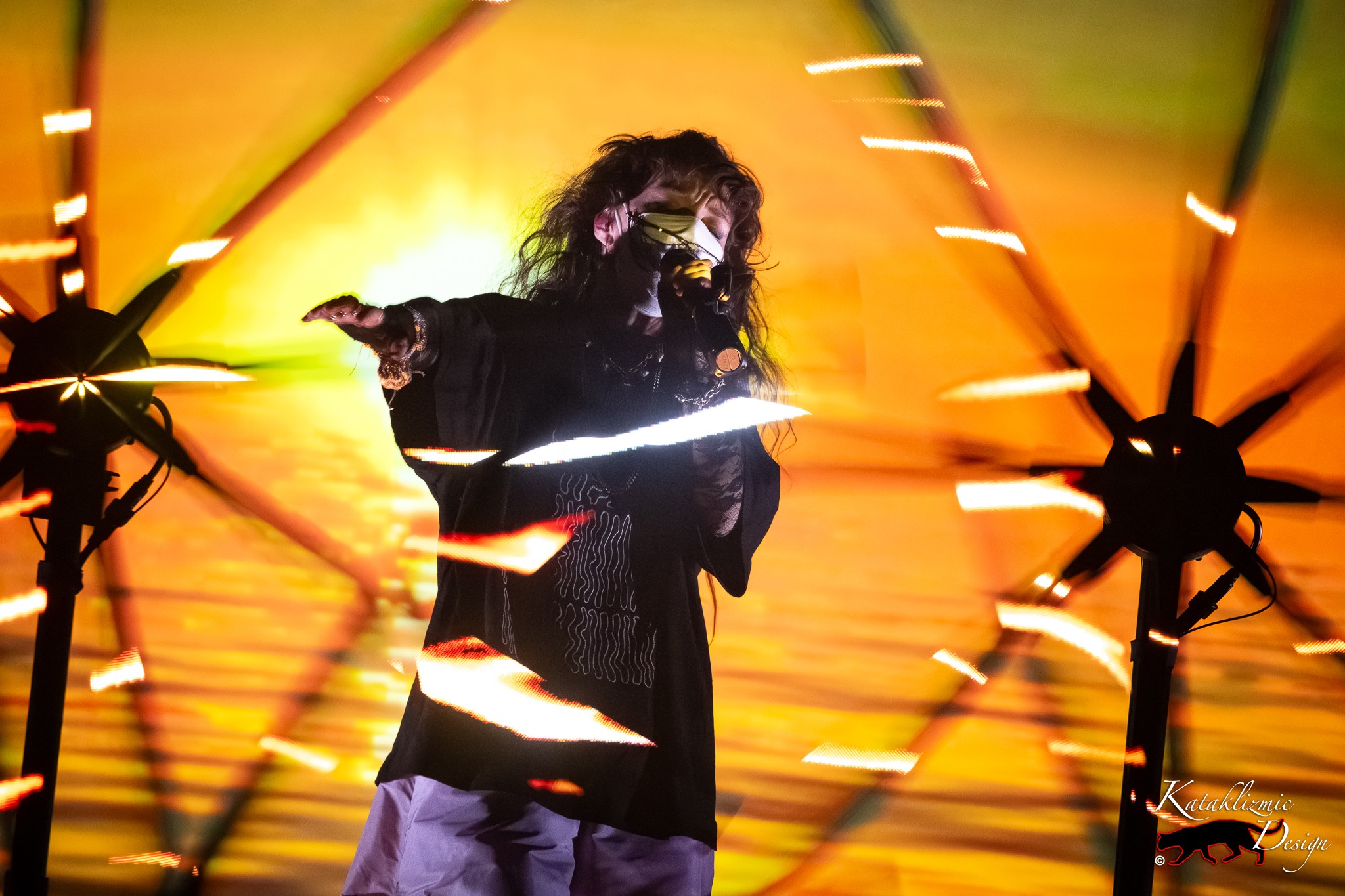
The room settled as the stage shifted from yuniVERSE’s dreamlike garden into the darker, more mysterious world crafted by Purity Ring. Corin Roddick stood alone at first, lighting up sections of the stage with his touch while the star-shaped fans began to spin, projecting red light that looked like sparks spraying across the dark.
During “Many Lives,” the lights flickered and danced like floating embers. “Obedear” pulled us into caverns and stars, with what looked like fireflies curling upward like smoke. “Soshy” arrived with bright, breathy vocals and pounding bass, blue lights sparkling before shifting into sharp red flashes deeper into the song.
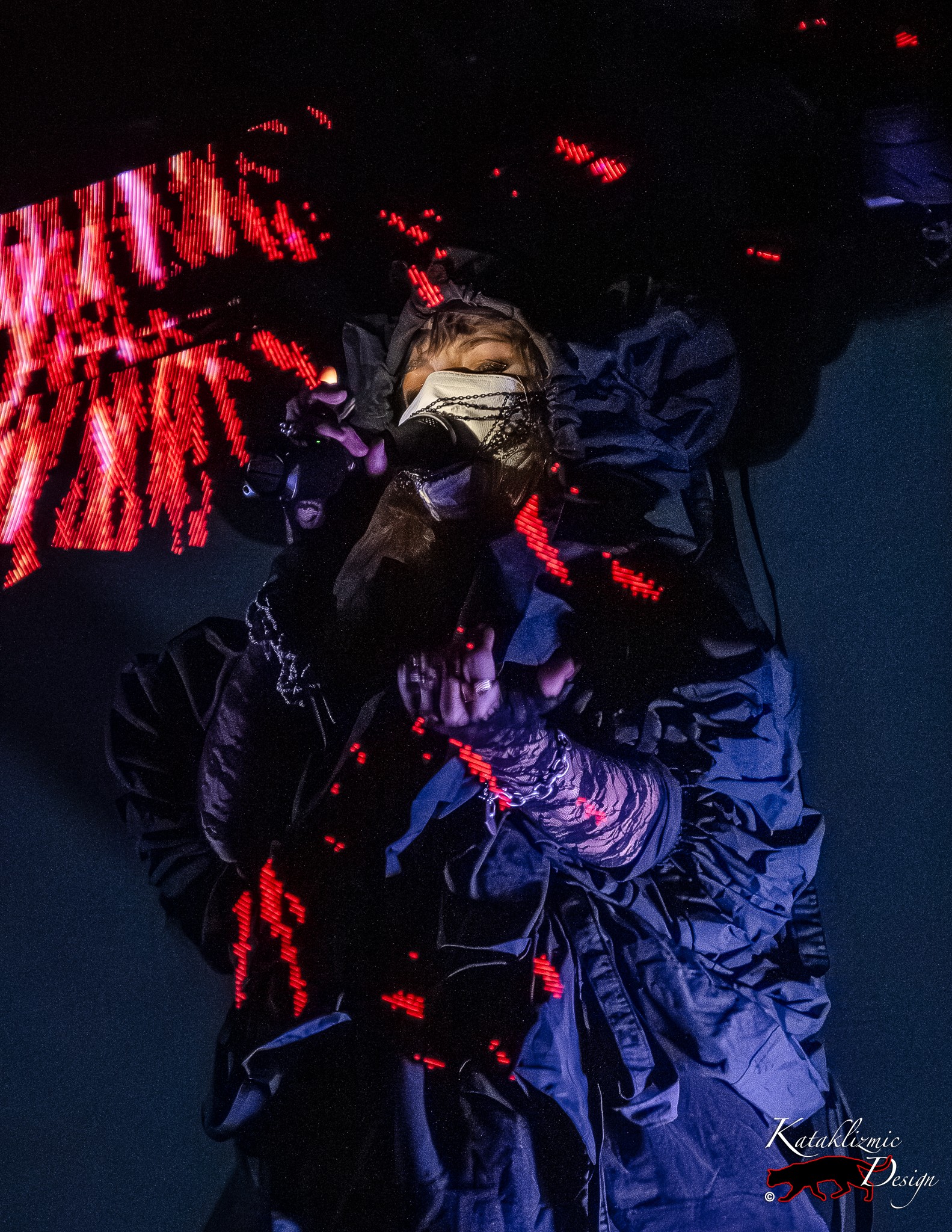
James took a moment to thank the people in the crowd who wore the masks the band provided for everyone’s health. She appreciated the contribution to community care and valued taking care of each other. As she gushed while thanking yuniVERSE, she admitted she was rambling before continuing the set. It was clear the two acts genuinely appreciated their time together. This became even more apparent after noticing Roddick’s contributions to at least three of yuniVERSE’s tracks (“FALL 4 U,” “18 nite texts,” and “wasted”).
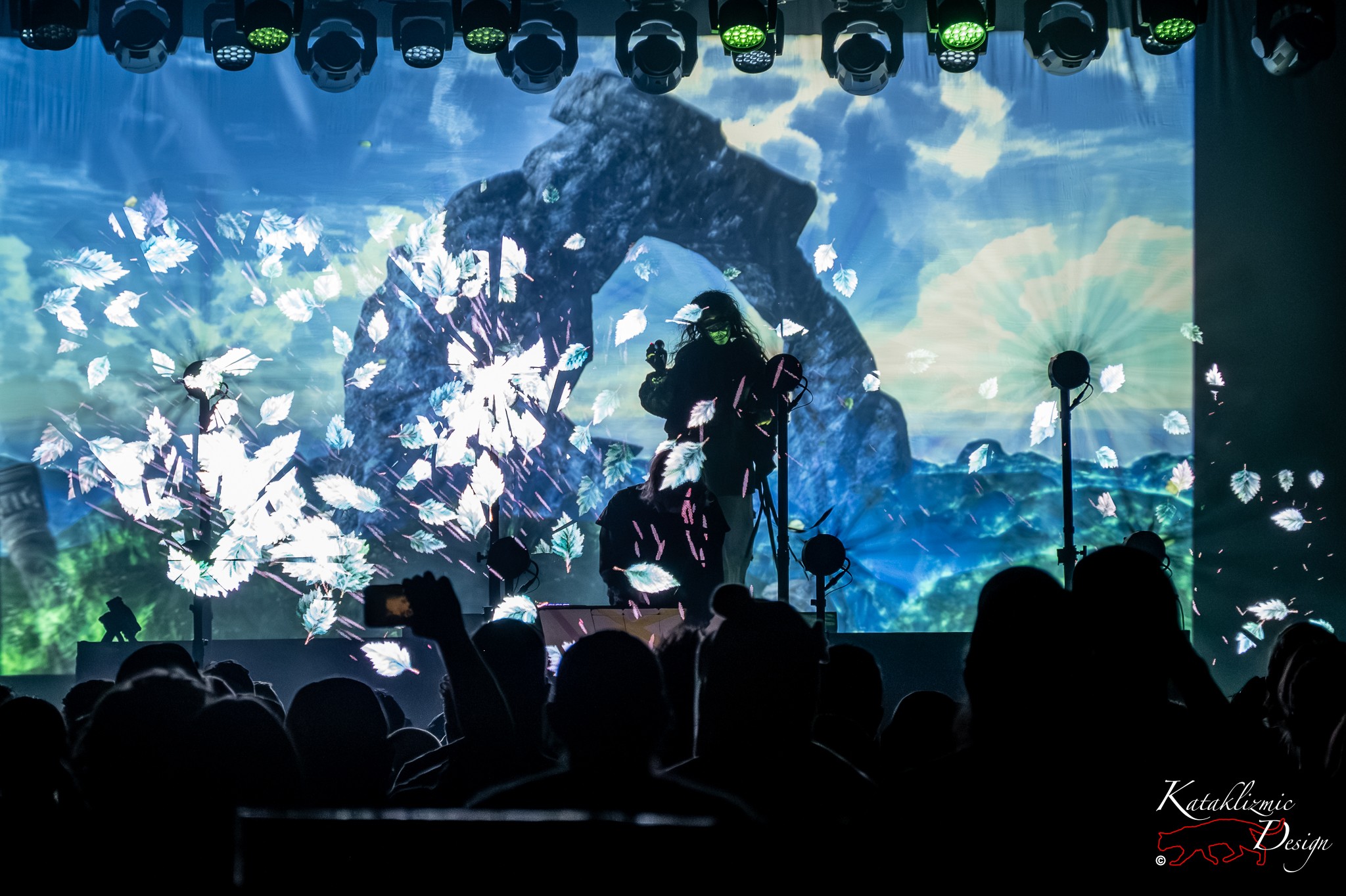
Our journey resumed as holographic leaves of blue, green, and red light appeared and danced around the stage, swirling toward the crowd as the room stayed completely locked in the performance.
The final song, “Begin Again,” brought everything together. Galaxy patterns pulsed behind the band, and the twinkling vocals reached out with swirls of light bursting like magic. The fans met the band’s energy as they sang along during the quiet pauses. As we traveled back to reality with this song, and as the band thanked Phoenix to end the night, cheers of fanfare erupted and filled the room with adoration as we exited the enchanted world of Purity Ring.
I want to tell you a story. A story about how one image—one bold, provocative, controversial cover—became a lightning rod not just for Sabrina Carpenter, but for how we police women’s voices, feelings, and interpretations. It’s not just about me. It’s about how any survivor, any person with trauma, any person with nuance is expected to choose one read and shut up.
This is not a Sabrina Carpenter takedown, nor is it a total seal of approval. I enjoy her music and her style. What fascinates me about her Man’s Best Friend album cover is how it sparks opposite reactions: empowerment for some, discomfort for others, and in my case, a social media pile-on that revealed just how unwilling people are to hold multiple interpretations at once.
Keep reading. This might not go the direction you expect.
The Image, the Reaction, the Rules of the Game
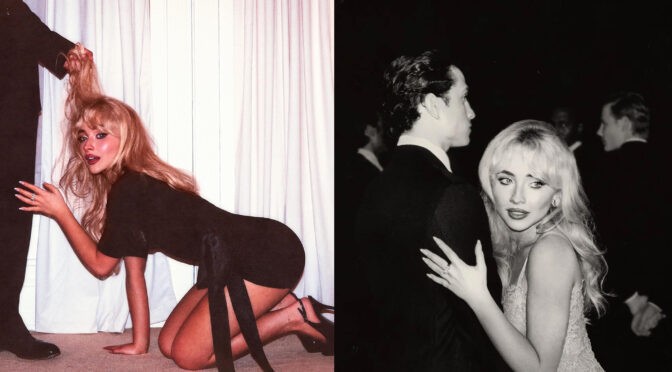
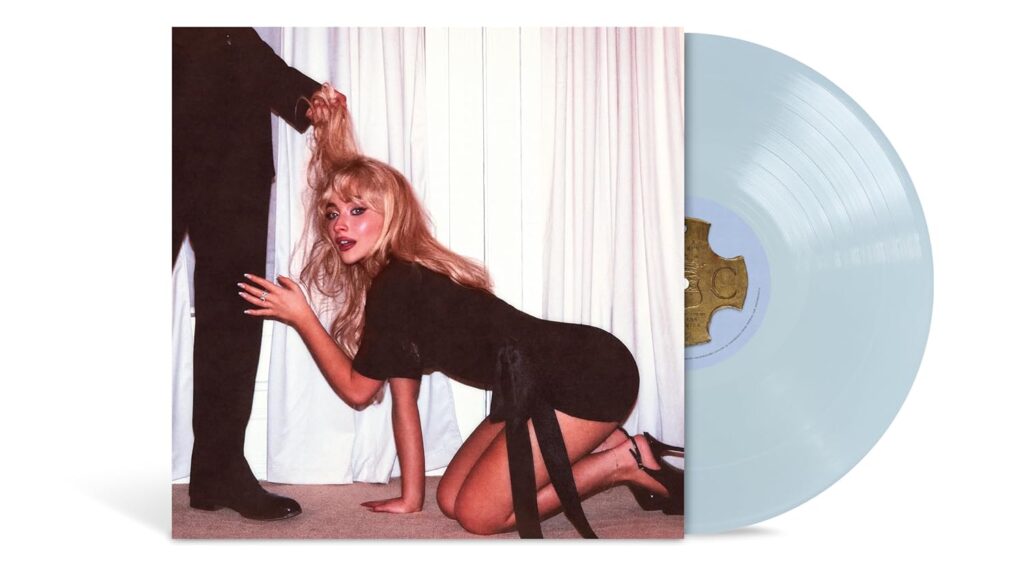
It began with the album cover itself: Carpenter on all fours in a black mini dress, a suited man off-frame dragging a fistful of the ends of her blond hair. That cover didn’t just hint at submission or objectification, it leaned into tropes of pet-like posturing, dominance, hair-pulling, and control.
The vinyl release of Sabrina Carpenter’s “Man’s Best Friend” features the now-infamous cover that sparked heated debate – a provocative image that some call empowering, others regressive, and many still unresolved.
It is a powerful visual that asks: Who is doing the looking, and who is being looked at?
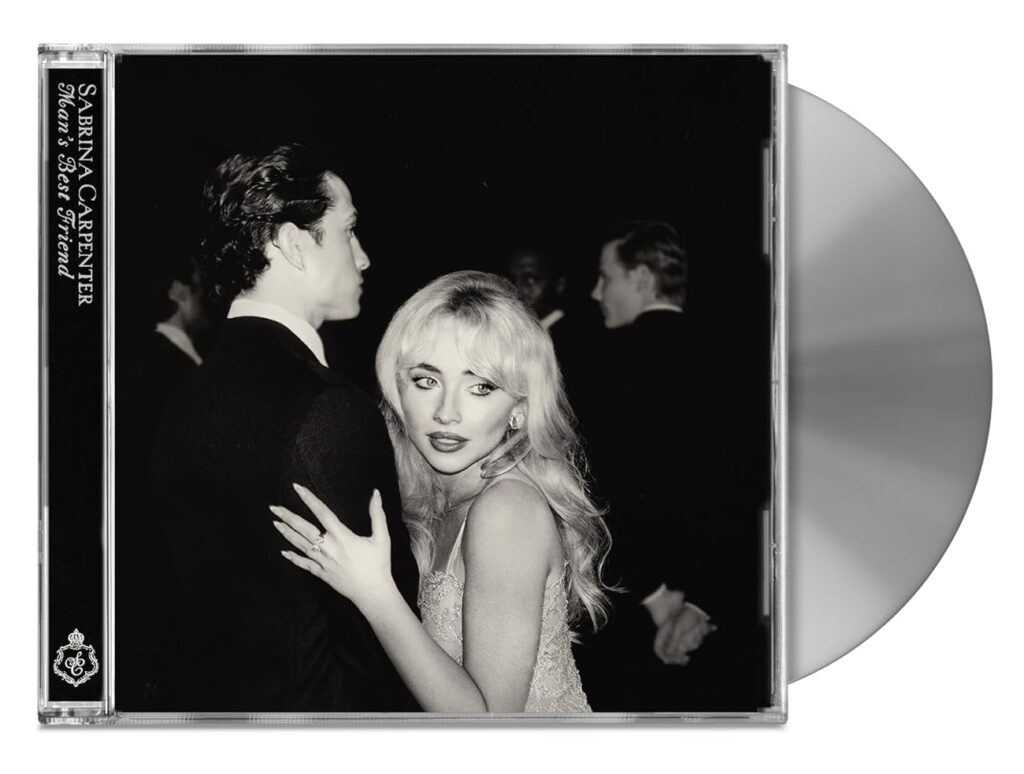
The alternate “God-approved” cover of Sabrina Carpenter’s “Man’s Best Friend” CD edition, offering a starkly different, almost angelic visual to contrast the original artwork.
Some defended it as satire, irony, or shock value. Others saw it as regressive. Glasgow Women’s Aid even called it “pandering to the male gaze” and “regressive,” citing its element of control and violence. Carpenter later released alternate covers calling one “approved by God,” which signals that she was already aware of, and leaning into, the controversy.
The alternate “God-approved” cover of Sabrina Carpenter’s “Man’s Best Friend” CD edition, offering a starkly different, almost angelic visual to contrast the original artwork.
From the start, it is not obvious which side she’s on. But that ambiguity is part of the power.
A few weeks later, she brought Drag Race queens and trans rights signs to her MTV VMA performance. One commenter summed up the dissonance: “Making up for that tone-deaf album cover?” And it was not an outlier opinion.
The firestorm didn’t begin in a vacuum. It started with a social media post of Sabrina Carpenter’s Man’s Best Friend album cover.
In the comments, someone wrote:
“Women: Stop viewing us as sexual objects. Also women: ”
That’s where I entered the thread with a classic “me” response. I said:
“Just because some women have internalized misogyny doesn’t mean they all do or [that it] makes it okay. I look at this photo and I see domestic violence, and it’s disturbing.”
When I first saw it, the image brought domestic abuse to mind, not because I believe kink = abuse, but because the stylistic choices and framing can trigger that impression.
After one woman commented that they see two consenting adults, I replied, “It certainly can be, but my opinion is that it looks different from that. I’m certainly not opposed to kink (he really should be grabbing her hair by the roots). And [I’ve] experienced domestic violence and seen it in many others, [and] the style of this visual triggers that impression.”
I’m not a prude or against kink or BDSM when it’s practiced ethically and consensually. As seen above, I offered advice that (if the intent is role play rather than harm) hair should be pulled closer to the root, to avoid the non-pleasureful sort of pain (unless you’re into that kind of thing… I won’t kink shame). My point was never to condemn sexuality, but to share one possible reading of the picture. But these days, especially on social media, it seems people are always looking for a fight, and nuance is a blood sport.
Rather than a debate, what followed was a pile-on of ad hominem attacks and distortions.
The first reply dropped in a meme of Ronald McDonald on a phone saying, “Hello madam? Your abortion is still alive and it’s posting stupid shit on Facebook.” That moment set the tone for what I now call the “Sabrina dogpile”: a cascade of ridicule, deflection, and bad-faith arguments aimed not at engaging with my point, but at silencing it.
I was mocked, accused of “dumping trauma,” dismissed as hysterical, told to get therapy, called out for “playing the victim.” Others mutated my argument, claiming I said things I never said. Some even weaponized their own trauma to try to invalidate mine. One person accused me of being “mid-transition” even though I’m not. That cruelty was irrelevant, but it was also bigoted.
When I shared a minuscule mention of my own experience with DV, I was not trying to forever cast myself as a victim. I was offering context for why the image hit me the way it did, and to voice concern for women who might be triggered, because I know how much suffering PTSD causes.
I also worried the cover could backfire, feeding into the already heavy stream of violent porn and objectification saturating entertainment. But expressing concern isn’t a call for pitchforks and record burnings.
These were not thoughtful disagreements; they were attempts to shut down the conversation altogether. And that’s the larger issue: when women raise perspectives shaped by trauma, the response is often not dialogue but dismissal, a cultural reflex that polices how and when we are “allowed” to speak.
I replied to one commenter, “And I was simply sharing my perspective. The experiences I went through are shared by countless women. But you should understand that I’m not looking at this from one angle. I like Sabrina Carpenter, and I’m not telling anyone what to do – unlike you, who thinks you are entitled to tell me what to do… making you a hypocrite.”
Here is something worth stating plainly: the kind of backlash I faced (mockery, dismissal, emotional invalidation for sharing a trauma-informed perspective) is not unique to me. It is part of the cost of speaking as someone who has survived or lives with trauma.
Any woman, any person who has experienced harm in their life, is often forced into an emotional straightjacket: either stay quiet or risk being mocked for caring.
There is a frustrating double standard at play. When women express strong emotions, especially around sexuality or violence, they are often labeled as hysterical, “dried up”, or attention-seeking. But when men express anger, offer critique, or even share trauma, it is more likely to be seen as bold, brave, or intellectual. Women are expected to make every emotion palatable, every insight charming, and every critique inoffensive. That is not just unrealistic. It is silencing.
I should also note that years ago, I was more reactive. I had almost zero tolerance for imagery that even resembled objectification. But I have done exposure therapy, and it helped me regulate my nervous system and process trauma triggers. Some might dismiss that as proof my perspective is invalid. I see it as the opposite: it gave me the tools to hold multiple interpretations at once. I can see how some read this image as empowerment, while also recognizing how it could hit others as violence. And to be clear, I am still morally and ethically opposed to objectification.
For those who want a deeper dive into the difference between being empowered and being objectified: I recommend Dr. Caroline Heldman’s TEDx talk. She unpacks how objectification harms women, even when it’s dressed up as empowerment, and why that distinction matters now more than ever.
Many of the voices in that thread likely weren’t even fans of Sabrina. They were not making arguments grounded in her discography or artistic intent. They were using her and me as proxies to defend or attack generalized ideas about women. They criticized the image and simultaneously used it as an excuse to criticize me, and women in general.
That is signal-shaming: punishing someone simply for raising a perspective that challenges the group consensus.
That is what the dogpile revealed: not a disagreement about art, but a reflex to silence women who refuse to flatten their perspectives.
But amid the pile-on, one comment stood out: “I see that too.“ It was brief, but meaningful. Even a lone voice of agreement underscored that my reaction was not an anomaly. It reflected a truth that others could recognize, even if they did not shout it as loudly.
The Turn: Listening, Reading, Noticing
It was listening to the album that made me appreciate the depth of the contrast between album cover image and content. At first glance, the cover screams “submission.” But the songs? They bite back.
Take “Manchild.” It is not a love ballad. It mocks men for emotional immaturity, for failing at basic behavior. “Won’t you let an innocent woman be?” she coos, layering sweetness over critique. The song begins with:
“You said your phone was broken, just forgot to charge it Whole outfit you’re wearing, God, I hope it’s ironic Did you just say you’re finished? Didn’t know we started It’s all just so familiar, baby, what do you call it?”
Or look at “Tears.” It leans disco, but lyrically it is razor-sharp: she jokes that a man being basically competent is enough to arouse her. It’s satire with a sting. In the music video, she pole dances while singing the song with lyrics like, “I get wet at the thought of you / being a responsible guy”—a cheeky juxtaposition of hypersexualized performance and exasperated standards. The video also features drag performers and trans representation, underlining her alignment with queer visibility and layered self-expression.
She frames themes of heartbreak, anger, desire, disappointment. There is self-critique in there too, not just projection. In interviews, she has said the cover was about control: “being in on your lack of control and when you want to be in control.”
That said, not every message in Carpenter’s broader discography screams feminist solidarity…
For example, I initially thought the track “Taste” from her sixth studio album Short n’ Sweet (2024) was about being a side chick—and I was not alone. A quick scroll through fan reactions shows that others had the same first impression. With lyrics like this, it is understandable:
“You’re wonderin’ why half his clothes went missin’ My body’s where they’re at”
“I heard you’re back together and if that’s true You’ll just have to taste me when he’s kissin’ you”
But a closer read suggests something different: she is not actively seeing someone else’s partner, she’s reflecting on a past dynamic. The lyric “Now I’m gone” suggests she is out of the picture. So while the tone is still petty and provocative, it does not depict her as a willing side chick—more like a thorn in the side of someone’s reconciliation. It is cheeky, bold, and not without controversy.
Back to Man’s Best Friend: While the album plays with biting commentary, it is important to acknowledge that there are many different schools of feminism, each offering its own lens through which to interpret provocative imagery (and many other things, such as sex work, fashion, or performative femininity).
I also question whether the bait-and-switch strategy works. The men drawn in by the album cover are not the ones most likely to hear themselves in the lyrics and make adjustments. They are the ones most likely to mock it. Instead of confronting their behavior, they will dismiss the message as “man-hating.” It is certainly not the most biting feminist music I have ever heard, but perhaps that accessibility is part of the point. For a few listeners who would never otherwise engage with feminist critique, it could plant a seed. More often, though, it risks reinforcing the very dynamics it set out to subvert.
To some, visual boldness (whether in fashion, posture, or persona) is a way to reclaim space traditionally policed by patriarchy. To others, it can read as a perpetuation of harmful archetypes, depending on how and where the power is situated.
These perspectives are not contradictions; they are reflections of different lived experiences, cultural contexts, and feminist priorities.
And they raise an important question:
If Sabrina Carpenter’s cover invites such polarized readings, how do other artists navigate the same terrain?
Kate Nash, Performance, and the Politics of Self-Exposure
There are far too many of these perspectives to fully capture in one article. But the fact that they coexist doesn’t weaken feminist discourse, it strengthens it. These tensions challenge us to expand our thinking, to recognize that empowerment looks different for different people.
Take Kate Nash, for example. In 2023, she launched an OnlyFans campaign called “Butts for Tour Buses” to fund her tour independently. She had not released an album since 2013, and I had often wondered what had happened to her until this campaign put her back in the headlines. (She has since returned with a new album in 2024: 9 Sad Symphonies.)
“If you work in the music business or care about music you should repost this and tag @spotify@spotifyuk & @livenation@livenationuk or start your own protest. It’s time to start being vocal without worrying about being punished. They’ve built an ivory tower & they’ve leaving artists behind, it’s unethical & unsustainable. Album countdowns, playlists & billboards don’t cut it anymore. The music industry needs to pay up. I’m not scared to be vocal & neither should you be.”
Kate Nash on an Instagram reel in which she took her tour bus to outside the London offices of Spotify, Live Nation, and the Houses Of Parliament
In my early twenties, she was one of several artists that made me feel finally solidarity as a feminist, alongside: Emilie Autumn, Angelspit (while Amelia Arsenic was in the band), Lily Allen, and Amanda Palmer. (Palmer, of course, now comes with her own controversies, particularly surrounding whether she was culpable in her ex-husband Neil Gaiman’s alleged sexual assaults and coercion. This has forced me into a lot of uncomfortable re-examination.)
Back then, I listened to her 2007 Made of Bricks album on repeat and had formed an idea of who she was. I didn’t expect this campaign from her at all, either because I had not truly familiarized myself with who she was, or perhaps because she has evolved while in survival mode. (I have been there.) So when I saw the campaign, it surprised me, and many other fans have expressed shock and disappointment.
But Kate Nash’s campaign is not exactly about titillation, it is a performance art critique on how artists are forced to commodify themselves to survive in the streaming era. She used the platform to blur the line between objectification and authorship, showing how the music industry often demands exposure without offering security. And because sex sells, it was also a very smart move to draw more attention to the issue. Her message: if you’re going to sell my image, I want to be the one selling it.
Emilie Autumn
Nash turned the commodification of her image into protest. But the emotional cost of that commodification, and of being hyperaware in a world that constantly objectifies and flattens women, is something artists like Emilie Autumn have long captured in their work. Like Nash, Autumn often used sexuality as part of her performances, though in her case it was laced with Victorian aesthetics, burlesque, and gothic spectacle.
In her track “Opheliac,” Autumn delivers this haunting spoken passage:
“Studies show: Intelligent girls are more depressed Because they know What the world is really like Don’t think for a beat it makes it better When you sit her down and tell her Everything’s gonna be all right She knows in society she either is A devil or an angel with no in between She speaks in the third person So she can forget that she’s me”
These lines reflect how impossible it can feel to exist authentically in a system that asks women to be both marketable and morally acceptable, yet never too loud, too sad, too smart, or too real.
Art, Ownership, and Misunderstanding
These kinds of artistic choices—like Nash’s, or perhaps Carpenter’s—don’t come from a monolith of feminism. And I know firsthand how complex this conversation can be.
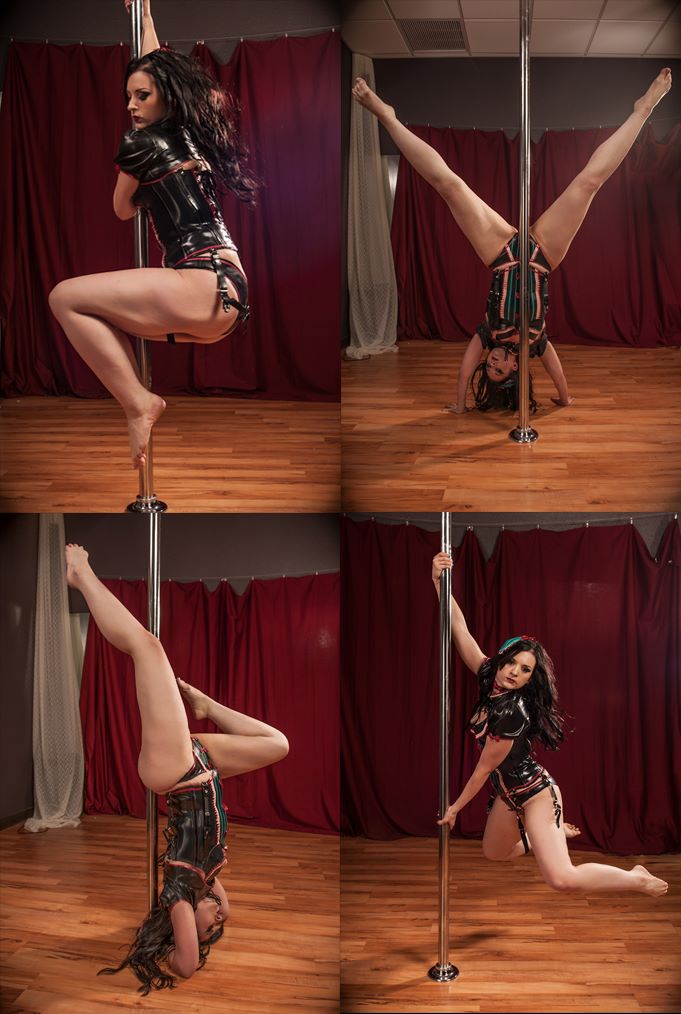
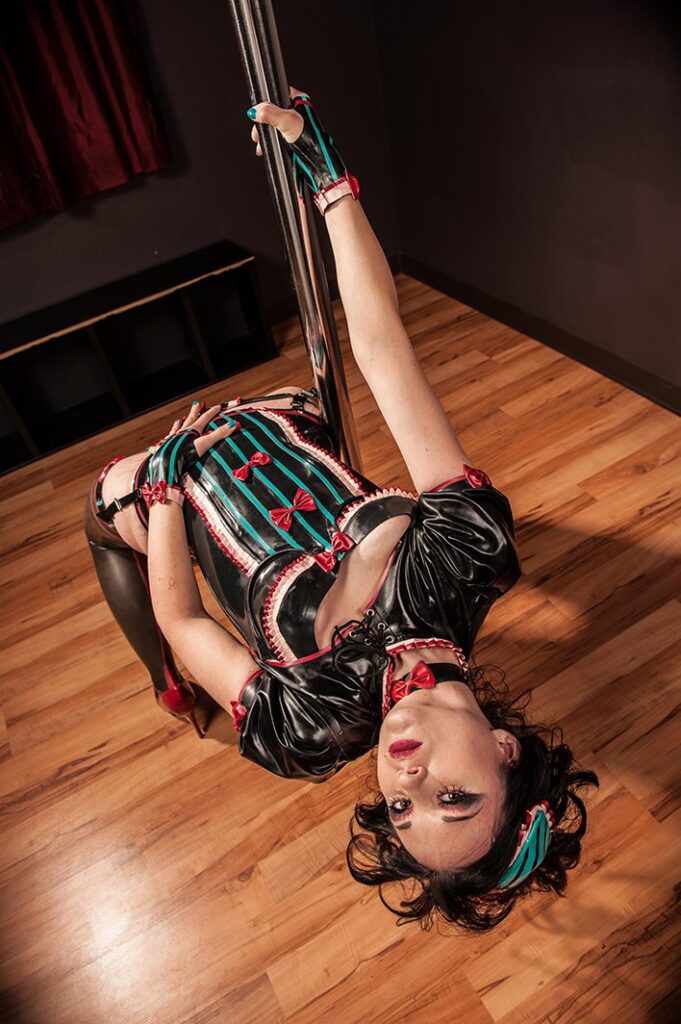
In the past, I’ve been called a hypocrite for doing pole dance, as well as one burlesque show, and one go-go dance performance, and for sharing my dance content and amateur alternative modeling on social media.
What those critics don’t understand is the deeper context:
I had lost 145 pounds, and these performances were about reclaiming my body and celebrating what it could do. I felt like I was finally free of a costume and I could be myself unapologetically.
It was cathartic. Dance became a way to process emotion, especially grief and healing.
It was a continuation of an existing artistic discipline. I was already a dancer, with training in ballet, ballroom, and social dance. Pole was a natural extension of that passion, allowing me to explore a different, more acrobatic dimension of movement and expression that I could not do before.
Pole dancing in particular made me feel strong. I never felt more like a powerful grown-ass woman and simultaneously playfully embracing my inner child than when I was training. (Fun fact: pole inversions release endorphins.)
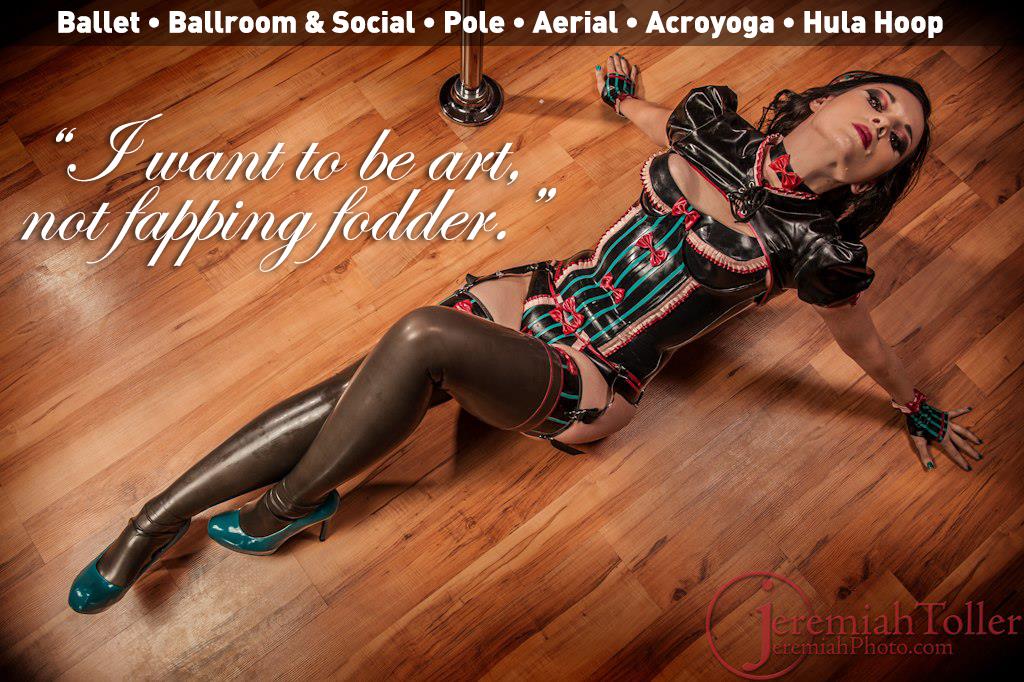
My intention was never to titillate. I’ve even used the slogan: “I want to be art, not fapping fodder.“
It is a reserved space. People choose whether to follow or watch. I was not putting it on highway billboards. And I fully expect criticism for sharing myself in this article, but that is kind of the point of this piece: interrogating how we judge female expression.
I’ve been in relationships where some or all love languages were neglected, often due to emotional abuse in an attempt to control my behavior or due to a partner’s neurodivergence (which is a spectrum with different challenges for different people), despite my healthy and available sexuality to them. Sharing dance became a healthy outlet to reclaim that emotional feedback loop on my own terms.
“My man on his willpower / Is something I don’t understand He fell in love with self restraint / And now it’s getting out of hand He used to be literally obsessed with me / I’m suddenly the least sought-after girl in the land Oh my man on his willpower / Is something I don’t under Something I don’t understand”
Lyrics from “My Man on Willpower” from Carpenter’s “Man’s Best Friend” album.
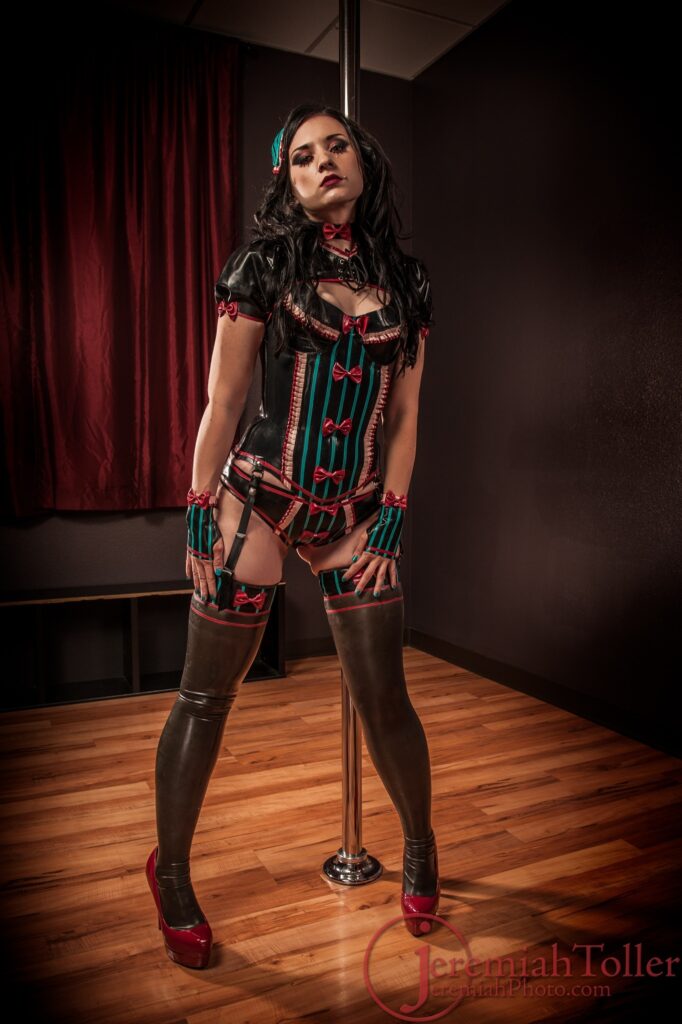
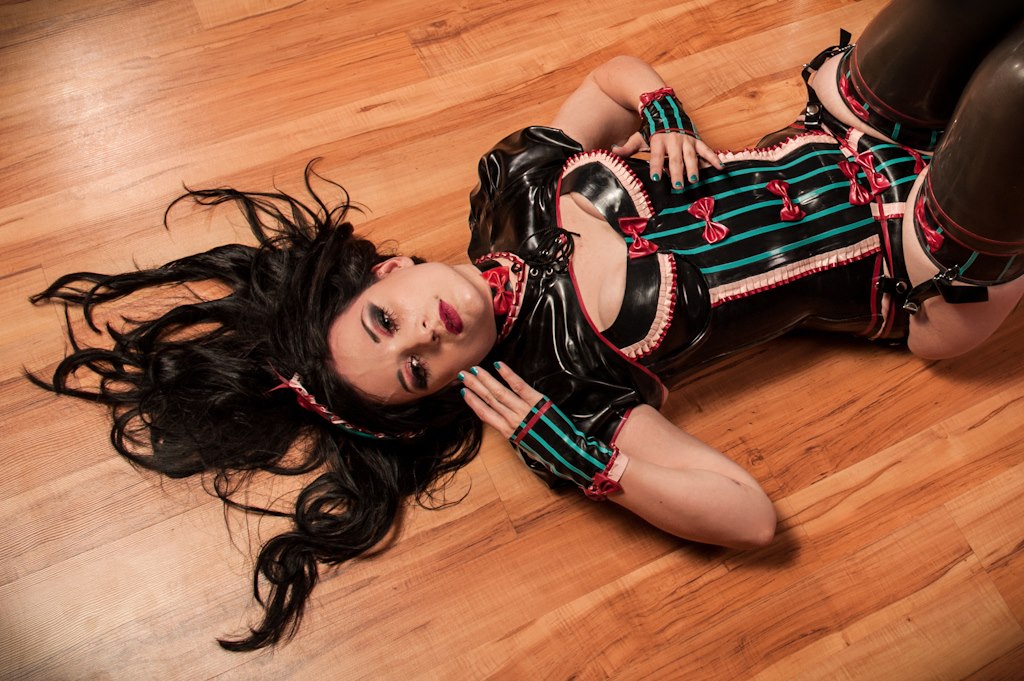
Author Katherine Amy Vega in a Westward Bound custom latex ensemble at her pole studio. The session was a birthday gift to herself celebrating a major personal milestone: her weight loss transformation and reclaiming of body confidence. Photography: Jeremiah Toller
Since becoming disabled, I have been on an unwelcome hiatus from dance. Losing that outlet has been deeply difficult. It was more than expression: it was identity, therapy, strength, and joy. I can only hope that with more treatment and physical therapy, I’ll be able to return to it someday, because it is a part of my core and spirit.
So when people react to women in pop (or to me) based only on surface optics, they miss the full picture. Empowerment and expression aren’t always about who’s watching. Sometimes, it is about reclaiming something you were told not to enjoy.
They operate in dialogue with systemic issues: economics, control, performance, pleasure, and resistance. So no, I am not erasing my first reaction.
That emotional reading was valid. But I also hold the possibility that the cover is a Trojan horse: baiting the gaze, then subverting it. I am not saying it is the perfect tactic, or that I agree with every part of it. But I understand it. And I can appreciate what’s smart and strategic about it in a world where sex continues to sell, and most people won’t engage unless their attention is provoked. I also do not claim to be the arbiter of what is universally “right,” if such a thing even exists.
Sabrina’s Subversion in Context
Sabrina Carpenter’s transformation is also part of a larger pop cultural arc: the Disney-to-pop pipeline. Like Britney Spears, Christina Aguilera, Miley Cyrus, and Selena Gomez before her, she has made a deliberate pivot from clean-cut, hyper-polished teen star to a provocative pop icon who still leans into that glossy aesthetic.
While it’s not inherently wrong to evolve, this well-trodden path has uncomfortable subtext: a cultural hunger to sexualize women exactly as they transition out of girlhood. The public watches and waits, and then critiques the result… no matter how it is styled. It’s worth asking whether Sabrina is playing into that pipeline, breaking it apart, or both.
Her current persona leans into vintage-inspired, hyperfeminine glamour. She’s described Man’s Best Friend as “glossy, confident pop … served with a wink,” and fashion profiles highlight her embrace of soft pastels, sequins, and lingerie silhouettes that nod to retro “dream girl” aesthetics. This carefully styled visual identity is not accidental, it is part of the duality she appears to be playing with.
This is not the first time pop has flirted with contradiction, but Sabrina Carpenter’s is distinct in how direct it is.
Madonna
Madonna weaponized sexuality and taboo, famously blending eroticism and Catholic imagery in “Like a Virgin” and later pushing sexual provocation even further with “Like a Prayer” and the Erotica era. These performances weren’t only provocative; they forced audiences to confront how female desire and sacrilege had been framed as threats to social order. Her work redefined visibility as defiance, yet also exposed how quickly subversion could be commercialized and turned back into spectacle.
She consistently blurred the boundaries between empowerment and exploitation, often reclaiming symbols of patriarchal control and turning them into tools of authorship. However, her autonomy was frequently reframed through the same lens she sought to dismantle. Critics labeled her outrageous or attention-seeking, overlooking the fact that she had full creative control over her image. Madonna understood that control and controversy were inseparable currencies in pop culture, and she spent her career mastering both.
Peaches
Peaches built her career on radical sexual expression and gender-blurring. Her lyrics in songs like “Fuck the Pain Away” and her visuals subvert traditional power structures, using vulgarity to command rather than be commanded. (Pitchfork)
Fiona Apple
Fiona Apple, especially in Fetch the Bolt Cutters, embodies a refusal to submit to neat aesthetics or emotional expectation. The album is celebrated for rejecting curated perfection, instead foregrounding rawness, resistance, and bodily truth. Its title comes from a line in a crime show about freeing someone locked away, which is an apt metaphor for emotional, systemic, and relational confinement. Songs like “Under the Table” confront abuse, shame, and suppression, while “Ladies” calls for women’s solidarity in fraught spaces.
Her earlier work, like “Criminal,” already cracked open the difficulty of being visible, rebellious, and wounded in the same body. It embodied vulnerability and confrontation at once. Her music videos, stripped of gloss, often placed viewers in uncomfortable intimacy. She did not hide her trauma, she worked with it. Fiona Apple’s artistic identity itself is a pushback against the notion that feminine expression should be sanitized and safe.
Carpenter, however, does not shed polish or trip into avant-garde rejection of conventional beauty standards. She keeps it glamorous enough to get attention, then (at least in this scenario) pulls the rug from under the viewer.
Spice Girls
The Spice Girls brought pop feminism to the global stage with a simple but resonant message: “Girl Power!” For many, especially those who came of age in the late ’90s, they weren’t just pop stars, they were a cultural awakening. Loud, diverse, and authentic, they stood in stark contrast to the polished passivity expected of so many female performers at the time.
They weren’t silenced by purity culture like Britney Spears, or victimized in the way she was allowed to be. They weren’t filtered through the male fantasy lens like The Pussycat Dolls, whose image leaned more toward stripper-polished perfection. Instead, the Spice Girls stormed into pop unapologetically. They laughed, yelled, wore whatever they wanted, and told girls they didn’t need to change to deserve attention.
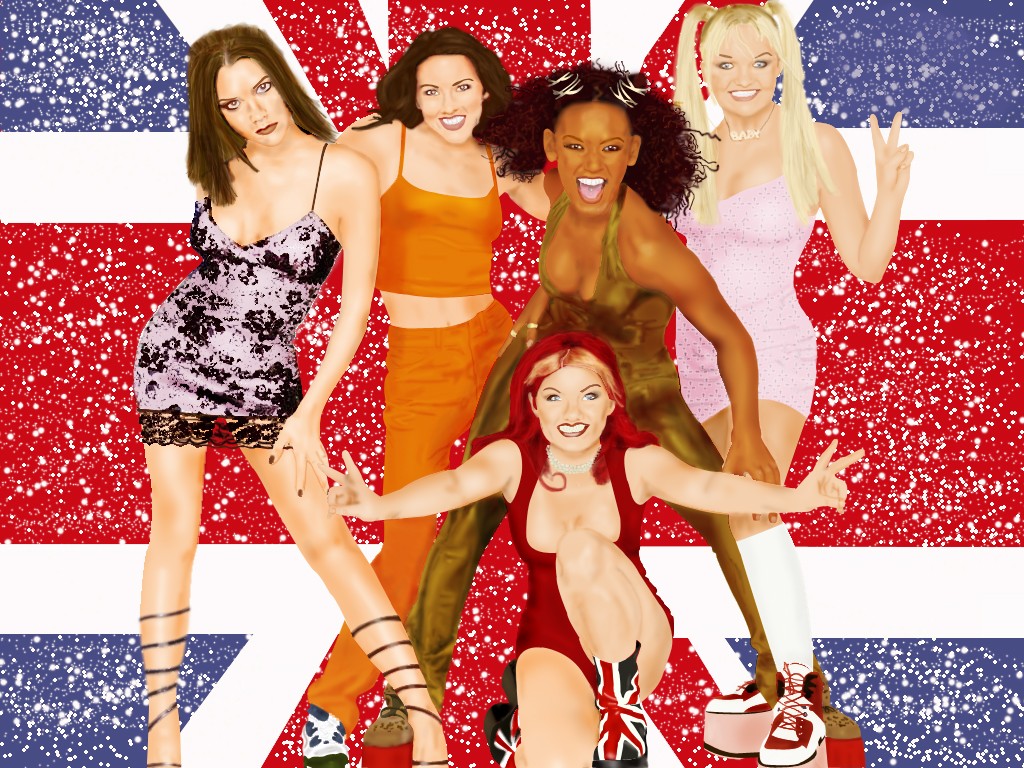
A digital painting based on a popular photo of the Spice Girls by the author, created in 2005 as a tribute to the group’s cultural impact. Their message of empowerment, individuality, and bold authenticity made them the author’s most formative influence in early youth—a vibrant antidote to pop culture’s more silenced or hyper-filtered portrayals of women at the time. Artwork: Katherine Amy Vega
That is not to say they escaped criticism. People questioned their outfits, their influence on young girls, their commercialism, and their outspokenness. But their message was louder than the backlash, and for many, it stuck.
As a preteen, they were the pop influence that shaped me the most. Other pop stars would impact me later as a teen, but the Spice Girls came first. I’m grateful it started with them. They gave me a model of power that didn’t require pain or performance to be real.
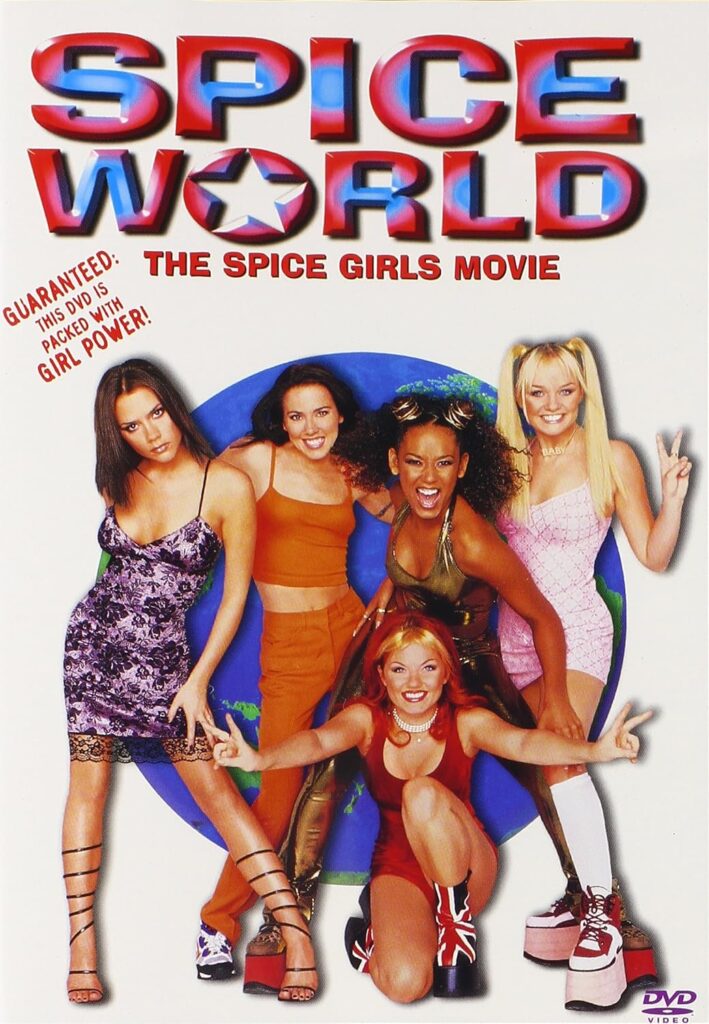
“Spice World: The Spice Girls Movie” DVD cover
The movie Spice World comically portrayed how the tabloids hounded the girls. However, at my young age, I could not have known that the real tabloids weren’t just absurd; they were relentlessly cruel, misogynistic, and violating. Combined with the intense micromanagement and uneven standards imposed by their former manager Simon Fuller, the pressure on the group was immense and, at the time, began to erode their bond. Thankfully, with age and distance, they have healed much of that strain, or at least that is what we have been told.
Melanie C’s memoir “The Sporty One”
As empowering as their message was, Melanie C (Sporty Spice) later reflected in her autobiography The Sporty One: My Life as a Spice Girl (2022) that the group faced a relentless double bind: “We were slut-shamed on one hand, and called ‘frigid’ on the other.” The same press that amplified their fame also distorted their image. “I felt insecure and I had low self-esteem… The icing on the cake, the thing that really kicked me when I was down, was the press, who loved to tell me who I was: Single Spice, Plain Spice, Beefy Spice, Sumo Spice… When I think about the press, it’s such a dark shadow that hangs over me.”
Her reflections expose how even pop feminism was not immune to the Madonna–whore complex, rewarding confidence and visibility only to punish women for them. That tension haunted her deeply, leading to silence, depression, and an eating disorder. It is a reminder that the culture of empowerment they helped spark could never fully shield women from the violence of public contradiction.
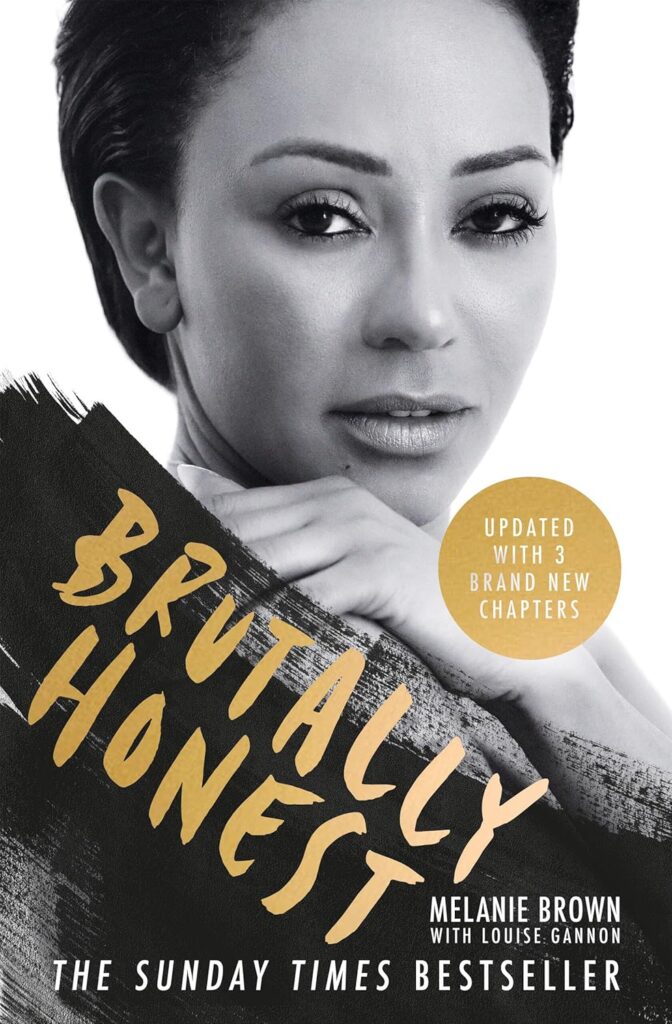
Mel B’s memoir “Brutally Honest”
In her 2018 memoir Brutally Honest, Mel B (Scary Spice) revealed she had endured years of domestic violence and coercive control during her marriage. That revelation created a jarring contrast. The girl who shouted “Girl Power!” into stadiums had also been living with control and fear behind closed doors. It serves as a stark reminder that no message of confidence or rebellion can fully shield women from systemic harm. Feminist slogans can inspire, but they don’t always protect.
However, what makes her story especially powerful is not just that she escaped, but that she found the strength to speak out. Her decision to share her truth publicly is a reminder that empowerment isn’t about having never been harmed, it is about reclaiming your story in the aftermath. Survival, in itself, is strength.
Brandy
Both Melanie C and Brandy have spoken about losing themselves under the pressures of fame and expectation. In The Sporty One, Melanie C describes how years of being scrutinized and labeled by the press caused her to lose touch with who she really was, followed by burnout. Brandy reflects on a similar struggle in her Audible Original A New Moon, recalling how every choice she made at fifteen was judged. She resisted sexualization, and her mother acted as both manager and protector, yet she still felt torn between her authentic self, her role as Moesha (the television character she played), and her persona as a musician.
Miley Cyrus
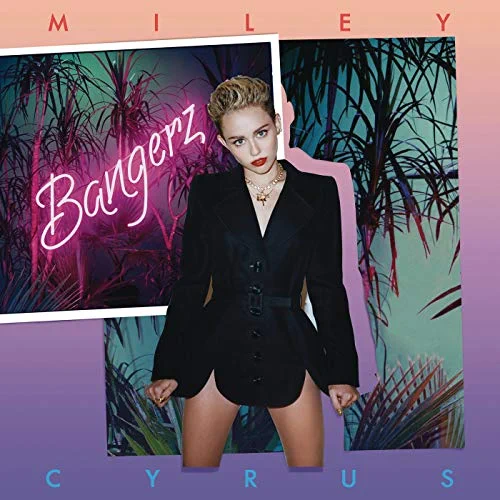
Miley Cyrus has also discussed this kind of identity dissonance. On Spotify’s Rock This podcast, she said that Hannah Montana was “a character almost as often as I was myself,” and that the show’s premise implied that when she wasn’t in character, “no one cared about me.” She has described that time as an identity crisis, highlighting how early fame and constant performance can blur the line between self and persona.
In the years that followed, Miley’s career ignited fierce debate about sexuality and agency. Her Bangerz era leaned into provocation, often interpreted as both rebellion and self-exploration after years of constraint. More recently, Miley has spoken of her eras as metamorphoses of self rather than costumes. Her newer work reflects themes of healing, vulnerability, and control, as if she’s intentionally exploring what it means to live confidently on her own terms.
Billie Eilish
Billie Eilish is another useful comparison. In her early visuals, she obscured her body, controlling what was seen, when, and how. Where Eilish initially used concealment as a form of control, Carpenter leans into hyper-visibility, positioning her body as the center of the frame.
Both strategies wrestle with the same question:How do women claim agency in an industry that profits from their objectification?
And in songs like “Your Power,” from Happier Than Ever, she confronts the dynamics of grooming and statutory abuse head-on, painting a picture of an older man who “played the part” of hero while exploiting a school-aged girl. This is a stark indictment of how men mask predation as care.
“How dare you? And how could you? Will you only feel bad when they find out? If you could take it all back Would you?”
It’s soft, but searing. It’s critical of industry norms and real-life imbalance.
Melanie C has also voiced deep respect and support for Billie Eilish. She has described giving Billie advice early in her rise and feeling proud of how her words resonated. Melanie C has also spoken about watching Billie perform and recognizing a familiar energy in the crowd, one that reminded her of the intensity of the Spice Girls’ early days. In later interviews, she has reflected on their friendship and how they connect over the shared pressures of fame and expectation. That continuity across generations of pop artists is quietly powerful, illustrating how women who have endured the industry’s contradictions often become mentors to those still learning to navigate them.
In her solo project, Lauren Mayberry of CHVRCHES writes lyrics that challenge male behavior directly. Her 2023 debut solo single, “Are You Awake?”, takes a more intimate, emotionally stripped-down approach, but still centers a woman’s emotional needs. And her 2024 follow-up “Change Shapes” from Vicious Creature critiques performative masculinity and toxic relational cycles, further exploring themes of control and harm that she has been outspoken about in interviews. She has also been outspoken about misogyny in music, both in and out of interviews.
Megan Thee Stallion
Megan Thee Stallion also offers a powerful template of feminist subversion. Her lyrics boldly reclaim sexual agency, as seen in tracks like “Savage” and “Body.” In “Savage,” she proclaims: “I’m a savage / Classy, bougie, ratchet / Sassy, moody, nasty.” These lyrics collapse stereotyped binaries into a self-defined identity.
Megan has also publicly addressed surviving violence and the emotional toll of being scrutinized. She balances joy, grief, sensuality, and rage in a way that resists flattening. Her work pushes beyond simple empowerment into something more expansive. It is a celebration of being multifaceted while still being targeted.
Black women in pop often face harsher criticism regardless of what they express, and Megan’s presence underscores the need for intersectionality in any conversation about feminist expression.
Christina Aguilera
Christina Aguilera, in particular, challenged this paradigm early on. Her 2002 feminist anthem “Can’t Hold Us Down,” featuring Lil’ Kim, directly criticized gendered double standards in sexuality: “The guy gets all the glory the more he can score / While the girl can do the same and yet you call her a whore.”
The song appears on Stripped, the same album where Aguilera shed her bubblegum pop persona for something bolder and more confrontational. In the “Dirrty” video, she wore triangle bikini tops, chaps with exposed short-shorts, and a microskirt, claiming space as both an artist and a sexual being. Aguilera didn’t just lean into sexuality, she used it to provoke, reclaim, and confront the culture that tried to control it.
She also embraces Sabrina Carpenter. In a playful Instagram video, the two appear together saying that Sabrina is Christina’s daughter. It is tongue-in-cheek, but symbolic like a passing of the torch from one subversive pop star to another.
Sabrina’s approach is not unique in its interplay of opposites. Many modern female pop artists have made deliberate contradiction part of their language, particularly those who are hyper-aware of image politics from Madonna and Lady Gaga to FKA twigs, Lana Del Rey, and, more recently, Taylor Swift, whose The Life of a Showgirl era is playing with similar tensions. What makes Sabrina distinct is not that she invites contradiction, but that she does it through a glossy, deceptively light package. She uses the language of pop fantasy to smuggle in discomfort, which is subtle enough to miss if you are not paying attention. Sabrina sits between those worlds: accessible pop and sharp critique, part of an ongoing lineage of women using contradiction as commentary.
Why This Matters, Beyond Me
These dynamics apply to anyone who has survived, or is living with, harm. Whether it is domestic violence, emotional abuse, coercion, trauma from childhood—critics often insist you must present a single, palatable narrative. If your instincts shift, you’re inconsistent, too sensitive, “overreacting.“
But trauma is not linear. Growing isn’t linear. Interpretations can evolve without making the first one “wrong.” We should want complexity, not purity tests of emotion.
The maddening part is how rapidly people reject nuance in women’s expression. They say “choose a single read or shut up” in ways rarely demanded of men. In that thread, people excoriated me for offering one reading of an image that can hit many people differently. They denied my experience. They insulted. They gaslit.
But that kind of dogpile is not about you. It is about how fragile our culture is around women having layered thoughts about sexuality, trauma, beauty, violence. It is about how much people want women to perform comfort, never discomfort.
When Beauty Becomes a Battleground: Tova Leigh’s Exposure of Verbal Violence
There is one rule that seems to hold no matter what a woman looks like: she will be criticized.
On Instagram, creator Tova Leigh frequently demonstrates this through a striking format. She shares a single image of a well-known, often conventionally attractive woman (the kind that media has told us is the best kind of woman) and then follows it with a carousel of cruel, degrading comments from men. The men’s faces appear after their words, underscoring just how shameless and ordinary this behavior has become.
In one of her videos featuring Sabrina Carpenter, Leigh highlights how even someone as young, petite, and hyperfeminine as Carpenter is not immune. Some of the vile comments are: “Be great with a bag to cover face”, “Solid 3”, and “if her ass and tits were bigger, sure”.
One image. Dozens of attacks, simply for existing while female in the public eye.
(Leigh has made these videos featuring artists that were mentioned earlier as well, such as Billie Eilish and Melanie C.)
While I primarily see misogyny come from a lot of men, I want to note many women make horrible comments about female celebrities too, and I see it when I subject myself to comment threads almost every day. It is disappointing, to say the least, and that brings things back to the internalized misogyny I mentioned earlier.
Leigh’s work lays this pattern bare. And once you see it, you can’t unsee it.
It drives home a brutal point:no matter what you do, someone will be waiting to take you down. Perfect makeup, clear skin, styled hair, a fit body, disproportionately curvy proportions, and a slew of other so-called ideals (many of which completely contradict each other). None of it protects you from the dissection. Beauty doesn’t buy immunity. Sometimes, it paints a bigger target.
Britney Spears summed it up in her 2007 track “Piece of Me”:
“I’m Mrs. ‘Lifestyles of the Rich and Famous’ (you want a piece of me?) I’m Mrs. ‘Oh my God, that Britney’s shameless’ (you want a piece of me?) I’m Mrs. ‘Extra! Extra! This just in’ (you want a piece of me?) I’m Mrs. ‘She’s too big, now she’s too thin’ (you want a piece of me?)”
It is a takedown of the media machine that both builds and destroys women in the public eye. And nearly two decades later, those lines still feel timely.
Final Reflection & Invitation
Women are multidimensional. Instead of defaulting to criticism at every opportunity, we should do more asking and more listening to understand the fuller context of their choices, their art, and their self-expression. Curiosity creates space for complexity in ways that condemnation never will.
I am not walking this back. I’ll always say the image initially made me think of domestic violence (it has since grown on me a bit, while I still recognize it causes discomfort). And I can also say I believe, with some evidence, that Sabrina Carpenter may be performing subversion. Those are not mutually exclusive.
This record might mark a shift in how feminist pop is packaged: the idea that provocation and direct critique can cohabit in the same aesthetic. That’s a risky move. It may yield misinterpretations, especially in a mainstream pop landscape that often struggles to handle this level of complexity. But it also expands what pop can do.
If you are reading this and you have ever felt silenced for pointing out nuance, I see you. If you want to call something out and also enjoy it, you can. If you want to evolve your opinion, do it. Do not let culture, or the lack of emotional intelligence and unwillingness to intellectualize nuance, guilt you into sameness.
You can be critical, kind, evolving, and honest…at the same time.
To close, here’s a spoken word piece by actress and poet Caitlin O’Ryan. Her work often explores the complexities of womanhood, and this particular poem, “At What Point,” resonates deeply with some of the themes discussed throughout this piece.
PHOENIX — Cat Power (née Charlyn Marie “Chan” Marshall) took the stage at The Van Buren to celebrate the 20th anniversary of her landmark album The Greatest. What makes the concert a true triumph is the journey that led her here — setting it apart from the increasingly common anniversary album performances that have become routine for many artists in recent years.
You see, twenty-plus years ago, shortly before the album was released, Cat Power was last. At least, that was what the sign on the front door of the venue said when I first saw her perform in October 2005. As I understood it, she flew into St. Louis, got into a rental car, and started to drive to Springfield, Illinois and not Springfield, Missouri — where I lived and where the show was.
The handwritten sign posted on the venue door in October 2005 after Cat Power drove to the wrong Springfield, delaying the show until nearly 1:00 AM.
The estimated time of her arrival was 11:30 PM, but it ended up being nearly 1:00 AM when she pulled up and rushed in with her guitar case in hand. For an hour, she played for a crowd of diehard, devoted Cat Power fans who owned and loved her six albums and, by extension, loved her. She seemed a bit stressed by all that had transpired, and when she would pause or seem agitated, someone in the crowd would call out “We love you, Chan,” drawing a smile from her before she returned to singing.
Still though, her set that night was beautiful and brilliant. She included a few new songs, as she described them, that would appear just a few months later on her album The Greatest — an album that is the indie rock equivalent of Dusty Springfield’s Dusty in Memphis.
The Slipcase Edition of The Greatest, Cat Power’s 2006 studio album, photographed sealed in its original shrink wrap with promotional stickers intact.
Cat Power in 2026
“Gracias,” said simply with a brief bow and a sip from a mug of hot tea.
Clad in a bright white ensemble of shoes, pants, belt, shirt, and jacket, she shone with the stage lights upon her, looking like I hope my guardian angel might look like, if such beings exist. As a performer, though, for all of her brilliance, she has never seemed fully comfortable on stage. She is not one for banter either, so throughout her set on Sunday, she simply said “Gracias” and bowed after each song.
Cat Power performs at The Van Buren in Phoenix on March 15, 2026. Audience photo by Ryan Novak
It is difficult to put into context what The Greatest means to me and the rest of the audience. We, the Gen-X indie rockers of Phoenix, let each song wash over us. To look around was to see mouths moving while slightly singing, not necessarily along, but each to themselves. For so many of us, those songs all felt like hugs that we each needed those twenty years ago in the lost days of our youth and maybe, probably, still need now. Cat Power’s music has always been very emotionally raw, and something about that album clearly resonated in our souls.
With each song, she used two microphones to recreate the haunting reverberation of the vocals on the album (I always wondered how they achieved that effect). Even when she pulled the mics from the stand and moved about the stage, she held one in each hand and sang with the same passion that we felt with each song.
Cat Power performs at The Van Buren in Phoenix on March 15, 2026, bathed in vivid magenta stage lighting. Audience photo by Ryan Novak.
With the album’s closing, she did not leave the stage. Cat Power has never been one for encores. No, she plays until she is ready to play no longer. She did a run through a short set of songs off her most recent albums, but finished with songs from across her three different albums of cover songs, culminating in a gorgeous full-band version of “Sea of Love,” originally performed on her The Covers Record in a slow, stark acoustic sung with a melancholy and longing. Now, though, it felt soaring and hopeful.
As I left that art gallery at 2:00 in the morning more than twenty years ago, I took the “Cat Power Got Lost” sign from the door and kept it. It now rests in a scrapbook of set lists and show flyers from over the years. Cat Power is no longer lost. On stage, shimmering in a heavenly white, she was most definitely found, and now she is triumphant and should take a moment to celebrate what is arguably her greatest work: The Greatest. This time, aside from her “Gracias,” she responded to each person who cried out, “We love you, Chan,” with that same smile, less nervous and more , and with a tender reply of “I love you, too, so much.“
Official tour artwork for Cat Power’s The Greatest 20th Anniversary Tour, featuring tour dates and the iconic boxing gloves from the original album artwork.
Montreal, QC – Extreme metal juggernaut NARCOTIC WASTELAND has announced they will be joining the “Praise the Beast North American Tour” with BELPHEGOR, INCANTATION, and HATE for February and March 2026, continuing their relentless assault on stages worldwide.
This marks the band’s third major run in less than a year, following the “Annihilation of Wasteland Tour” across the U.S. in September 2025 and their headlining “Annihilation of Europe Tour” in November and December 2025.
Fronted by guitarist/vocalist Dallas Toler-Wade (ex-Nile), Narcotic Wasteland has built a reputation for uncompromising brutality, technical precision, and lyrical themes that confront addiction, corruption, and societal decay. Their recent tours have drawn packed venues and critical acclaim, cementing their place as one of the most ferocious acts in modern death metal. “The energy we felt from fans in both North America and Europe has been incredible. We’re coming back harder than ever in 2026. Expect a setlist that spans our catalog, new material, and the kind of intensity that defines Narcotic Wasteland,” says Toler-Wade. The upcoming tour will see the band storm through major cities across the U.S. and Canada, dates and venues listed below. The tour is a crushing lineup, making this one of the most anticipated metal tours of early 2026.
Tickets for the “Praise the Beast North American Tour” with BELPHEGOR, INCANTATION, HATE, and NARCOTIC WASTELAND go on sale on Wednesday, Nov. 19, 2025, at 12:00 pm PST / 3:00 pm EST.
2026 “Praise the Beast North American Tour” Dates
Feb 19 – Brooklyn, NY – Brooklyn Monarch
Feb 20 – Lowell, MA – Taffeta Music Hall
Feb 21 – Montreal, QC – Le Studio TD
Feb 22 – Toronto, ON – Lee’s Palace
Feb 23 – Lakewood, OH – Mercury Music Hall
Feb 24 – Joliet, IL – The Forge
Feb 26 – Denver, CO – HQ
Feb 27 – Albuquerque, NM – Launchpad
Feb 28 – Haltom City, TX – Haltom Theater
Mar 1 – Houston, TX – Scout Bar
Mar 2 – San Antonio, TX – Paper Tiger
Mar 5 – Mesa, AZ – The Rosetta Room
Mar 6 – San Diego, CA – Brick by Brick
Mar 7 – San Francisco, CA – DNA Lounge
Mar 8 – Roseville, CA – Goldfield Trading Post
Mar 9 – Los Angeles, CA – 1720
Mar 10 – Anaheim, CA – The Observatory
Narcotic Wasteland: A Modern Force in Extreme Metal
Narcotic Wasteland has carved out its place as a dominant force in the modern metal scene, unleashing a punishing fusion of razor-sharp technicality, feral aggression, and raw intensity. At the helm is guitarist and vocalist Dallas Toler-Wade, celebrated for his tenure with Nile, whose unmatched precision and commanding stage presence drive the band’s sonic assault.
Narcotic Wasteland photographed on location, capturing the band’s stark, unfiltered presence. Known for their uncompromising approach to extreme metal, the trio blends technical precision with raw aggression, delivering a sound as imposing as their visual aesthetic.
Behind the kit, Joseph Howard delivers a relentless barrage of power and accuracy, propelling the band’s crushing rhythms with thunderous authority. His dynamic drumming lays the foundation for the group’s dark and uncompromising atmosphere. Anchoring the low end, Kenji Tsunami injects depth and texture with inventive, hard-hitting bass lines. His formidable musicianship and commanding presence add another layer to the band’s overwhelming wall of sound, amplifying the ferocity of their live performances. Together, Dallas, Joseph, and Kenji form a unit that is both unstoppable and uncompromising, captivating audiences with explosive performances and boundary-pushing compositions. With their collective skill and vision, Narcotic Wasteland stands tall as one of the most formidable powerhouses in extreme music today.
After a weekend of speculation sparked by mysterious billboards in Phoenix and other major cities, the wait is over: My Chemical Romance has officially announced new live dates across North America to celebrate the 20th anniversary of their landmark third album. “The Black Parade 2026” tour will bring the band to stadiums across North America, the UK, and Europe next year.
Among the tour stops is a highly anticipated show in Phoenix, AZ, where My Chemical Romance will perform at Chase Field on September 6, 2026, joined by Jimmy Eat World, a hometown favorite.
The pairing highlights a long-running connection between the two bands, who first toured together in Australia in 2005 and have since appeared on the same lineups at numerous festivals, including multiple years at When We Were Young Festival. Their parallel trajectory underscores a shared legacy in shaping the alternative and emo scenes, and brings added resonance to what promises to be a standout night for Arizona fans.
Tickets for all dates on the “Black Parade 2026” tour go on sale Friday, September 26 at 12:00 pm local time on Ticketmaster.
The announcement confirms what fans suspected when they spotted the cryptic Keposhka glyphs and teaser images on billboards in Phoenix, Los Angeles, Minneapolis, New York, and Nashville: My Chemical Romance is marching back, bigger than ever.
My Chemical Romance 2026 US Tour Dates
August 09, 2026 – New York, NY – Citi Field – with Franz Ferdinand
August 13, 2026 – Nashville, TN – Nissan Stadium – with Pierce The Veil
August 18, 2026 – Washington, DC – Nationals Park – with Modest Mouse
August 21, 2026 – Detroit, MI – Comerica Park – with Iggy Pop
August 24, 2026 – Minneapolis, MN – Target Field – with Sleater-Kinney
August 27, 2026 – Denver, CO – Coors Field – with The Breeders
August 30, 2026 – San Diego, CA – Petco Park – with Babymetal
September 06, 2026 – Phoenix, AZ – Chase Field – with Jimmy Eat World
September 12, 2026 – San Antonio, TX – Alamodome – with The Mars Volta
October 21, 2026 – Los Angeles, CA – Hollywood Bowl
October 23, 2026 – Los Angeles, CA – Hollywood Bowl
October 24, 2026 – Los Angeles, CA – Hollywood Bowl
Festival Appearances
May 10, 2026 – Daytona Beach, FL – Welcome to Rockville
May 14, 2026 – Columbus, OH – Sonic Temple
September 18, 2026 – Louisville, KY – Louder Than Life
Phoenix has become one of several U.S. cities to receive cryptic signs from My Chemical Romance. Fans began spotting billboards today near Chase Field and outside Tempe Marketplace, featuring the band’s distinctive Keposhka glyphs.
Meanwhile, in other cities (including Los Angeles, Minneapolis, New York City, and Nashville ) fans have captured this signage, as well as teaser billboards with images of the band in their Black Parade uniforms, sparking a wave of speculation across Reddit and fan communities.
For Arizona fans, the excitement is especially intense. My Chemical Romance last performed in Tempe in 2008 at the Tempe Music Festival. A planned return in 2011 was canceled after the band joined The Sound Strike, a coalition of artists boycotting Arizona in protest of the controversial SB 1070 immigration law. That cancellation has made the wait for MCR’s return feel all the more torturous — or expensive, for those who’ve had to travel out of state to see them live.
While no official announcement has been made, the coordinated rollout has many convinced that My Chemical Romance is preparing to unveil more U.S. dates for 2025. The buzz follows hints dropped during the band’s last run of shows that “there was more to come.”
With sightings spanning multiple cities, anticipation is mounting that fans nationwide may soon get their chance to march again.
My Chemical Romance Photography: Devin Sarno
News & Reviews from the Fiery Mosh Pits of Arizona